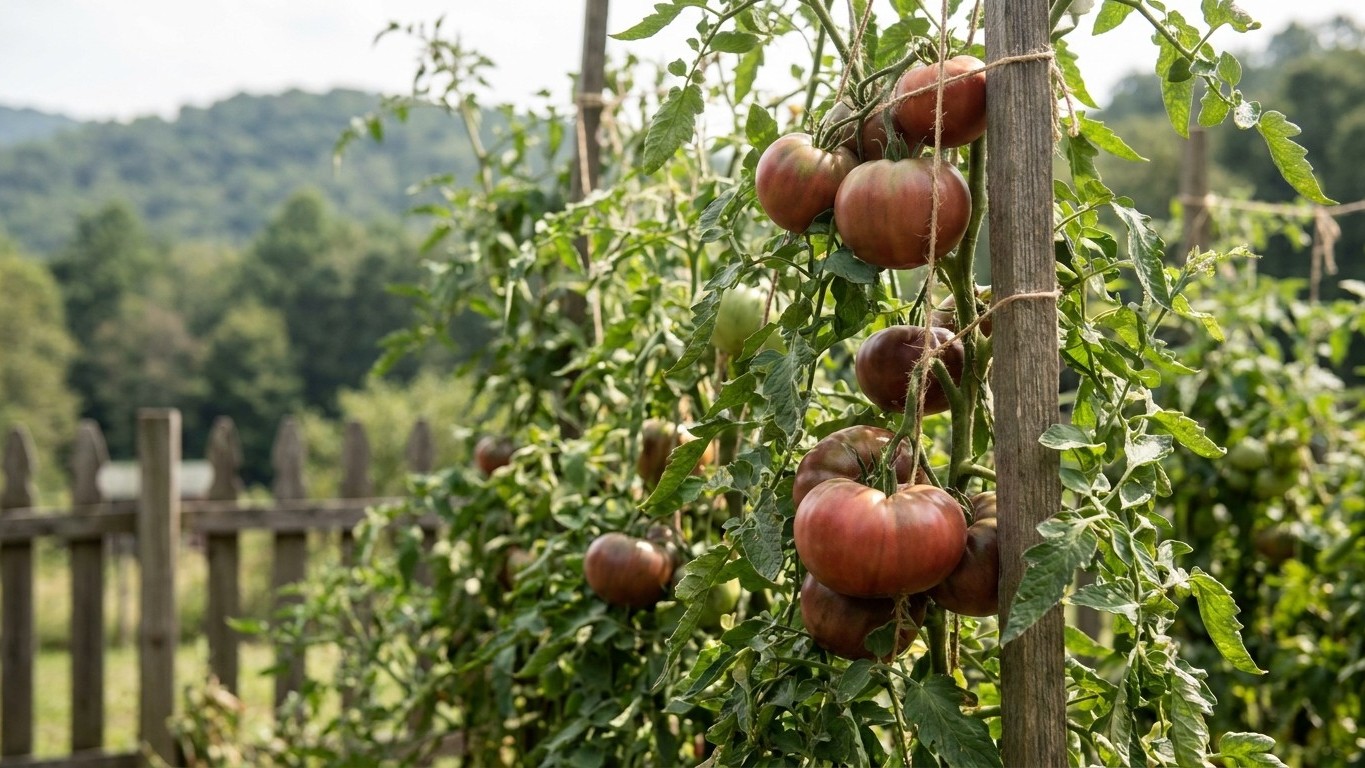

Most tomatoes ripen in West Virginia if you match the variety’s days-to-maturity to the growing season NOAA’s 1991-2020 climate normals show for Charleston: last spring freeze April 9 to April 23, first fall freeze October 18 to November 1. That gives a working season of roughly five to six months in the Kanawha Valley, tighter at higher elevation. Pick varieties rated at 50 to 75 days from transplant for a reliable finish, and treat anything past 80 days as a gamble unless you’re set up to push the season.
What this comes down to in West Virginia

A Better Boy planted the last week of May, right on schedule, still won’t blush before mid-August — and in the higher valleys around Pocahontas or Randolph County, where frost can settle in by mid-September, that leaves almost no cushion if a cool, wet stretch slows things down further. What follows is a wheelbarrow of green tomatoes and a compost pile that didn’t need to be that full. The fix starts with reading days-to-maturity honestly, before the seed order goes in.
The cultivars below are ordered from shortest days-to-maturity to longest, so you can see where your own risk tolerance and elevation put the cutoff. Days-to-maturity on a seed packet is counted from transplant, not from seed, and it shifts by a week or so either direction depending on the weather that particular season, so treat these as guides rather than guarantees.
Fourth of July

This one is bred for speed: about 49 days from transplant to first ripe fruit, the fastest widely sold slicer on the market. The fruit is smaller than a standard slicer, good for fresh eating rather than canning, but it buys you the most cushion against an early fall freeze anywhere in the state, including higher ground where the season runs shorter than Charleston’s.
Early Girl

Early Girl runs about 50 to 59 days, still on the fast end, with medium round fruit suited to sandwiches and general kitchen use. It’s an indeterminate vine, so it keeps producing until frost rather than ripening all at once, which matters if you want a steady supply rather than one big flush.
Stupice

An heirloom out of the former Czechoslovakia, Stupice matures in about 52 to 60 days and tolerates cooler soil at transplant better than most slicers, which helps in a state where a warm stretch in April can trick you into planting before the ground has actually caught up. The fruit is small, but the plant keeps setting through a long season.
Celebrity

Celebrity is a determinate variety at about 70 days, meaning the plant sets a concentrated crop rather than trickling fruit out all season. It carries broad disease resistance on the seed packet, which matters in a humid state where foliar disease pressure builds as the summer goes on. Seventy days puts it right at the point where a cool, late spring can push your finish date uncomfortably close to the fall frost window.
Better Boy

Better Boy runs about 72 days and produces a full-size slicer on a vigorous indeterminate vine. It’s a step past Celebrity in season length, which is fine in the Ohio and Kanawha valleys most years but starts to cut it close anywhere the growing season runs shorter than Charleston’s.
Brandywine

Brandywine is the classic large-fruited pink heirloom, and catalogues list it anywhere from 80 to 100 days depending on the strain. That’s a wide window, and it’s the variety most likely to still be carrying green fruit when the first fall freeze arrives, especially away from the river valleys. It’s worth growing for flavor, but it belongs in a garden with a plan for pushing the season, not a first attempt at timing.
| Variety | Days to maturity | Growth habit | Best use |
|---|---|---|---|
| Fourth of July | ~49 days | Indeterminate | Fresh eating, earliest harvest |
| Early Girl | ~50-59 days | Indeterminate | General slicing |
| Stupice | ~52-60 days | Indeterminate | Cool-soil tolerance, small slicer |
| Celebrity | ~70 days | Determinate | Concentrated harvest, disease pressure |
| Better Boy | ~72 days | Indeterminate | Full-size slicer |
| Brandywine | ~80-100 days | Indeterminate | Flavor, season-extension needed |
Working it out for your own garden
Start from the frost window, not from a calendar date. NOAA’s 1991-2020 normals put Charleston’s last spring freeze at April 9 to April 23. Most transplants go in after that date has passed and the soil has warmed, which is covered in more detail on Tomato Planting Dates in West Virginia: Counting Back From Your Frost Window. The arithmetic that matters is the other end of the season: how many days a variety needs, counted forward from transplant, against how many days you actually have before the first fall freeze.
Take Fourth of July as the example. If you transplant any time in the window after Charleston’s last spring freeze of April 9 to April 23, and the variety needs about 49 days to first ripe fruit, you’re looking at a first harvest somewhere in late May to mid June. NOAA’s normals put Charleston’s first fall freeze at October 18 to November 1, so a 49-day variety finishes with months to spare even if the actual planting date lands late in that spring window.
Now run the same math on Brandywine at the long end of its 80 to 100 day range. Transplanting inside the same April 9 to April 23 window and counting forward 100 days lands the first ripe fruit in mid to late July, which still leaves time before the October 18 to November 1 freeze window in Charleston. The problem isn’t the average year, it’s the years when a cool spring delays transplanting past that window, or when you’re gardening at an elevation where frost arrives well before Charleston’s date. The margin that looks comfortable on paper shrinks fast once the season runs late or short.
Do this same subtraction with whatever variety you’re actually planting, using the days-to-maturity on its seed packet and the frost dates for your reference city, not Charleston’s if you garden somewhere colder.
What changes across the state
Charleston’s frost dates come from a river valley station, and NOAA’s own data flags that as a caveat: higher elevations across West Virginia freeze noticeably earlier in fall and later stay cold longer in spring. USDA’s Plant Hardiness Zone Map puts the state across zones 5a to 7a, and that spread alone tells you the season length is not one number statewide. A garden in the eastern highlands or high in the Allegheny counties is working with a meaningfully shorter frost-free stretch than a garden down in the Ohio or Kanawha valley.
The practical effect is that a variety which finishes comfortably in Charleston with room to spare can run out of season at higher elevation with the exact same transplant date. If you garden above roughly 2,500 feet, or in a valley known locally for cold air pooling, treat the longer end of any days-to-maturity range as the number that matters, and lean toward the shorter-season cultivars rather than the Brandywine end of the list.
South-facing slopes and low-lying frost pockets can differ by more than a week from each other even within the same county. Local soil, tree cover and which way a slope faces all shift the effective frost date around whatever a nearby weather station reports.
The mistakes this state punishes

The most common mistake is planting into cold soil after a warm stretch in early spring. A run of 70-degree days in late March or early April can feel like the season has arrived, but soil temperature lags behind air temperature, and tomatoes set back by cold soil often never fully recover their growth rate, which pushes the whole harvest later and eats into the margin you were counting on at the other end of the season.
The second mistake is choosing a long-season heirloom like Brandywine as a first tomato without a backup plan, then losing the crop to an early fall freeze at higher elevation while a Charleston-area garden two counties over is still picking ripe fruit. Match the variety to your actual elevation and frost history, not to the state-wide average.
The third is ignoring the pest calendar while chasing the perfect ripening date. A vine that’s stripped of foliage or has its fruit hollowed out doesn’t finish on schedule no matter how good the days-to-maturity number looked on the packet. The details on what actually shows up and when are covered on Tomato Pests in West Virginia: Which Ones Actually Show Up Here, which is worth reading alongside variety selection, not after the damage is done.
- Don’t trust a warm week in March or early April as a sign the soil has warmed enough for transplants.
- Don’t plant only long-season heirlooms if you garden above the valley floor.
- Don’t skip pest scouting because the variety is supposed to finish early.
Checking this against your county
Charleston’s frost dates and this arithmetic are a starting point, not a substitute for what your own county extension office can tell you about your specific hollow, ridge or valley. Call your local WVU Extension office before you commit to a long-season variety if you’re not sure how your site compares to the river valley station these normals come from. WVU Extension, part of the USDA’s land-grant university network, maintains a statewide directory at extension.wvu.edu where you can find the office for your county and ask about local frost history specifically.
If you’re still working out your own transplant window before applying any of this, the planting calendar page walks through that calculation step by step for West Virginia’s frost range.
Common questions
Can I still grow Brandywine in West Virginia or is it just too risky?
You can, but treat it as the variety that needs the most favorable conditions on this list. It suits gardeners in the milder river valleys who transplant promptly after the local last frost and who can cover plants if an early fall freeze threatens before the fruit finishes.
Do determinate tomatoes ripen faster than indeterminate ones?
Not necessarily faster overall, but determinate varieties like Celebrity concentrate their harvest into a shorter window instead of trickling fruit out all season, which can make the difference feel bigger than it is. Check the days-to-maturity number on the packet rather than assuming determinate always means quicker.
What happens if I plant a short-season variety too early?
Cold soil stunts tomato transplants regardless of how fast the variety is rated to mature, and a stunted plant doesn’t make up the lost time later in the season. A fast variety helps most when it’s paired with a transplant date that respects the local frost window, not planted ahead of it.
Why do seed catalogs give a range instead of one number for days to maturity?
Because the actual count depends on temperature, sunlight and how the plant was hardened off, all of which vary year to year even at the same address. Use the range as written rather than picking the middle number, and add a buffer if you’re gardening somewhere colder than the reference city a frost date came from.