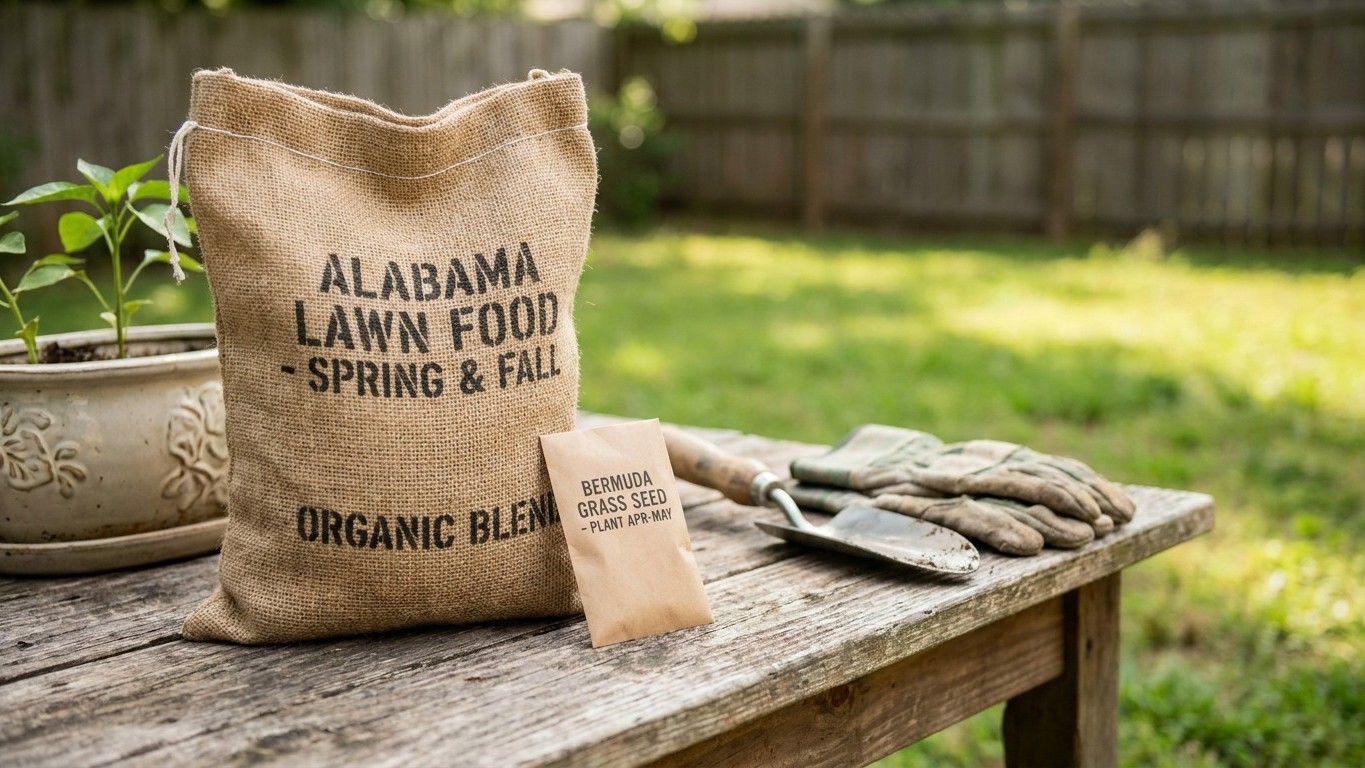

Your grass needs to fit the summer you actually have, and Alabama’s summers run hot enough — well over 50 days a year past 90°F — that a cool-season lawn simply won’t survive here. That single fact settles the whole question before you even think about fertilizer: you’re growing a warm-season grass, full stop. Bermudagrass, St. Augustine, Zoysia, Centipede — the pick among them comes down to your sun and foot traffic, not habit or what’s already growing next door. Start there: walk your yard, note where the shade falls and where feet actually land, and get a soil test before you buy anything.
Which grass belongs in Alabama

Every decision on an Alabama lawn starts with one question: warm-season grass or cool-season grass. At the NOAA NCEI reference station in Huntsville, the 1991-2020 climate normals record 58.5 days a year at or above 90°F and a coldest-month minimum of 31.8°F. That much summer heat rules out a cool-season lawn outright, and a winter minimum well above the teens rules out nothing on the warm-season side. The answer for most of Alabama is a warm-season lawn, not the cool-season turf a state like Michigan grows almost exclusively; see Michigan Lawn Care: What to Plant and When to Feed It for how differently that calendar runs.
Matching the grass to the yard
Clemson Cooperative Extension’s HGIC 1214 fact sheet lists the warm-season species that fit this climate: Bahiagrass, Bermudagrass, Carpetgrass, Centipedegrass, Seashore Paspalum, St. Augustinegrass and Zoysiagrass. Each suits a different yard. Bermudagrass takes full sun and heavy foot traffic and recovers fast from wear, but won’t hold in shade. St. Augustinegrass tolerates the shade a Bermudagrass lawn can’t, at some cost to wear tolerance. Centipedegrass asks for little once established, low mowing and low fertilizer both, and is the common choice on the sandy, acidic soils where other species struggle. Zoysiagrass sits between Bermudagrass and St. Augustinegrass on both shade and traffic tolerance, but establishes more slowly than either. Bahiagrass and Carpetgrass see less residential use and turn up mostly on roadsides and low-maintenance ground. Seashore Paspalum is a coastal specialist bred for salt tolerance, with little reason to go into an inland yard.
None of these figures hold state-wide. Huntsville sits in north Alabama, and the higher ground in the northeast corner of the state runs colder than this reference station, which can push a marginal Bermudagrass or St. Augustinegrass lawn closer to winter injury in a hard year — a good reason to check an Alabama lawn Best grass Alabama lawn Calendar against your own local conditions before timing any treatment. The Gulf Coast counties run warmer and wetter than Huntsville in every season, which favors St. Augustinegrass and Seashore Paspalum over Centipedegrass. Gardeners just across the state line in Arkansas deal with a true transition zone, where neither a warm-season nor a cool-season grass clearly wins, a different problem from Alabama’s; see Arkansas Lawn Care: What to Plant and When to Feed It for that trade-off. Check your own county’s conditions before you settle on a species, particularly if your yard sits on a ridge or in a low frost pocket.
When to seed or sod here
Clemson Cooperative Extension’s HGIC 1203 fact sheet sets the planting window for warm-season lawns at around May, once the soil has warmed and the grass is actively growing, and for cool-season lawns at mid to late September. Alabama’s grasses fall in the first group: seed, sprig, plug or sod Bermudagrass, Zoysiagrass, Centipedegrass or St. Augustinegrass in May, not earlier. Soil that hasn’t warmed will not root a warm-season grass, whatever the calendar says, and a late cold snap on freshly disturbed ground does more damage than waiting two more weeks would have.
Anchoring the deadline on local frost
The other end of the planting season is where local frost data matters more than a generic month. At the NOAA NCEI reference station near Huntsville, the 1991-2020 climate normals put the first fall freeze in the 30 to 70 percent probability band between November 2 and November 16. That’s a deadline running backward: new warm-season turf needs enough growing weeks to root in before growth stops for winter, so anything planted after midsummer is racing that window, not working comfortably inside it. Push sod or plugs much later than that and the plant has less time to build a root system before cold weather shuts growth down, leaving it more exposed to winter injury and slower to green up the following spring.
This window shifts with geography inside the state. Gardens well south of Huntsville typically see their first fall freeze later than the airport-station figures above, buying extra weeks for late-summer sodding. Gardens at higher elevation, or in low-lying frost pockets, tend to freeze earlier than the reference station and lose that same margin. Confirm your own county’s frost pattern before you commit to a planting date late in the season, rather than trusting a single statewide figure.
Not every species establishes the same way. Bermudagrass and Centipedegrass are commonly seeded as well as sodded. St. Augustinegrass and most Zoysiagrass cultivars are typically established from sod, sprigs or plugs rather than seed, because seed of those species is either scarce commercially or unreliable to establish. Budget for that difference: sod costs more upfront than seed, but it fills in and stabilizes the yard within one season, which matters if you’re working inside a narrow post-frost window near Huntsville or points north.
The feeding calendar that fits this climate
Nitrogen timing follows the grass’s growing season, not the wall calendar. Alabama’s warm-season lawns are actively growing from late spring through summer, so that’s when they take up nitrogen efficiently. Feeding a warm-season lawn in fall, when growth is already slowing toward dormancy, pushes tender new growth into a season it can’t use before frost, which does the lawn no favors. A cool-season lawn, where one persists at real elevation, works the opposite calendar and feeds heaviest in September, as growth resumes with cooler weather.
Nitrogen rates by species
The exact pounds of actual nitrogen per 1,000 square feet, and the number of feedings across the season, differ by species enough that a single figure for “Alabama lawns” would be wrong for at least three of the four common grasses. Centipedegrass in particular grows on far less nitrogen than Bermudagrass and yellows or thins if it’s overfed, one of the few cases in lawn care where more fertilizer makes the grass worse, not better. Bermudagrass, at the other end, is a heavy feeder that supports more frequent applications through its growing season than any other grass on this list.
Rather than guess at a rate that doesn’t fit your grass, use the calendar written for the species you actually have. Clemson Cooperative Extension publishes one maintenance calendar per species, not one per state, and each carries the pound-per-1,000-square-foot rate and the exact months for that grass:
- Bermudagrass Maintenance Calendar (HGIC 1216)
- Zoysiagrass Maintenance Calendar (HGIC 1217)
- Centipedegrass Maintenance Calendar (HGIC 1215)
- St. Augustinegrass Maintenance Calendar (HGIC 1218)
Look up the one that matches your lawn before you buy a bag of fertilizer. A rate correct for Bermudagrass applied to Centipedegrass, or the reverse, does more harm than skipping a feeding altogether.
Mowing height and watering here
Cut warm-season lawns shorter than cool-season habit suggests. Exact mowing heights differ by species and even by cultivar within a species, so check the calendar for the grass you actually planted, since Clemson’s maintenance calendars linked above give the mowing height alongside the feeding dates for each grass. What stays constant across all of them is the one-third rule: never remove more than a third of the leaf blade in a single pass. Scalp a warm-season lawn past that limit in the heat of a Huntsville-area summer and you expose the crown to sun damage it doesn’t shake off quickly.
Watering through Alabama summers
Watering follows a similar logic. An inch of water a week, delivered in one or two soakings rather than daily sprinkling, is the common starting figure for an established warm-season lawn. Alabama’s climate pushes that figure in both directions. At the Huntsville reference station, NOAA’s 1991-2020 normals record 58.5 days a year at or above 90°F, and a lawn losing water to that much heat, plus the state’s typical summer humidity, needs watching for wilt rather than a fixed schedule followed blindly. Sandy soil, common in the Coastal Plain counties of south Alabama, drains fast and can call for splitting that inch into two lighter waterings instead of one deep soak, while the heavier clay soils common further north hold moisture longer and can go without added irrigation for longer stretches between rains.
What goes wrong on lawns in Alabama

Three failure patterns tied to this climate
Alabama’s combination of long hot summers and mild winters produces a specific, recurring set of lawn failures, not the generic list you’d find in a national lawn-care book.
Humidity is the first culprit. A hot, wet stretch on St. Augustinegrass or Zoysiagrass often brings up circular patches of brown or yellowing grass with a darker, water-soaked ring at the edge, the classic look of brown patch fungus. It shows up fastest on lawns watered in the evening, when the blades stay wet overnight, and on lawns mowed too short for the species growing there.
Dry heat produces a different, better-known problem: dormancy that looks like death but isn’t. With 58.5 days a year at or above 90°F at the Huntsville reference station, and stretches without rain in between, warm-season lawns commonly brown off and stop growing in the driest weeks of summer. That’s the grass protecting itself, not dying, and a lawn that greens back up within two or three weeks of the next good rain was never dead to begin with. Pulling it up or reseeding during a dry brown spell wastes money on a lawn that would have recovered on its own.
Mild winters cause the third problem, and it’s one gardeners further north don’t deal with the same way. With a coldest-month minimum of only 31.8°F at the Huntsville station, per NOAA’s NCEI normals, winter cold across much of Alabama isn’t reliably hard enough to fully stop cool-season weed growth. Henbit, chickweed and wild onion can stay active through mild stretches of a warm-season lawn’s dormant season, when the turf itself has no growth to compete with them. Winter weed control on a dormant Bermudagrass or Centipedegrass lawn matters here in a way it doesn’t in states with a harder, more consistent freeze.
Local help
A soil test is the one step most Alabama lawns skip and shouldn’t. Nitrogen and lime recommendations both depend on what’s already in your soil, and guessing wastes money in either direction. The Alabama Cooperative Extension System runs county offices that handle soil testing and can speak to conditions specific to your part of the state, from the sandy Coastal Plain to the ridge-and-valley country in the northeast. Start there before you buy fertilizer, not after.
Common questions
What is the best grass for Alabama lawns?
There’s no single best grass, only a best fit for your yard’s sun, soil and use. Full-sun, high-traffic yards usually do best with Bermudagrass, shaded yards with St. Augustinegrass, and low-maintenance yards on poor soil with Centipedegrass. Match the species to the site instead of picking one because a neighbor has it.
Can I plant grass seed in the fall in Alabama?
Not for a warm-season lawn. Seeding Bermudagrass or Centipedegrass in fall gives the grass too little growing time before dormancy and the first frost shut it down, so it goes into winter weakly rooted. Wait for the spring planting window instead, and use the fall for a soil test and weed control.
Why does my grass look dead after the first frost?
It’s dormant, not dead. Warm-season grasses go brown and stop growing once cold weather sets in, and green back up on their own once soil temperatures rise again in spring. Scratch a blade near the crown. If you find any green or white tissue under the brown surface, the plant is alive.
Do I need to fertilize my lawn in winter?
No, and doing so can hurt a warm-season lawn. Nitrogen applied while the grass is dormant doesn’t get used by the plant and can instead feed the winter weeds that stay active through mild stretches of the season. Save the nitrogen for the grass’s own growing months.
Why does my lawn have circular brown patches in summer with green grass in the middle?
That pattern, a ring of brown or yellow with a darker, water-soaked edge, is the classic look of brown patch fungus, common on St. Augustinegrass and Zoysiagrass during humid stretches. It’s a fungal disease rather than drought stress, and it responds to changes in watering time and mowing height as much as to any fungicide.