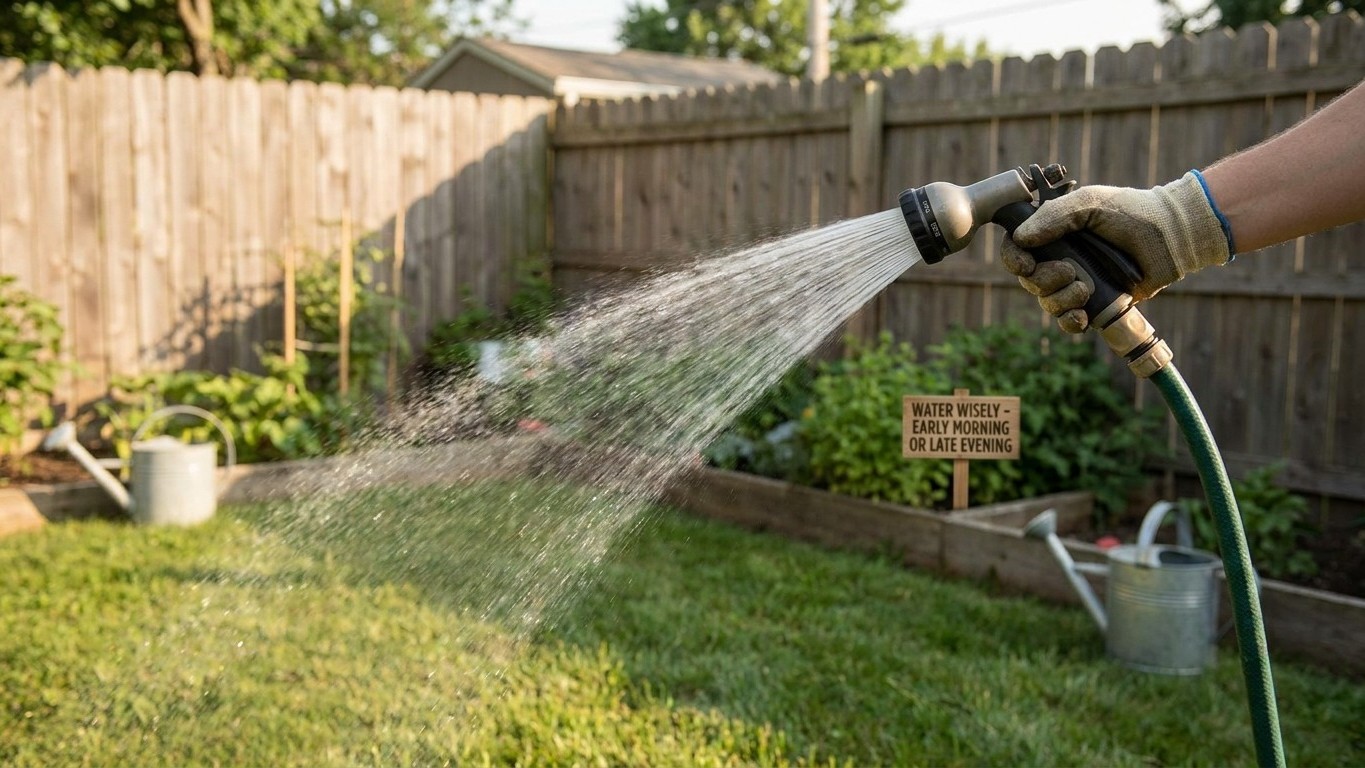

Root depth is what decides almost everything here. Shallow, frequent watering trains roots to stay near the surface where moisture already sits, and that habit doesn’t cost you anything until a hot, dry stretch arrives weeks later and those roots find nothing to reach for. The lawn that browns then isn’t reacting to today’s weather — it’s reacting to a watering pattern set a month earlier. Water deep and less often, and roots follow the water down.
Why this matters
A lawn does not show a bad watering habit the day it happens. It shows it three or four weeks later, when a hot stretch or a dry wind arrives and the roots that were never trained to reach deep for water simply cannot find any. By then the damage looks like a disease problem or a heat problem, and the actual cause, a summer of shallow daily sprinkling, is long past and easy to miss.
Overwatering is just as costly and just as slow to show. Constantly wet soil pushes roots to stay near the surface where the moisture already is, and it also favors the fungi that cause lawn disease, which tend to show up as patches weeks after the wet pattern started rather than the week it started. The visible symptom always lags the cause, which is why watering mistakes get blamed on weather, insects, or bad luck instead of the schedule that actually caused them.
It helps to remember that brown is not dead. Both cool-season and warm-season grasses go dormant under stress, cool-season types in summer heat and warm-season types in winter cold, and a dormant lawn that still has living crowns will green back up once conditions and water return. Ripping out a lawn or reseeding over a dormant patch, based on color alone, wastes money and seed on a lawn that was never dead to begin with.
When to do it
Cool-season and warm-season grasses grow in opposite halves of the year, and watering timing has to follow whichever one is actually growing. Fine fescues, Kentucky bluegrass, perennial ryegrass, rough bluegrass and tall fescue are all cool-season species, according to Penn State Extension’s Lawn Establishment guide and Clemson Cooperative Extension’s HGIC 1214, and they do their active growing in spring and fall, slowing or going dormant through the hottest weeks of summer. Bahiagrass, Bermudagrass, carpetgrass, centipedegrass, seashore paspalum, St. Augustinegrass and zoysiagrass are warm-season species per HGIC 1214, and they grow hardest through summer, then go dormant and brown off once cold weather sets in.
That split matters because watering a dormant lawn heavily to force it green fights the plant’s own cycle instead of working with it. A cool-season lawn under summer stress needs less coaxing and more patience, and a warm-season lawn in winter dormancy needs almost no supplemental water at all. Trying to keep either one green outside its natural growing window usually just wastes water and can weaken the grass going into its next stressful season.
The exact week any of this starts or ends is a local question, not a national one, since it tracks regional temperature and rainfall patterns rather than a fixed date on a calendar. Clemson publishes a maintenance calendar for each warm-season species it covers, including HGIC 1216 for Bermudagrass, HGIC 1217 for Zoysiagrass, HGIC 1215 for Centipedegrass, HGIC 1218 for St. Augustinegrass, and HGIC 1219 for Tall Fescue, and matching the right one to the grass actually in the ground is worth the few minutes it takes. For a fuller picture of how watering fits alongside mowing and feeding across the season, see Lawn Care.
How to do it

Match the schedule to the root system, not the clock
The single biggest lever in watering practice is depth versus frequency. A lawn watered deeply but infrequently pushes roots down to chase the moisture, while a lawn watered lightly every day trains roots to stay shallow, right where they are most exposed to the next dry spell. This is also why mowing height and watering are connected: species mowed taller, like tall fescue and fine fescues at 2.5 to 3.5 inches per Penn State Extension and Clemson Cooperative Extension’s HGIC 1214, carry more leaf area to support a deeper root system, while species kept low, like Bermudagrass at 0.75 to 1.5 inches and seashore paspalum at 1 to 1.5 inches, rely more on the drought tolerance bred into the plant itself.
The exact depth and frequency that suits a particular yard depends on soil type, slope, sun exposure and local rainfall, none of which is the same from one county to the next, so it is worth checking with your own state extension office for a number specific to your soil rather than applying a nationwide figure that may not fit.
Read the tolerance ratings before you set anything
Species differ enormously in how much watering they actually need, and Clemson Cooperative Extension’s HGIC 1214 rates that tolerance directly.
| Grass | Season | Mow height | Drought tolerance |
|---|---|---|---|
| Fine Fescues | Cool | 2.5–3.5 in | Good |
| Kentucky Bluegrass | Cool | 2–3 in | Fair |
| Tall Fescue | Cool | 2.5–3.5 in | Fair |
| Bermudagrass | Warm | 0.75–1.5 in | Excellent |
| Zoysiagrass | Warm | 0.75–2 in | Good |
| St. Augustinegrass | Warm | 2.5–4 in | Good |
| Carpetgrass | Warm | 1–2 in | Very poor |
A lawn of Bermudagrass and one of carpetgrass sitting side by side will not need the same watering attention even in identical weather, because one is rated excellent for drought tolerance and the other very poor. Know the species before you decide the schedule, since the same watering habit that keeps carpetgrass alive would be far more than a stand of Bermudagrass ever needs.
- Grass blades folding lengthwise or looking dull rather than glossy is an early sign of moisture stress.
- Footprints or mower tracks that stay visible instead of springing back mean the leaf tissue has lost turgor.
- A uniform, gradual color fade across the whole lawn usually points to watering, while patchy or ring-shaped discoloration usually points to disease.
What goes wrong
The most common failure is exactly the shallow-daily habit described above, and it rarely gets caught early because the lawn still looks green while it is happening. The tell shows up later, when a stretch of hot, dry weather hits and the lawn thins or browns faster than a neighboring yard watered on a deeper, less frequent schedule, even though both received roughly the same total amount of water over the month.
Watering right after a fertilizer application is another common misstep, since a heavy soak can move nitrogen past the root zone before the grass has a chance to take it up, wasting the feeding and adding to runoff. Matching irrigation to the label rate and timing on the bag avoids that overlap, and Fertilizing a Lawn: Reading the Bag and Timing the Feed covers how to time that step so it does not fight against the watering schedule.
Shaded turf creates its own trap. Areas under tree cover hold soil moisture longer than open lawn, so the same watering schedule that suits the sunny side can leave shaded turf too wet, which is exactly the condition that favors fungal disease. Fine fescues and St. Augustinegrass are rated excellent for shade tolerance by Penn State Extension and Clemson Cooperative Extension’s HGIC 1214 respectively, but even a shade-tolerant species still needs its watering adjusted downward under a canopy. Growing Grass in Shade: What Works and When to Stop Trying goes into how to make that adjustment.
Mowing too short compounds every watering mistake on this list, since a shorter blade has less leaf area to shade its own roots and less capacity to store the sugars a stressed lawn needs to recover. Clemson Cooperative Extension’s HGIC 1205 sets the mowing heights for each species, and cutting below the low end of a species’ range turns an ordinary watering slip into a much slower recovery.
How this changes across the country
A cool-season grower and a warm-season grower are working from opposite calendars, and neither approach transfers directly to the other’s climate. In Pennsylvania, Penn State Extension’s Lawn Establishment guide centers on cool-season species like fine fescues and Kentucky bluegrass, mowed at 2.5 to 3.5 inches and 2 to 3 inches respectively, which take their heaviest watering demand in the shoulder seasons and coast through summer heat on stored root reserves rather than constant irrigation.
In South Carolina, Clemson Cooperative Extension’s HGIC 1214 covers warm-season species such as Bermudagrass, mowed at 0.75 to 1.5 inches with excellent drought tolerance, and centipedegrass, mowed at 1.5 to 2 inches with only fair drought tolerance, and the watering priority there sits squarely in summer, when the grass is actively growing and the state’s heat draws moisture out of the soil fastest.
The transition zone, the band of states where summers are hot enough to stress cool-season grass but winters are cold enough to stress warm-season grass, does not get a clean answer from either playbook. Tall fescue, a cool-season species mowed at 2.5 to 3.5 inches with only fair drought tolerance per HGIC 1214, is the compromise grass many transition zone lawns lean on precisely because nothing else splits the difference as well, even though it still needs more careful summer watering than it would further north.
Whichever region a lawn sits in, the species growing in it, not the state on the map, is what should set the watering plan, since two lawns in the same town can carry different grasses with very different tolerance ratings.
Common questions
How do I know if I’m overwatering or underwatering?
Overwatered lawns tend to show patchy discoloration and soft, spongy soil, while underwatered lawns fade evenly and the blades fold or lose their spring underfoot. If footprints stay pressed into the grass long after you walk across it, that is closer to underwatering than overwatering.
Should I water a dormant lawn?
A small amount of water keeps dormant crowns from drying out completely, but heavy watering meant to force green growth during dormancy usually just wastes water, since the grass is not actively growing regardless of moisture. Let the species’ natural cycle, cool-season dormancy in summer heat or warm-season dormancy in winter cold, run its course.
Does a new lawn need a different watering approach than an established one?
Yes, seedlings and fresh sod have no established root system yet, so they need more frequent, lighter watering to keep the top inch or two of soil consistently moist while roots form. That is a separate stage from the deep, infrequent watering described for an established lawn, and switching too early can stall root development.
Can I skip watering entirely and let the lawn go dormant on purpose?
Some growers do exactly that with drought-tolerant species like Bermudagrass or bahiagrass, both rated excellent for drought tolerance by Clemson Cooperative Extension’s HGIC 1214, accepting a browned-off summer or winter in exchange for skipping irrigation. It is a riskier strategy on species rated fair or poor for drought tolerance, since those are more likely to thin out or die rather than simply go dormant and recover.