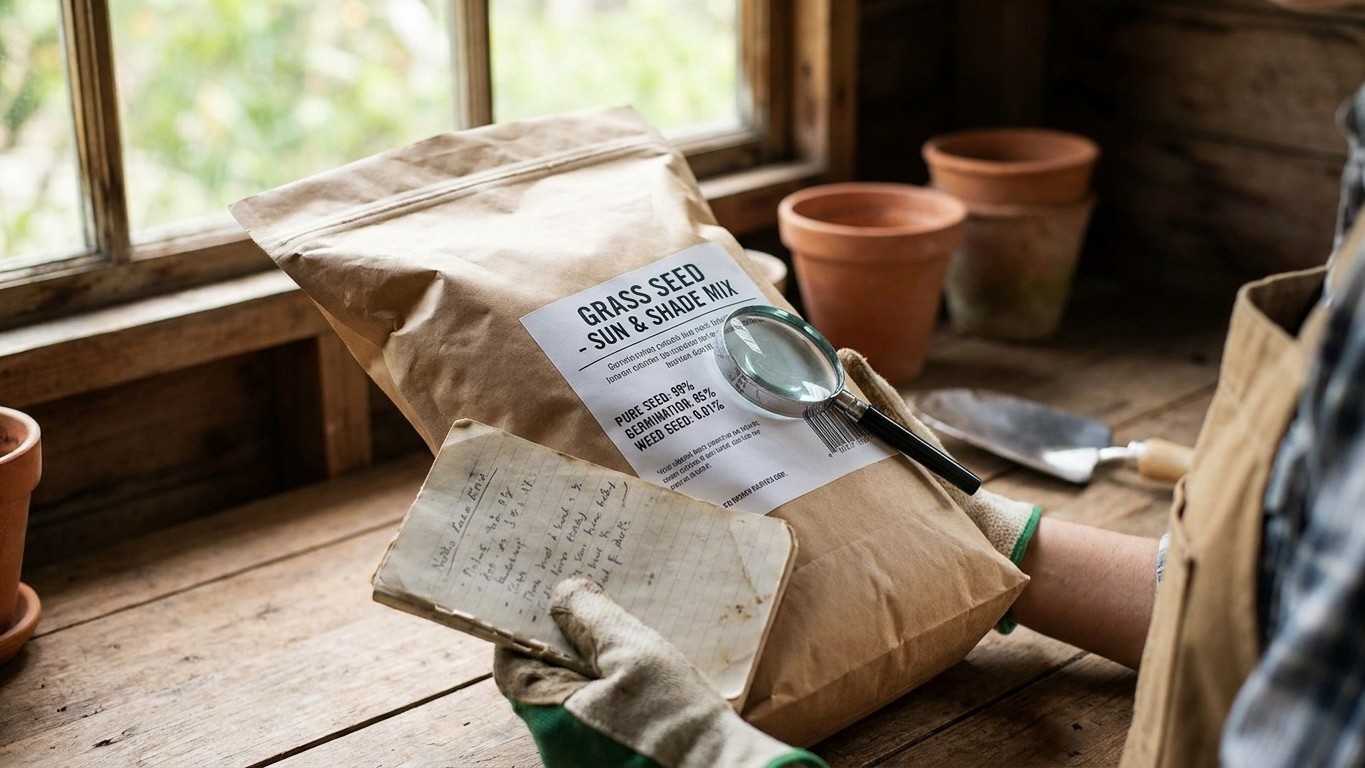

What’s actually in the bag that matters most? It’s not the species name on the front, it’s whether that grass can survive the specific stress your yard puts on it, shade, drought, or foot traffic, and the bag itself never says. Before you buy, check the species name against a tolerance rating table for mowing height, shade, drought, and wear, because a lawn that looks perfect at germination can still thin out under a tree or a swing set months later, once the label’s silence turns into a bare patch you’re stuck looking at.
Why this matters
Buy the wrong seed and you won’t find out until the lawn tells you, weeks or months later, when the grass that looked green on the bag photo thins out under the trees or gives up on the path the dog runs every day. A bag of pure fine fescue looks identical to a bag of pure Kentucky bluegrass once it’s germinated and mowed to a normal height. The difference only shows up under stress, and by then the seed money and the season are both spent.
Fine fescue rates excellent for shade and good for drought, but poor for wear, according to Penn State Extension’s lawn establishment guide. Put it under a swing set and it thins out within a season, not because it germinated badly but because the label never claimed it could take foot traffic. Kentucky bluegrass and perennial ryegrass rate good for wear and only fair for shade, the opposite trade-off. Neither species is defective. The mismatch is the buyer’s, made at the store, and paid for in the yard.
The same logic runs through the warm-season list. Bermudagrass rates excellent for drought and wear but very poor for shade, per Clemson’s HGIC 1214 fact sheet, which makes it a bad bet under a mature oak no matter how well it establishes on the open side of the yard. Reading the tolerance table before buying costs five minutes. Finding out the hard way costs a growing season, sometimes two, and this is the step people skip when a bag is on sale.
When to do it
Cool-season grasses and warm-season grasses grow in opposite halves of the year, and the seed you buy has to match the half you’re aiming for. Fine fescue, Kentucky bluegrass, perennial ryegrass, and rough bluegrass are cool-season species that do their growing in fall and spring, according to Penn State Extension’s lawn establishment guide, so seed shopping and sowing both need to happen ahead of one of those windows, not against it.
Bahiagrass, bermudagrass, carpetgrass, centipedegrass, seashore paspalum, St. Augustinegrass, and zoysiagrass are warm-season species that grow through the summer, per Clemson Cooperative Extension’s HGIC 1214 fact sheet, which means the buying decision has to happen in spring, before that flush starts, rather than in fall when a cool-season grower would be shopping.
A promotional date printed on the bag or the store display means nothing without knowing which of those two seasons you’re actually chasing. Check your own territory’s planting calendar at your state extension office before you commit to a species, since the exact weeks vary by region even within the same growing season. If you haven’t yet worked through bed preparation, our guide to starting a lawn from seed covers grading, testing, and the steps that come before any seed touches soil.
How to do it

Read the whole tag, not just the front
Every legitimate seed bag carries a tag with the same categories of information, and each one earns a look before you pay for it:
- Species and cultivar names, listed by percentage of the total weight
- Germination rate, tested at a specific date printed on the tag
- Percentage of “other crop” seed, weed seed, and inert matter
- Net weight of the bag, which determines how far it actually covers
A bag tested many months before you buy it can still meet its stated germination rate on paper, but seed viability drifts downward the longer it sits in a warehouse. A recent test date is worth paying attention to, and it costs nothing extra to check.
Match the species to the ratings, then set your mower to match
Once you know which species is actually in the bag, the mowing height and stress tolerances that decide whether it survives your yard are published by extension services, not printed on the label. The table below combines Penn State Extension’s ratings for cool-season species with Clemson Cooperative Extension’s HGIC 1214 ratings for warm-season species.
| Grass | Season | Mow height | Shade | Drought | Wear |
|---|---|---|---|---|---|
| Fine Fescue | Cool | 2.5-3.5 in | Excellent | Good | Poor |
| Kentucky Bluegrass | Cool | 2-3 in | Fair | Fair | Good |
| Perennial Ryegrass | Cool | 2-3 in | Fair | Fair | Good |
| Rough Bluegrass | Cool | 2-3 in | Excellent | Poor | Poor |
| Tall Fescue | Cool | 2.5-3.5 in | Good | Fair | Fair |
| Bahiagrass | Warm | 3-4 in | Poor | Excellent | Good |
| Bermudagrass | Warm | 0.75-1.5 in | Very Poor | Excellent | Excellent |
| Carpetgrass | Warm | 1-2 in | Fair | Very Poor | Poor |
| Centipedegrass | Warm | 1.5-2 in | Fair | Fair | Poor |
| Seashore Paspalum | Warm | 1-1.5 in | Poor to Fair | Fair to Good | Good |
| St. Augustinegrass | Warm | 2.5-4 in | Excellent | Good | Fair |
| Zoysiagrass | Warm | 0.75-2 in | Excellent | Good | Very Good |
The seeding rate itself, in pounds per 1000 square feet, is printed directly on the bag’s tag and varies by species and by whether you’re seeding bare ground or overseeding an existing lawn. Follow the number on your specific bag rather than guessing from memory, since blends and pure stands are rated differently. Once the lawn is up, Clemson’s HGIC 1205 Mowing Lawns fact sheet has the general mowing frequency guidance that pairs with the height ranges in the table above.
What goes wrong
Buying on price or photo instead of species name
A cheap bag with a high percentage of a fast-germinating filler species will green up fast and look like a win for the first month. The tell comes later, when that filler species thins out under the tree line or in the high-traffic strip by the driveway, exactly where the tolerance table would have flagged it as weak. That gap becomes visible by the following season, not the same year, which is why the mistake feels invisible at purchase.
Ignoring the test date on old seed
Seed bought on clearance at the end of a season and stored in a garage over summer can carry a germination rate on the tag that no longer reflects reality. The tell is patchy, uneven germination, visible within two to three weeks of sowing rather than months later. If more than a quarter of the seeded area looks bare at that point, the batch itself is the likely cause, not the soil or the watering.
Mistaking dormancy for failure
Both cool-season and warm-season grasses go brown and stop growing under stress, and neither state means the grass is dead. A lawn that browns during a summer dry spell or a winter cold snap is usually just dormant, and pulling it out and reseeding on that assumption wastes seed that wasn’t needed. If the brown patches instead show rings, streaks, or a slimy texture, that’s a different problem, and it’s worth checking against lawn diseases and the symptoms that separate them from watering mistakes before buying anything new.
How this changes across the country
A grower in the Northeast or Upper Midwest is shopping the cool-season list almost exclusively: fine fescue, Kentucky bluegrass, perennial ryegrass, or a blend of the three, chosen by the shade and wear ratings Penn State Extension publishes for each. Their seeding decisions are timed around fall and spring growth, and a bag of bermudagrass on the shelf there is simply the wrong product for the climate, not a superior one.
A grower in the Deep South or along the Gulf Coast is working from the opposite list. Clemson Cooperative Extension’s HGIC 1214 fact sheet covers bahiagrass, bermudagrass, carpetgrass, centipedegrass, seashore paspalum, St. Augustinegrass, and zoysiagrass, all of which grow through summer and go dormant in cooler months. Someone establishing centipedegrass or St. Augustinegrass can follow the species-specific maintenance calendars Clemson publishes, HGIC 1215 for centipedegrass or HGIC 1218 for St. Augustinegrass, for the year-round schedule that follows the seed decision.
South Carolina, where Clemson’s extension service is based, sits in the transition zone between those two lists, and growers there often settle on tall fescue as a compromise species, with its own dedicated schedule in Clemson’s HGIC 1219 Tall Fescue Maintenance Calendar. Neither the pure cool-season nor pure warm-season answer works reliably across an entire transition-zone state, and conditions shift enough within South Carolina itself, from the coastal plain to the upstate, that the tolerance ratings matter even more there than in a state solidly on one side of the divide. Whatever region you’re in, the buying decision folds back into the same routine covered under general lawn care: match the species to the site, then manage it on that species’ own calendar.
Common questions
Can I mix a cool-season seed bag with a warm-season one to cover both seasons?
No. Cool-season and warm-season grasses have different growth cycles, and combining them doesn’t give you year-round green, it gives you two species competing at cross purposes. Choose based on which season your region’s grass actually grows in, per the ratings and growing seasons above, not by trying to cover both.
What does “other crop” mean on the seed tag?
It refers to seed of a cultivated crop plant, other than the grass species you’re buying, that ended up mixed in during harvesting or processing. A small percentage is normal and not the same as weed seed, but a higher-than-expected number on the tag is worth comparing against other bags on the shelf before you buy.
Is a higher germination rate always the better bag to buy?
Not automatically. A high germination rate on an old test date can still perform worse than a slightly lower rate on a fresh one, since viability declines with storage time. Check the test date next to the percentage, not the percentage alone.
Can I use grass seed left over from last year?
You can, but expect a lower germination rate than the number printed on the original tag, especially if it was stored somewhere with temperature swings, like a garage. Sow it a little heavier than the label’s original rate to compensate, and treat thin, patchy germination as a sign the batch has aged rather than a sign of a soil problem.