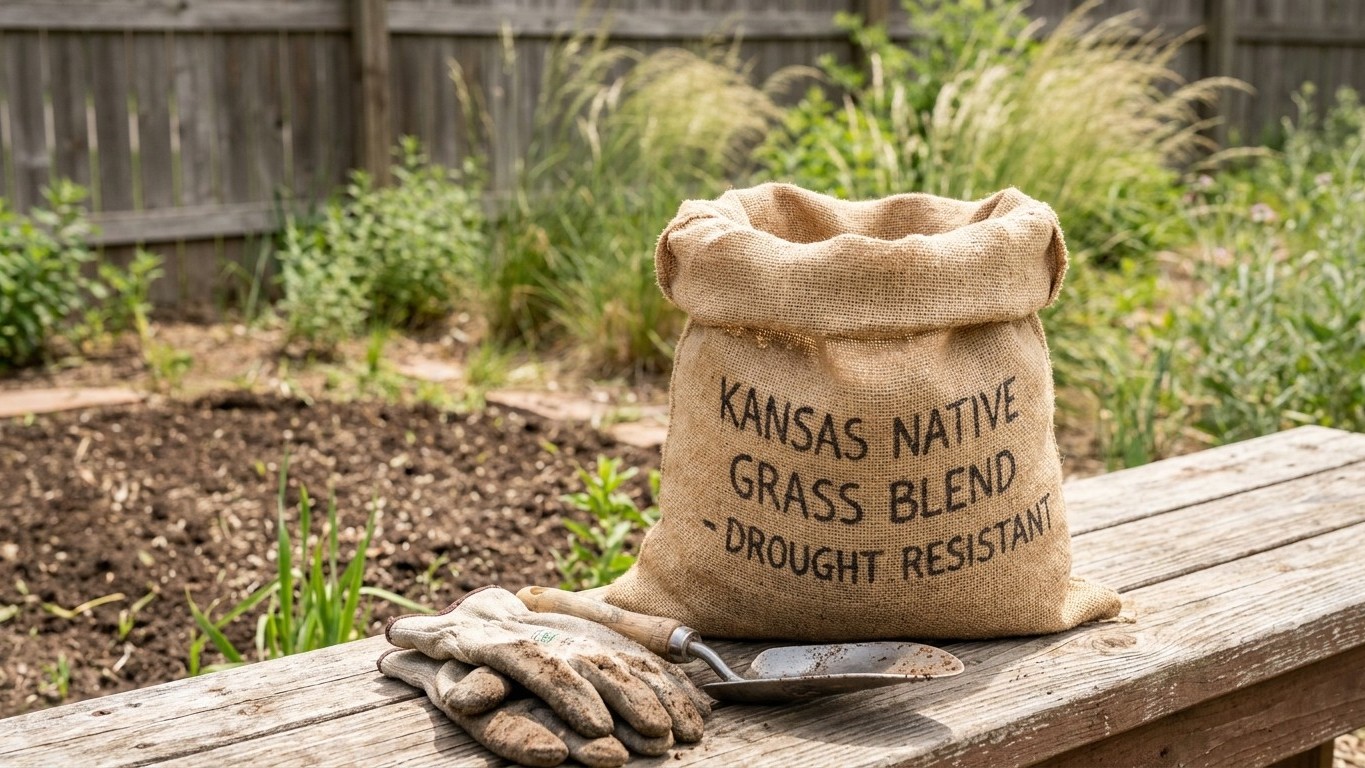

Kansas grass seed comes down to one choice: green through winter, or tough through summer, because this state sits right on the seam between the two. Tall fescue keeps its color when everything else browns off, but it can thin out during a rough August; bermudagrass and zoysiagrass do the reverse, staying thick through the worst heat and going brown the moment frost hits. Go look at your own yard before you buy anything — which way is it already leaning, heat or cold — because that’s what actually decides which bag you need, not the season on the calendar.
The short answer for Kansas
There is no single best grass seed for Kansas, because the state sits in a band where summers run hot enough to stress cool-season turf and winters run cold enough to brown out warm-season turf. Clemson’s HGIC 1214 names five realistic species for this zone: tall fescue, Kentucky bluegrass and perennial ryegrass on the cool-season side, zoysiagrass and bermudagrass on the warm-season side. A tall fescue lawn stays green through a Kansas winter but can thin during the hottest stretch of summer. A bermudagrass or zoysiagrass lawn shrugs off July heat but turns brown from the first fall frost until spring green-up, a dormancy that is normal turf behavior, not a dead lawn.
Which side fits a given yard depends on how the lawn gets used and how much summer water it can count on. A yard with heavy summer traffic, kids, a dog run, a trampoline, tends to hold up better on bermudagrass or zoysiagrass, since both keep growing through the heat that stalls fescue. A yard valued for its look across every season, or used more in cool months than hot ones, leans toward tall fescue, since it holds color long after warm-season turf has gone dormant. The basics of Kansas Lawn Care start with sorting out which of those two situations actually describes your yard, before any seed goes down.
Water settles most of the remaining argument. Fescue needs steady moisture through a Kansas summer to avoid drought stress, and without it the turf can visibly thin by August. Bermudagrass and zoysiagrass are the more drought-tolerant path once established, though both need a full growing season to fill in before they can compete with weeds on their own. NOAA NCEI’s first-fall-frost window near Wichita, October 23 to November 2, is the practical deadline behind all of this: a cool-season lawn seeded after that window will not root before the ground shuts down for winter, so timing decides as much as the species you pick.
Working through the year

Kansas turf calendars split hard along the cool-season and warm-season line, and running the wrong one for your grass wastes a season rather than saving it.
Cool-season lawns: tall fescue, Kentucky bluegrass, perennial ryegrass
Clemson’s HGIC 1219 tall fescue maintenance calendar carries a cool-season lawn through two active growth stretches, spring and fall, with a summer holding pattern between them. New seeding or overseeding happens in the fall window, when soil is warm enough for germination but the worst heat has passed, giving the grass time to build real roots ahead of NOAA NCEI’s first-fall-frost window (October 23 to November 2 near Wichita). Spring is for a second, lighter feeding and for pre-emergent herbicide timed ahead of crabgrass, not for seeding, because young cool-season seedlings rarely survive a full Kansas summer. HGIC 1219 sets a mowing height and nitrogen rate for each month directly; the pattern behind those numbers is to back off nitrogen and raise the mower deck through the hottest weeks, since scalped fescue in July burns.
Warm-season lawns: zoysiagrass, bermudagrass
Bermudagrass runs on Clemson’s HGIC 1216 calendar, and zoysiagrass on HGIC 1217. Both start the year dormant and brown, easy to mistake for a dead lawn but ordinary winter dormancy. Green-up begins once soil warms in spring, and both calendars hold off the season’s first nitrogen feeding until the lawn is mostly green rather than still waking up, since feeding a half-dormant lawn mostly feeds the weeds coming up ahead of it. Midsummer is the growth peak for both grasses and the window for new sod, plugs or seed, because turf planted then has a full stretch of heat left to root in before its first frost. Mowing height differs by species and even by cultivar, so HGIC 1216 and HGIC 1217 each carry their own deck-height and nitrogen schedule; running fescue’s numbers on a bermudagrass lawn, or the reverse, is a common and costly mix-up. For the full month-by-month sequence once you know which calendar applies to your lawn, The Kansas Lawn Care Calendar, Month by Month lines it up in order.
| Grass | Season type | Winter look | Summer look | Calendar to follow |
|---|---|---|---|---|
| Tall Fescue | Cool-season | Green | Slows, can thin in heat | HGIC 1219 |
| Kentucky Bluegrass | Cool-season | Green | Slows in heat, needs water | HGIC 1219 (often blended with fescue) |
| Perennial Ryegrass | Cool-season | Green | Slows in heat | HGIC 1219 (often blended with fescue) |
| Zoysiagrass | Warm-season | Brown, dormant | Dense, heat-tolerant | HGIC 1217 |
| Bermudagrass | Warm-season | Brown, dormant | Fast-growing, heat-tolerant | HGIC 1216 |
What changes across Kansas
The Wichita figure is a reference point, not a rule
Suburban and rural yards typically see their first fall frost arrive earlier than that airport figure, sometimes by a week or two, because open fields and low ground cool faster than a paved apron. A lawn sitting in a valley or a low-lying frost pocket should treat the October 23 to November 2 window as an outer edge, not a target date, and plan cool-season seeding a week or two ahead of it rather than up against it.
Elevation shifts the window further west
Western Kansas sits considerably higher than Wichita, and higher ground cools faster in the evening and warms more slowly after a cold front, which tends to push the first fall freeze earlier than the reference-city figure suggests. Eastern Kansas, lower and more humid, tends to run closer to or slightly behind the Wichita window. None of this changes which five species are realistic for the state; Clemson’s HGIC 1214 list of tall fescue, Kentucky bluegrass, perennial ryegrass, zoysiagrass and bermudagrass holds across Kansas because the whole state sits in the same broad transition band. What shifts county to county is the calendar, not the species list: a gardener toward the western part of the state should give a cool-season lawn extra lead time before the average frost window, and pull a warm-season lawn’s last nitrogen feeding earlier in the fall than a gardener near Wichita would.
The mistakes this climate punishes
Late-season nitrogen on a warm-season lawn
Feeding bermudagrass or zoysiagrass in September or October, the way a fescue lawn gets fed heading into its fall window, pushes a flush of tender new growth right before the first freeze. That growth has no time to harden off before NOAA NCEI’s first-fall-frost window arrives near Wichita (earlier inland and to the west), and the damage doesn’t show until spring, as dead or thin patches where the freeze caught soft tissue. The last nitrogen feeding on a warm-season lawn should land well ahead of that window, not after it.
Seeding cool-season grass in late spring
Tall fescue, Kentucky bluegrass and perennial ryegrass all germinate and root best in cool soil. Seeded in April or May, seedlings sprout but rarely build enough root before summer heat sets in, and the lawn thins or dies out by July or August, exactly when it should be filling in. HGIC 1219 puts the real seeding window in fall for tall fescue specifically because of this.
Cutting too short in a Kansas summer
A cool-season lawn scalped for a tidy look in July loses the leaf area it needs to shade its own root zone, and the damage shows within a couple of weeks as browning and thinning rather than a clean, short cut. Bermudagrass and zoysiagrass tolerate a lower deck once they are actively growing, but cutting either short before it has fully greened up in spring leaves bare soil exposed to weeds that get ahead of the turf for the rest of the season.
Checking this against your county
Frost and calendar figures are measured at or near Wichita, and the rest of the state runs earlier or later around it, sometimes by a week or more once you move away from town or up onto higher ground. K-State Research and Extension keeps a county-by-county office network; check with the county extension office nearest your address before you lock in a seeding date, and ask specifically for that county’s frost guidance rather than relying on a statewide figure. Find your local office through K-State Research and Extension.
Common questions
What’s the best time of year to plant grass seed in Kansas?
It depends on which grass you’re planting. Cool-season species (tall fescue, Kentucky bluegrass, perennial ryegrass) go in during the fall growth window on Clemson’s HGIC 1219 calendar, well ahead of NOAA NCEI’s first-fall-frost window of October 23 to November 2 near Wichita. Warm-season species (bermudagrass, zoysiagrass) go in during their summer growth peak, per HGIC 1216 and HGIC 1217, so the new turf has a full season of heat to root in before its first frost.
Can I overseed my fescue lawn in spring if I missed fall?
You can, but expect a weaker stand. Spring-sown cool-season seedlings rarely build enough root before Kansas summer heat arrives, and a lot of that seeding thins out again by midsummer. The more reliable fix is waiting for the next fall window and overseeding then, per HGIC 1219.
Why does my zoysiagrass or bermudagrass look dead in winter?
It’s dormant, not dead. Both species brown out after the first fall frost and hold that color until soil warms again in spring, which is normal for warm-season turf anywhere in the transition zone. Scratch a small patch of stem near the soil line: if it’s still pliable rather than dry and hollow, the lawn is fine.
Do I need to water grass seed every day after planting?
The seedbed needs to stay consistently moist while the seed germinates, which usually means light, frequent watering rather than one deep soak, but the exact schedule depends on your soil, sun exposure and that week’s weather. Check with your county extension office for a watering routine suited to your particular yard instead of following a fixed number of minutes a day.