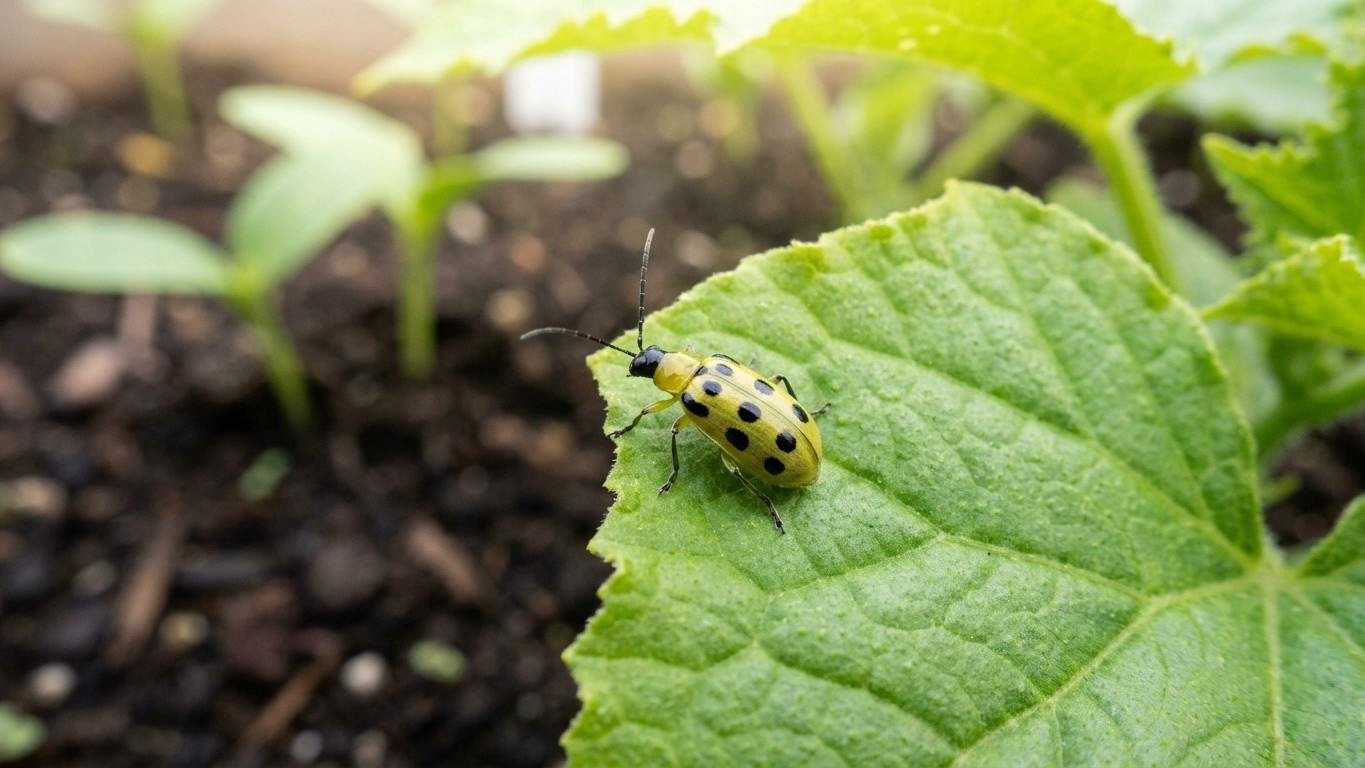

The spotted cucumber beetle turns up in Kentucky gardens as soon as cucurbit seedlings break ground, usually between late April and mid-May once soil temperatures climb into the mid-60s. What stops it isn’t a single spray but a layered approach: physical barriers during the vulnerable seedling stage, sanitation that removes overwintering sites, and targeted treatment only when beetle counts cross a real threshold. Skip any one of those steps and the beetle finds a way back in.
Identifying the Beetle Before It Does Damage

Diabrotica undecimpunctata howardi, the scientific name behind the common one, measures about a quarter inch long. Its body is a soft yellow-green, and twelve black spots run across the wing covers in a pattern that’s easy to mistake for random freckling until you count them. The head and antennae are solid black, which helps separate it from the striped cucumber beetle, a close relative with three black racing stripes instead of spots.
Both insects show up on the same crops and cause similar chewing damage, so gardeners in Kentucky’s Bluegrass region and the western part of the state often confuse the two. The distinction matters because the spotted beetle has a wider host range. Beyond cucumbers, squash, and melons, it also attacks beans, corn seedlings, and even peanuts in southern counties where that crop gets grown. Its larval stage, known separately as the southern corn rootworm, tunnels into corn roots and can cause plants to lodge in a strong wind.
- Yellow-green body with twelve black spots (not stripes)
- Black head and black antennae
- Roughly a quarter inch long, oval-shaped
- Feeds on cucurbit leaves, flowers, and fruit rinds, plus corn and beans
When It Shows Up in Kentucky
Kentucky sits in a transition zone for this insect. Farther south, adults survive winter tucked under leaf litter and crop debris, then simply resume feeding as temperatures rise. In Kentucky’s colder winters, especially in the eastern mountains, survival is spottier, so a good share of each spring’s population arrives through northward migration rather than local overwintering. That’s part of why populations can vary sharply from one growing season to the next, depending on how mild the previous winter was and how strong the spring winds blew from the south.
Once temperatures stabilize, expect the first wave on newly emerged cucurbit seedlings sometime in late April through May. This is the most dangerous window, since young plants have so little leaf tissue that even light feeding on cotyledons or stems can kill a seedling outright. A second generation typically builds through July and August, as eggs laid earlier in the season mature into adults that feed on foliage, chew into flowers, and scar the rind of developing fruit. Gardeners who only scout in spring and assume they’re in the clear by midsummer often get caught off guard by this second wave.
Why the Timing Matters More Than the Beetle Count
A handful of beetles on mature, established squash plants rarely causes serious harm. That same number on a cucumber seedling with two true leaves is a different story entirely. Kentucky State University and University of Kentucky Cooperative Extension specialists generally recommend treating the seedling stage as the highest-risk period and easing up on control measures once plants are established and vigorously growing, since older plants tolerate a good deal of leaf loss without yield loss.
The Damage Goes Beyond Chewed Leaves
Direct feeding is the visible problem, but it’s not the costliest one. Spotted cucumber beetles carry the bacterium responsible for bacterial wilt, Erwinia tracheiphila, in their gut and introduce it into plants through feeding wounds. Cucumbers and muskmelons are highly susceptible, and once a vine is infected there’s no cure. A single leaf wilts first, then the whole vine collapses within days. A quick field test: cut a wilting stem, press the two halves together, then slowly pull them apart. If sticky bacterial strings stretch between the cut surfaces, that’s bacterial wilt, not drought stress or a nutrient problem.
Squash and pumpkin varieties tolerate the bacterium better than cucumbers do, which is one reason experienced growers often see wilt wipe out a cucumber patch while nearby squash keeps producing. Beetles also feed directly on flowers, which reduces pollination rates, and they’ll chew into the rind of thin-skinned fruit like young cucumbers, leaving scars that make produce unmarketable even when the plant itself survives.
What Actually Stops It
Floating row covers are the single most effective tool for the seedling stage. Installed at planting and left in place until flowers appear, they physically block adult beetles from reaching young plants during the highest-risk window. The catch is timing the removal correctly. Cucurbits need pollinators to set fruit, so covers have to come off once blossoms open, unless you’re prepared to hand-pollinate every morning with a small brush, which some backyard growers do for a handful of plants but isn’t practical at garden scale.
Trap cropping offers a second layer of defense that many Kentucky extension programs recommend for larger plantings. Blue Hubbard squash is intensely attractive to cucumber beetles compared to most other cucurbits, so planting a border row of it around the main crop draws beetles away from the plants you actually want to protect. Growers can then concentrate any insecticide application on that trap crop border instead of spraying the whole field, cutting overall pesticide use significantly.
Sanitation and Rotation Cut the Following Year’s Population
Because adult beetles overwinter in crop debris and leaf litter, clearing garden beds of old cucurbit vines and fallen fruit at the end of the season removes a chunk of the shelter they need to survive a Kentucky winter. Rotating cucurbits to a different part of the garden each year, away from where corn or squash grew the previous season, also reduces the buildup of larvae in the soil, since the rootworm stage develops in place and doesn’t travel far.
Yellow sticky cards placed at seedling height help with monitoring, giving a rough sense of pressure before damage becomes visible. Many extension guides use roughly one beetle per plant on seedlings as a point where action is worth taking, though thresholds shift depending on plant size and local conditions, so checking with a county extension office for current recommendations is worthwhile before spraying anything.
When chemical control is genuinely needed, pyrethroid products and spinosad-based insecticides are common choices, but timing the application for early evening protects bees and other pollinators that visit flowers during the day. Kaolin clay, sold under trade names as a particle film barrier, works as a repellent rather than a killer, coating leaves in a fine white powder that beetles find unappealing to land on and feed on. It won’t eliminate an infestation, but it can reduce feeding pressure enough to get seedlings past their most vulnerable stage without resorting to a stronger product.
Some newer cucumber varieties are bred with lower levels of cucurbitacin, the bitter compound that actually attracts Diabrotica beetles in the first place. Choosing those varieties won’t make a garden beetle-proof, but it does lower the odds of a heavy infestation compared to older, more bitter-tasting cultivars still common in seed catalogs.
Related guides
- Spotted cucumber beetle in Ohio: When It Shows Up and What Stops It
- Spotted cucumber beetle in Michigan: When It Shows Up and What Stops It
- Spotted cucumber beetle in New Jersey: When It Shows Up and What Stops It
- Fall webworm in Kentucky
- Spotted cucumber beetle in South Carolina: When It Shows Up and What Stops It