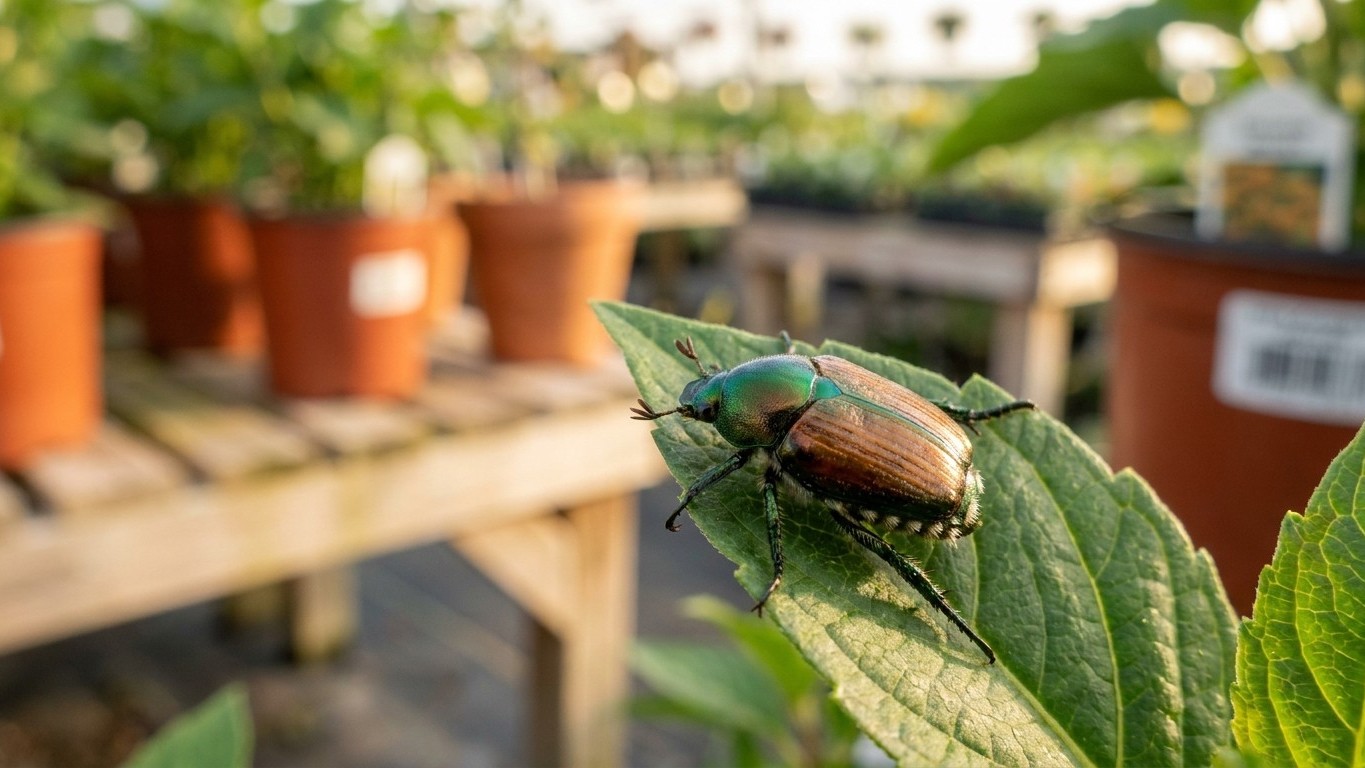

Manitoba sits outside the Japanese beetle‘s established range in Canada, but that doesn’t mean the pest is a non-issue. The Canadian Food Inspection Agency (CFIA) traps for this insect every summer across the province, and isolated adults do turn up at garden centers, nurseries, and high-traffic sites that receive plants or soil from Ontario and Quebec. The bug shows up from late June through August, and the tools that stop it (traps for monitoring, hand removal, targeted soil treatments) work best when applied before a local population gets a foothold.
Has the Japanese Beetle Actually Reached Manitoba?

Not in the way it has reached southern Ontario. Japanese beetle (Popillia japonica) built its first strong North American foothold in New Jersey back in 1916, then spread into Canada through the Windsor area of Ontario decades later. Today the CFIA maintains regulated zones mainly in parts of Ontario, Quebec, and Nova Scotia, where the insect breeds successfully year after year. Manitoba isn’t one of those zones.
What Manitoba does have is a national trapping network. Provincial and federal agencies set out pheromone-baited traps every summer at nurseries, garden centers, campgrounds, and other spots where an accidental introduction is most likely. When a beetle turns up in one of those traps, it usually arrived as a hitchhiker, riding in on nursery stock, sod, or even the soil clinging to a moving truck’s tires, rather than emerging from an established local grub population. Manitoba’s winters play a role here too: sustained deep frost kills overwintering grubs that aren’t buried below the freeze line, which is one reason the insect hasn’t gained the same permanent footing it has in warmer parts of eastern Canada.
That said, urban heat pockets, irrigated lawns, and heated greenhouses can create small microclimates where grubs survive a winter they’d otherwise lose. This is why homeowners near garden centers or landscaping operations that import plants from Ontario should know what to look for, even if the odds of a full-blown infestation stay low for now.
Life Cycle and Timing: When to Watch Your Yard
Japanese beetle runs on a one-year cycle in most of Canada, though colder regions can stretch that to two years. Adults emerge from the soil in late June, feed through July, and taper off by mid-to-late August. That six-to-eight week window is when you’ll actually see the insect: a 3/8-inch beetle with a metallic green head and thorax, copper-colored wing covers, and five small tufts of white hair along each side of the abdomen.
Females lay eggs in turf during July and August, favoring moist, well-irrigated lawns over dry ones. The larvae, C-shaped white grubs with brown heads, feed on grass roots through fall, burrow below the frost line to overwinter, then resume feeding in spring before pupating and emerging as adults the following summer. Two details matter for Manitoba homeowners specifically: irrigated turf and golf courses are more attractive egg-laying sites than unwatered lawns, and grubs that don’t reach sufficient depth before hard frost typically don’t survive a Manitoba winter.
Why Traps Alone Won’t Solve a Problem
Pheromone and floral-lure traps are useful for detection, which is exactly why CFIA and provincial programs deploy them. They’re a poor tool for control on a home property. Research from extension entomologists has shown these traps often attract more beetles into a yard than they actually capture, meaning a trap hung near your roses can turn your own garden into ground zero for beetle traffic. If you want to monitor for the insect, place traps well away from plants you care about, not next to them.
What Damage Looks Like, and What Else It Could Be
Adult Japanese beetles feed on more than 300 plant species, but they have clear favorites: roses, linden trees, grapevines, Virginia creeper, and crabapple rank high on the list. Feeding damage has a distinct signature. The insects eat the leaf tissue between veins and leave the veins themselves intact, a pattern entomologists call skeletonizing. A rose bush with lace-like, see-through leaves in July is a strong visual clue, though it’s worth confirming with an actual insect sighting since a few other pests leave similar patterns.
Grub damage in lawns is harder to pin on this species specifically without digging. Japanese beetle larvae feed on grass roots and can cause the same irregular brown patches that other white grubs, including June beetles and chafers common across the Prairies, also produce. If you see a scattered dead patch that lifts up like loose carpet, dig a one-square-foot section about 2 to 3 inches deep. Finding more than 8 to 10 grubs in that area suggests a problem worth treating, regardless of exact species.
Control Methods That Actually Work
For adult beetles on ornamentals, early morning hand removal remains one of the most effective, lowest-cost tactics. The insects are sluggish in cool morning temperatures, and knocking them into a bucket of soapy water kills them without chemicals. Doing this daily during the peak feeding weeks can meaningfully reduce damage on a handful of prized plants like roses or a small grape arbor.
For grubs, two biological options get recommended most often, though their track record shifts with local soil conditions:
- Beneficial nematodes (species like Heterorhabditis bacteriophora) applied to moist soil in late summer can infect and kill young grubs before they burrow deep for winter.
- Milky spore (Bacillus popilliae) has a strong record in warmer, established Japanese beetle regions, but its effectiveness drops in colder soils, making it a less reliable choice for Manitoba conditions compared to areas of southern Ontario.
Chemical options exist for both life stages. Adult beetles on ornamentals respond to insecticides containing carbaryl or chlorantraniliprole, applied directly to affected foliage. Grub control in turf works best with a properly timed soil-applied insecticide put down in late July or early August, right after egg hatch and before larvae move deeper into the soil profile. Timing matters more than the product choice here; an application made too early or too late misses the vulnerable young-grub stage entirely.
Floating row covers offer a simple physical barrier for vegetable gardens during the adult feeding window, particularly for beans and other crops beetles favor. It’s a low-effort option for anyone who’d rather skip chemical treatments on food crops altogether.
Nursery Stock and Soil: The Real Risk Vector
Because Manitoba sits outside the regulated zone, movement of certain plants, sod, and root-and-soil nursery stock from Ontario, Quebec, and other regulated areas into the province requires phytosanitary certification designed to keep grubs and eggs from traveling in soil. This regulatory layer, managed through the CFIA’s plant health program, is the main reason isolated adult beetles occasionally show up at Manitoba garden centers without signaling an established population. If you’re buying container plants, potted roses, or sod this summer, ask where the stock originated. Material shipped in from a regulated area should carry the proper certification, and reputable garden centers can confirm this on request.
Full details on regulated areas and movement requirements are available through the CFIA’s official Japanese beetle program page, which also outlines how to report a suspected sighting.
Reporting matters more in Manitoba than it does in places where the beetle is already common. A single confirmed adult found outside a trap, on a rose bush or clinging to a screen door in July, gives provincial and federal monitoring programs real data on how far the insect’s range is creeping. Photograph the beetle if you can, note the location, and pass it along to your provincial agriculture office rather than assuming it’s just another June beetle look-alike.