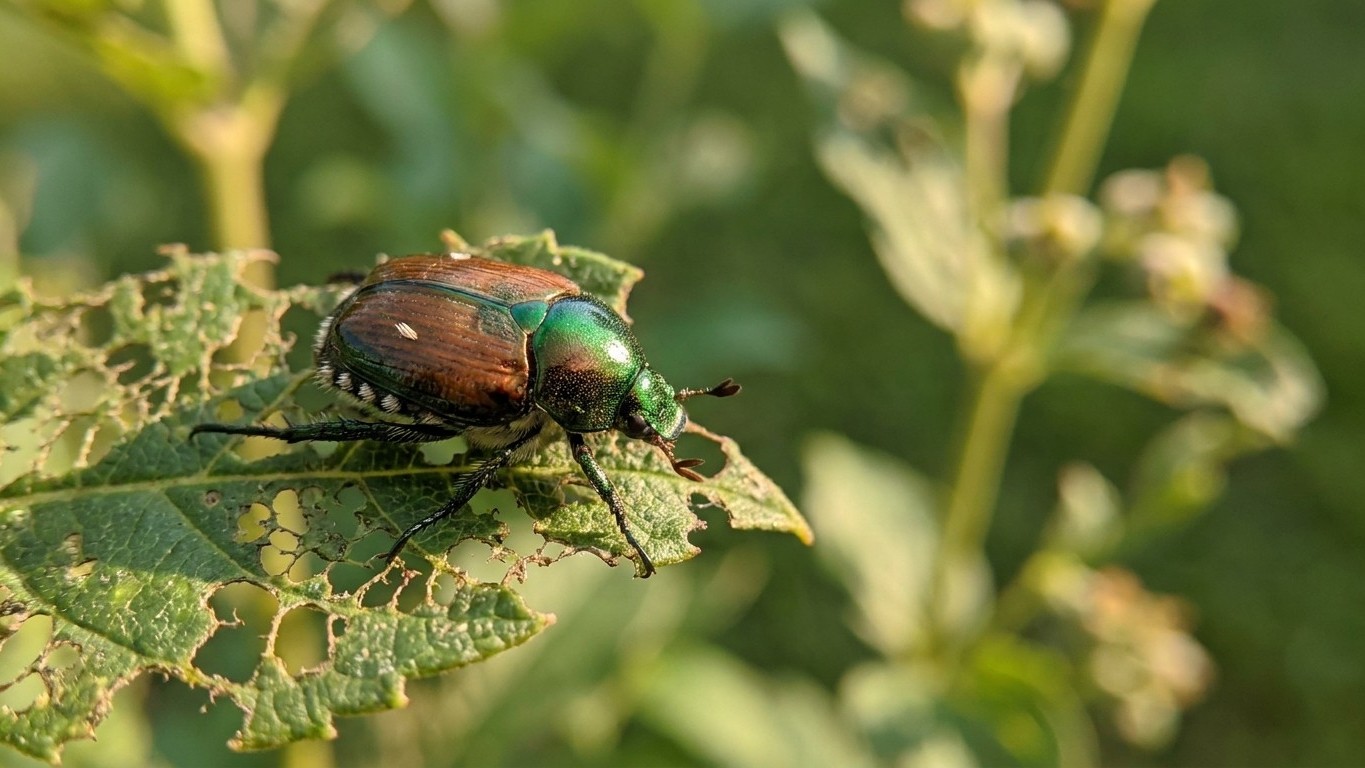

Japanese beetles show up in Minnesota lawns and gardens from late June through August, with the heaviest feeding damage typically hitting between the Fourth of July and Labor Day. The adults are easy to spot: metallic green bodies, copper-colored wing covers, and a row of small white tufts along each side. What actually stops them is a combination of timely lawn treatments for the grub stage and targeted handpicking or insecticide use for adults, since pheromone traps and one-time sprays rarely solve the problem on their own.
When Japanese beetles are active in Minnesota

The timing follows a fairly predictable calendar shaped by soil temperature. Grubs overwinter deep in the soil, below the frost line, and start moving upward as the ground warms in April and May. They feed briefly on grass roots, then pupate in late May or early June. Adult beetles emerge starting in late June, with populations building through July and tapering off by mid-to-late August.
That six-to-eight week window is when homeowners see the most damage: skeletonized rose leaves, chewed-up linden and birch canopies, and grapevines stripped down to their veins. Females mate within days of emerging, then burrow into turf, often in sunny, well-watered lawns, to lay eggs. A single female can lay 40 to 60 eggs over her lifetime, spread across several egg-laying trips back into the soil.
By August, those eggs hatch into first-stage grubs that immediately start feeding on grass roots. This is when lawns start showing irregular brown patches, and when the next generation’s damage potential gets set for the following summer.
How established are Japanese beetles across Minnesota
Japanese beetles aren’t new to the state, but they’ve gone from occasional find to established pest over the past few decades. The Minnesota Department of Agriculture has tracked spreading populations, especially concentrated in the Twin Cities metro area, where warmer urban microclimates and heavily irrigated lawns give the insect exactly the conditions it favors. Greater Minnesota has seen slower, patchier establishment, partly because colder winters and less irrigated turf make conditions tougher for overwintering grubs.
Nursery stock movement has played a role in spreading the insect to new counties. Because the larvae live in soil and potted plant root balls, transporting infested nursery material has historically been one of the main ways populations jump to new areas. That’s part of why some states maintain quarantine restrictions on nursery shipments from beetle-infested zones.
What Japanese beetles damage first
Adult beetles feed in groups, drawn to each other by aggregation pheromones released by feeding beetles themselves, which explains why damage often shows up in dense clusters on just a few plants while others nearby stay untouched. In Minnesota landscapes, a short list of plants consistently takes the worst hits:
- Roses, especially lighter-colored varieties with fragrant blooms
- Linden and littleleaf linden trees, a common boulevard tree in Twin Cities neighborhoods
- River birch and paper birch
- Grapevines and Virginia creeper
- Raspberries and other cane fruits
The feeding pattern is distinctive. Beetles chew between leaf veins, leaving a lace-like skeleton where only the veins remain intact. On heavily hit trees, entire branches can look scorched by midsummer even though the tree itself usually survives fine, since mature trees can tolerate significant leaf loss without long-term harm.
Lawns tell a different story, and it shows up later in the season. Grub feeding on roots causes turf to feel spongy, then loosens to the point where you can roll back sections like a carpet. Skunks and raccoons digging up lawns in search of grubs are often the first sign homeowners notice, sometimes before they even see the brown patches themselves.
Controlling adult beetles without making things worse
The single most common mistake in Minnesota gardens is buying a pheromone trap expecting it to solve the problem. University extension research has shown these traps often attract more beetles to a property than they actually catch, drawing in insects from surrounding blocks and increasing damage near the trap itself. If you use one at all, place it far from the plants you’re trying to protect, not near them.
Handpicking works surprisingly well for light-to-moderate infestations, particularly in the early morning when beetles are sluggish from cooler overnight temperatures. Knock them into a bucket of soapy water rather than crushing them on the plant, since crushed beetles can release pheromones that attract even more insects to the site.
For heavier infestations, insecticidal soap or neem oil offers a lower-impact option that still needs repeat applications every few days during peak feeding weeks. Foliar insecticides containing pyrethroids or carbaryl provide stronger, longer knockdown but carry real risk to pollinators if applied while plants are blooming. Spraying in the evening after bees have finished foraging for the day cuts that risk substantially, and choosing products labeled for use on the specific plant matters, since not every insecticide is cleared for edible crops like grapes or raspberries.
Stopping the grub stage before it starts
Because next year’s beetle population starts as grubs feeding in your lawn this fall, timing grub control right is more effective long-term than fighting adults every July. Preventive grub insecticides containing imidacloprid or chlorantraniliprole work best applied in June or early July, before eggs hatch, so the product is already present in the soil when young grubs start feeding.
If that window gets missed, curative treatments containing trichlorfon can still knock back grub populations in August and September, but they need to be watered in immediately to reach the root zone where grubs are actively feeding. Testing before treating makes sense here: digging up a one-square-foot section of lawn and counting grubs gives a real threshold to work from. Fewer than five grubs per square foot generally isn’t worth treating; ten or more usually justifies it.
Beneficial nematodes, specifically Heterorhabditis bacteriophora, offer a biological alternative that some Minnesota gardeners prefer over synthetic insecticides. They need moist soil and warm temperatures to establish, so applying them in late summer when soil temps are still favorable, then watering thoroughly, gives them the best shot at working. Milky spore disease, often marketed as a long-term grub solution, has a spottier track record in Minnesota than in warmer states, since the bacteria that cause the disease don’t persist as reliably in soil that freezes deeply each winter.
Lawn habits that make a difference
Beetles prefer laying eggs in moist, well-irrigated turf, which means a lawn watered heavily and frequently through July is more attractive to egg-laying females than one allowed to go slightly drought-stressed during peak beetle activity. Letting a lawn dry out a bit during the adult beetle flight period, then resuming normal watering in late August, can reduce the number of eggs laid without sacrificing overall lawn health for the season.
Healthy, deep-rooted turf also tolerates grub feeding better than thin, shallow-rooted lawns. Overseeding thin patches each fall and maintaining mowing height around three inches builds a root system resilient enough to handle moderate grub pressure without visible dieback.
Protecting specific plants through the season
Roses and other high-value ornamentals benefit from lightweight row covers or netting during peak beetle weeks, physically blocking access while still allowing light and water through. This works best on smaller shrubs and vegetable plants where covering is practical; it’s not realistic for mature trees.
Mixed plantings also help. Because beetles aggregate through pheromone signaling once a few individuals start feeding, breaking up large blocks of their favorite plants, like a hedge of roses or a solid stand of linden trees, with less attractive species can reduce how quickly a feeding cluster forms and spreads.
For gardeners managing grapevines or raspberry patches, timing harvest and spray schedules matters more than with ornamentals, since pre-harvest intervals on insecticide labels need to be followed exactly to keep produce safe to eat. Checking the label for the specific crop, not just the pest, avoids problems at harvest time.
Minnesota’s beetle populations tend to run in cycles tied to winter severity and summer rainfall, with unusually cold winters knocking back grub survival and wet summers boosting adult activity the following year. Keeping an eye on local extension reports each spring gives a reasonable heads-up on whether a given season is shaping up to be a heavy one before the beetles actually show up.
Related guides
- Japanese beetle in Iowa: When It Shows Up and What Stops It
- Japanese beetle in Missouri: When It Shows Up and What Stops It
- Japanese beetle in Nebraska: When It Shows Up and What Stops It
- Japanese beetle in Quebec: When It Shows Up and What Stops It
- Japanese beetle in Pennsylvania: When It Shows Up and What Stops It