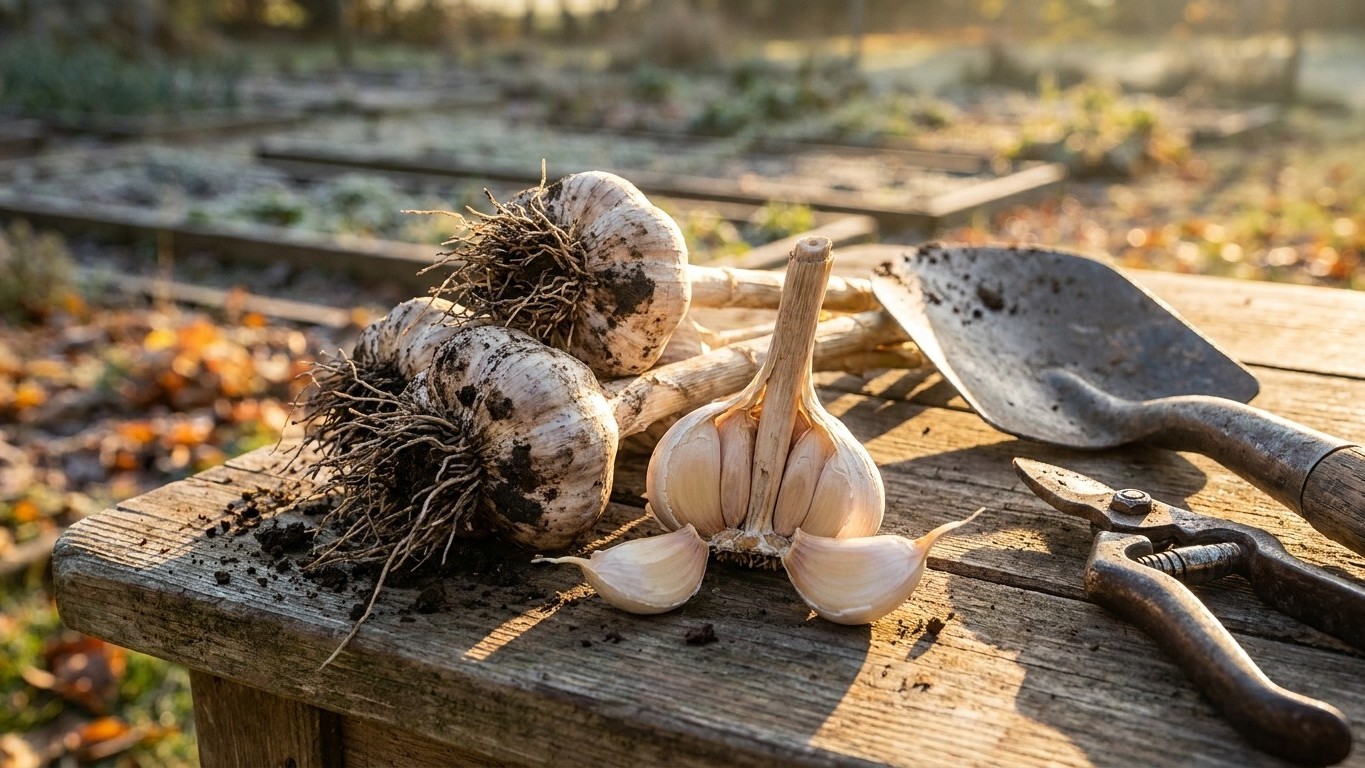

Garlic planted in Maryland the previous fall comes out of the ground the following summer, once the lower leaves have gone brown and only four or five green ones remain up top. Pull a test bulb, check the wrapper stays intact, then lift the rest. Cure whole plants for two to four weeks in a shaded, airy spot before trimming and storing in a cool, dry place through winter.
When garlic is ready to lift in Maryland
The signal that matters is leaf color, not a date on the calendar. Garlic works through its stored energy from the bottom of the plant up, so as the bulb finishes sizing, the lowest leaves brown off first while the top few stay green. Extension guidance generally points growers toward pulling one test bulb when roughly half the leaves have died back, then checking whether the cloves have separated and the wrapper skins are still tight. If the skins are still tight, garlic is ready. If they’ve split, harvest is already overdue and bulbs won’t store as well.
What pushes that timeline earlier or later, more than anything, is what happened at planting. Garlic goes into the ground in autumn, usually well ahead of the season’s first hard cold, and the strength of root development before winter dormancy sets in has a real effect on bulb size the next summer. NOAA NCEI’s 1991-2020 climate normals put the first fall freeze (32°F) for the Baltimore-Washington corridor somewhere between October 26 and November 5. That’s a midpoint, not a guarantee. In roughly half of all years on record, the first freeze arrives later than that window, sometimes well into the back half of November. Growers who plant with that date in mind, rather than treating it as a hard deadline, tend to get more consistent root establishment before the ground cools for good.
Regional variation across the state
Maryland’s geography stretches that timeline further than a single window suggests. Garrett and Allegany counties, tucked into the mountains of Western Maryland, run consistently colder and see their first freeze weeks ahead of the central corridor. The Eastern Shore, moderated by the Chesapeake Bay and Atlantic influence, tends to stay milder later into fall. Neither of those adjustments is quantified in the NOAA dataset cited above for this specific comparison, so treat the October 26 to November 5 window as a central Maryland reference point and adjust your own expectations regionally rather than applying it uniformly statewide.
Back to harvest itself: once roughly 50 percent of the leaves are brown and the rest are fading rather than fully green, that’s the window. Waiting for every leaf to die back is a common mistake, and it usually means the clove wrappers have already started to split underground.
Curing it, and where to hang it here
Curing is what turns a freshly pulled bulb, still full of moisture, into something that will keep for months rather than rotting in a few weeks. The process is simple: get air moving around the whole plant, keep it out of direct sun, and give it time. Two to four weeks is the general range most growers work with, and Maryland’s summer humidity means erring toward the longer end is usually the safer bet.
Don’t wash the bulbs before curing. Soil brushes off dry far more easily than it scrubs off wet, and any added moisture at this stage just slows the drying process down. Leave the roots and the stalk attached, hang or lay the whole plant somewhere shaded, and let it be.
Finding the right spot in a Maryland summer
The tricky part in this region is that late June through August is exactly when Maryland’s air is thickest with humidity. A closed garage with no airflow, or a basement that runs damp, will slow curing to a crawl and invite mold before the bulbs ever fully dry. Better options tend to be:
- A covered porch with a box fan running nearby for constant air movement
- A shed with the door propped and a fan pointed across the hanging bulbs
- A garage with the door cracked and a dehumidifier running if the space tends to run damp
- An attic space, provided it isn’t so hot it cooks the bulbs
Hanging garlic in loose bundles of six to ten plants, rather than in one dense clump, keeps air moving through the middle of the bundle instead of just around the outside. Spacing plants apart on a screen or a length of hardware cloth works just as well if hanging space is limited.
Garlic is cured when the outer wrapper feels papery and dry, the neck where the stalk meets the bulb has tightened down, and the roots have gone brittle enough to snap off rather than bend. At that point, trim the stalks down to an inch or so above the bulb, brush off any remaining dry soil, and it’s ready to move into storage.
Storing it through a Maryland winter
Once cured, garlic wants three things: cool temperatures, low humidity, and darkness. A pantry shelf, a closet on an exterior wall, or an unheated but insulated space that doesn’t freeze all work reasonably well. What garlic doesn’t want is a refrigerator, which is damp enough to encourage sprouting well before it should start, and it doesn’t want anywhere near a heat source, which will dry cloves out and shrink them fast.
Basements are a mixed bag in Maryland. Many run cool enough for good storage, but plenty also run damp, especially in homes without a dehumidifier or with any history of water intrusion. If a basement smells musty, that’s humidity garlic will absorb right along with everything else stored down there. A mesh bag, a loosely woven basket, or a cardboard box with air holes punched in the sides all work better than anything sealed, since trapped moisture around bulbs speeds up rot far faster than dry air ever will.
How long it actually lasts
Storage life depends heavily on variety, and this is where garlic splits into two broad camps. Softneck types, generally more common in warmer growing regions but still grown across Maryland, tend to store longest, often stretching six to eight months under good conditions. Hardneck types, which handle cold winters well and are a common choice for Maryland gardeners specifically because of that trait, typically store a shorter stretch, often in the range of four to six months before quality starts to drop.
Either way, check stored bulbs every few weeks. A single soft or sprouting bulb left in a bag with the rest can speed up spoilage in its neighbors, so pull anything that’s gone soft as soon as it’s noticed rather than waiting for a full inventory check.
What goes wrong here
Most garlic failures in Maryland trace back to moisture, not pests. The University of Maryland Extension Home and Garden Information Center documents a specific list of pests for this territory, including brown marmorated stink bug, Colorado potato beetle, flea beetles, harlequin bug, squash bug, squash vine borer, and tomato hornworm, among others. None of them are garlic-specific bulb pests. That’s worth noting on its own: garlic’s main enemies in this climate are humidity, timing, and storage conditions, not insects munching on the crop.
The most common mistake is harvesting too late, waiting for every leaf to brown rather than pulling at that roughly 50 percent mark. Bulbs left in the ground too long often have split wrappers, and split wrappers mean cloves exposed to soil moisture and fungal spores right up until harvest. Those bulbs rarely cure well and tend to rot in storage within weeks rather than months.
The second common mistake is curing in a space that’s damp, dark, and unventilated, which in Maryland usually means a closed garage or a basement corner during peak summer humidity. Mold can set in on the outer wrapper before the bulb has fully dried, and once mold takes hold, that bulb’s storage life is essentially over even if it looks fine on the outside.
The third is storing garlic in the refrigerator or in a sealed plastic container. Both trap moisture against the bulb, and both tend to trigger early sprouting, which pulls energy out of the clove and leaves it soft and less flavorful well before its expected storage window is up. Growers looking for more region-specific planting and variety guidance can check the University of Maryland Extension for current recommendations tied to local conditions.
Common questions
How do I know if garlic is ready to harvest instead of waiting too long?
Check when roughly half the leaves have browned and the rest are starting to fade rather than staying fully green. Pull one test bulb and confirm the wrapper skins are still tight and unsplit before harvesting the rest.
Can garlic be planted in Maryland right up until the first frost?
NOAA NCEI’s 1991-2020 climate normals put the first fall freeze for the central Maryland corridor between October 26 and November 5, but that’s a midpoint. In roughly half of recorded years, the freeze comes later than that window, so treat it as a general reference rather than a hard cutoff, and remember Western Maryland runs colder and the Eastern Shore runs milder than that central figure suggests.
Is it safe to store garlic in the refrigerator over winter?
Generally not recommended. Refrigerators run damp enough to trigger early sprouting in stored garlic, which shortens usable storage life. A cool, dark, dry space without added humidity works better.
Do pests documented in Maryland affect garlic specifically?
The University of Maryland Extension Home and Garden Information Center’s documented pest list for this territory, including stink bugs, flea beetles, and several beetle and moth species, doesn’t include garlic-specific bulb pests. Most garlic problems in this region come from harvest timing and storage humidity rather than insect damage.