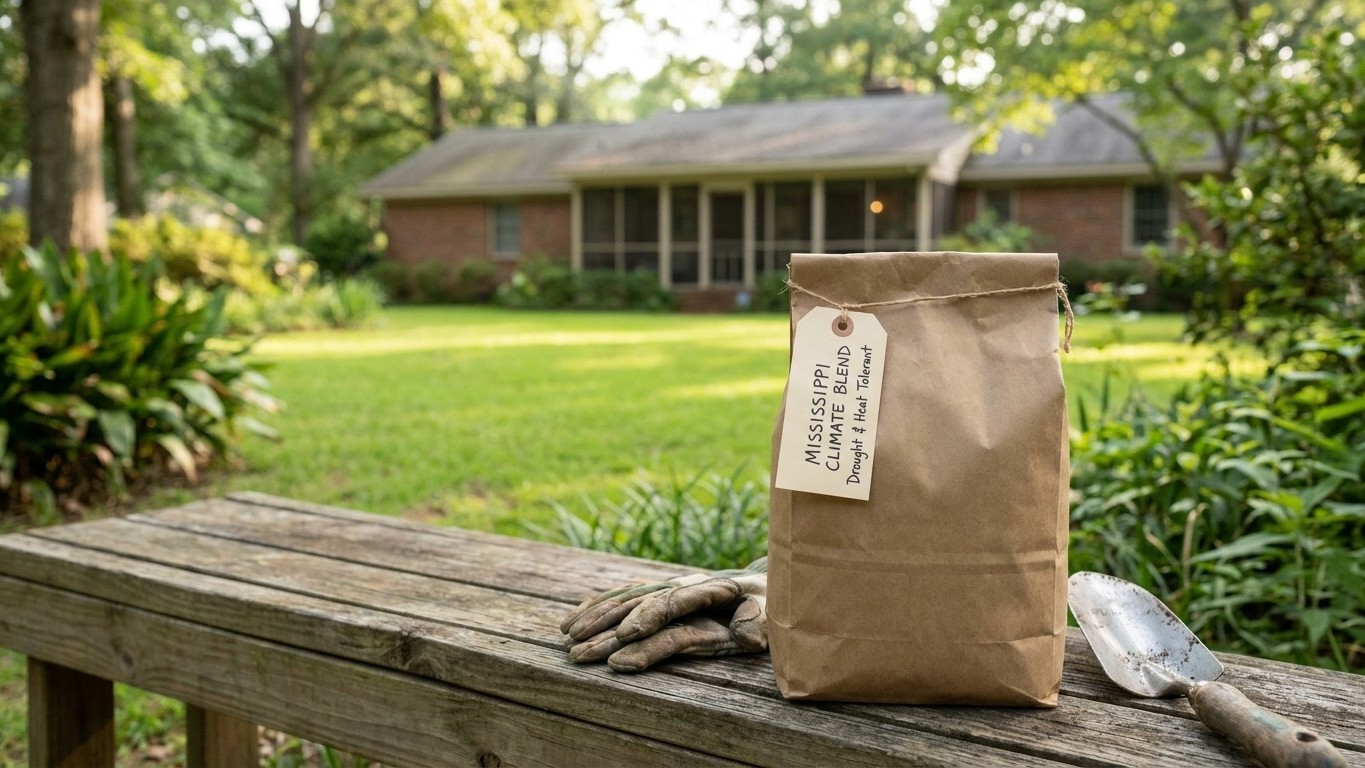

The best grass seed for a Mississippi lawn is a warm-season species: Bermudagrass, Centipedegrass, Zoysiagrass or Bahiagrass, the species Clemson Cooperative Extension lists for this climate in HGIC 1214. Cool-season seed such as tall fescue or ryegrass will not hold through a Mississippi summer as a permanent lawn. Start by matching the species to your sun, soil and how much mowing and feeding you’re actually willing to do, then seed it in the window that species needs.
The short answer for Mississippi
Bermudagrass, centipedegrass, zoysiagrass and bahiagrass are the four seeds that actually work here, and none of them is simply “best” — each wins by giving something up. Bermudagrass roots fastest and shrugs off foot traffic but wants full sun and constant mowing. Centipedegrass relaxes once established but takes its time getting there. Zoysiagrass looks the finest and tolerates shade but grows in slowest, sometimes a full season behind the rest. Bahiagrass survives poor soil at the cost of looking coarse.
Which of the four seedable species counts as “best” depends on what you’re willing to trade. Bermudagrass roots the fastest, recovers from wear the quickest and tolerates the most foot traffic, but it also demands full sun and the most frequent mowing and feeding of the group. Centipedegrass asks for almost none of that upkeep once it’s filled in, but it takes noticeably longer to establish from seed and won’t take heavy traffic. Zoysiagrass gives the finest, densest texture and handles a bit more shade than Bermudagrass, but it’s the slowest of the four to grow in from seed, sometimes by a full season. Bahiagrass is the toughest on poor soil and drought but has the coarsest look, closer to a pasture grass than a manicured lawn.
None of the cool-season species hold up as a permanent Mississippi lawn. Tall fescue and perennial ryegrass need a real winter dormancy and struggle through a warm-season summer, which is why Clemson’s recommended list for this region and Penn State Extension’s cool-season list don’t overlap at all. If more than one of the four warm-season options above would work on your site, the deciding factor is usually how much mowing and feeding you’re actually willing to keep up with, not which one looks better on paper. That step comes before anything else covered in Mississippi Lawn Care.
Working through the year

Warm-season grasses germinate and root only while the soil is warm, so all four of these species go into the ground in late spring through mid-summer, never in fall. Push a seeding date too late and the seedlings hit the ground without enough time to root deeply before winter, since NOAA’s 1991-2020 climate normals put Jackson’s first fall freeze between November 7 and November 22. Gardeners north or south of Jackson should expect that window to shift and check their own county before locking in a seeding date.
| Species | Establishment from seed | Nitrogen needs | Shade tolerance |
|---|---|---|---|
| Bermudagrass | Fast | High | Low, needs full sun |
| Centipedegrass | Slow | Low | Moderate |
| Zoysiagrass | Very slow | Moderate | Moderate |
| Bahiagrass | Fast | Low | Low, needs full sun |
Bermudagrass

Bermudagrass is the fastest of the four to establish from seed and the most aggressive once it’s in. Clemson Cooperative Extension’s HGIC 1216 Bermudagrass Maintenance Calendar lays out the full-season program: mowing height through the growing months, the spring and summer nitrogen schedule, and when to stop feeding before dormancy sets in. It wants full sun and tolerates foot traffic better than any other species here, which is why it ends up on athletic fields and fairways, but it also needs the most mowing and the most fertilizer of the group to hold its color and density.
Centipedegrass

Centipedegrass is the opposite trade. It’s slow to fill in from seed, but once established it needs less nitrogen and less mowing than Bermudagrass, which is why homeowners who want a lawn they don’t have to fuss over lean toward it. Clemson’s HGIC 1215 Centipedegrass Maintenance Calendar is built around a light feeding program, and over-fertilizing centipede is one of the fastest ways to weaken it. It also tolerates the acidic, sandy soils common through south Mississippi better than Bermudagrass does.
Zoysiagrass

Zoysiagrass seed is the slowest of the four to close a bare yard, often a full season or two behind Bermudagrass, which is why most Zoysia lawns get established from sod or plugs instead of seed. If you do seed it, Clemson’s HGIC 1217 Zoysiagrass Maintenance Calendar covers the mowing and feeding schedule once it’s up. It holds a fine, dense texture and tolerates a bit more shade than Bermudagrass, which makes it the better pick under high, thin tree canopy.
Bahiagrass

Bahiagrass is the toughest, lowest-input option on the list, tolerant of poor, sandy soil and drought, but it has a coarse, open texture that never looks as tailored as Bermudagrass or Zoysiagrass, and it throws up seed heads on tall stalks through summer that need extra mowing just to keep the lawn looking finished. There’s no Clemson maintenance calendar specific to Bahiagrass among the extension’s turf publications, so treat it as a working lawn grass for pasture edges and large low-input areas rather than a showpiece yard.
What changes across Mississippi
The frost figures above come from the NOAA weather station at Jackson, and Mississippi runs nearly 350 miles from the Tennessee line to the Gulf, so no single date or zone label holds for the whole state. The Gulf Coast counties around Biloxi, Gulfport and Pascagoula stay warmer later into fall than Jackson does, which is one reason Seashore Paspalum, a species tolerant of salt spray and brackish irrigation water, shows up on lawns and golf courses near the coast and almost nowhere else in the state.
North Mississippi, from the hill country around Tupelo up to the Tennessee border, sees its first freeze arrive earlier than Jackson’s November 7 to November 22 window, and its growing season for warm-season turf runs correspondingly shorter. That matters most for centipedegrass, which is the least cold-tolerant species on this list and is more prone to winterkill the closer a lawn sits to the state’s northern edge. Bermudagrass and Zoysiagrass, both more cold-hardy, hold up better in that part of the state.
The Mississippi Delta, the flat alluvial plain along the river in the northwest part of the state, brings heavy clay and silt soils that drain slowly, a different problem than the sandy soils common through the south. Centipedegrass and Bahiagrass both tolerate the acidic, sandy soils of south Mississippi better than they handle heavy clay, while Bermudagrass and Zoysiagrass are more forgiving of Delta soil once established, provided the lawn isn’t sitting in standing water after a heavy rain. Whatever region you’re in, treat the Jackson figures as a starting estimate and adjust from there rather than a guarantee for your own yard.
The mistakes this climate punishes
Late-season nitrogen is the most common way Mississippi homeowners hurt a warm-season lawn without realizing it. Feeding Bermudagrass, Centipedegrass or Zoysiagrass in September or October pushes soft new growth right when the plant should be hardening off for winter, and that tender growth is exactly what gets killed when the first freeze arrives, sometime between November 7 and November 22 at Jackson per NOAA’s 1991-2020 normals. The damage doesn’t show until the following spring, when those fed-too-late patches are slow to green up or don’t come back at all.
Seeding a cool-season grass like tall fescue or ryegrass as a permanent lawn is a mistake specific to this zone. Those species germinate readily in Mississippi’s mild spring, then die back hard once summer heat sets in, usually by mid-to-late summer. They belong here only as a temporary winter overseed on top of a dormant warm-season lawn, not as the lawn itself.
Cutting a warm-season lawn too short during peak summer heat is the other mistake that shows up fast. A scalped lawn loses the leaf area it needs to shade its own root zone, and in a Mississippi July that stress compounds with drought within a couple of weeks, showing up as thin, off-color turf that struggles to recover until growth slows in fall. St. Augustinegrass and Zoysiagrass are particularly quick to show this stress.
Overfeeding centipedegrass is its own specific trap, because gardeners used to Bermudagrass’s appetite apply the same nitrogen rate to centipede and get the opposite of what they want: a thin, yellowing lawn known locally as centipede decline, which tends to show up the spring after the overfeeding, not right away. Once you’ve settled on a species and worked through its first season, the ongoing schedule fits into The Mississippi Lawn Care Calendar, Month by Month rather than starting over each year.
Checking this against your county
Every figure above is anchored to Jackson’s weather station, and Mississippi’s coastal, Delta and hill regions all run on a different clock. Mississippi State University Extension publishes county-level guidance and can confirm your local frost dates and soil recommendations before you buy seed. Call or check the office nearest you rather than assuming the Jackson figures apply exactly where you live.
Common questions
Can I mix Bermuda and centipede seed in the same lawn?
Not with good results. The two have very different mowing heights and nitrogen needs, so one tends to crowd out or outcompete the other within a season or two. Pick one species per zone of the yard and treat shaded or high-traffic areas as separate decisions if you need more than one.
Should I buy hulled or unhulled Bermudagrass seed?
Hulled seed has had the hard outer coat removed and germinates faster, usually within a week or two under warm, moist conditions, while unhulled seed is cheaper but slower and less predictable. Hulled seed is the better choice for a new lawn where you want quick, even cover.
None of these grasses seem to want shade. What do I do with a shady yard?
All seven warm-season species Clemson lists for this climate are sun-lovers to some degree, and none of them thrive in deep, all-day shade. Centipedegrass, St. Augustinegrass and Zoysiagrass tolerate moderate, filtered shade better than Bermudagrass or Bahiagrass, but a heavily shaded yard usually needs thinner tree canopy or a shade-tolerant groundcover instead of a dense turf lawn.
Is it too late to seed if it’s already fall?
Yes, for any of these warm-season species. They need warm soil to germinate and root, and a fall seeding won’t have time to establish before winter dormancy or the first freeze. Wait for the next warm season and use the intervening months to prepare the soil instead.