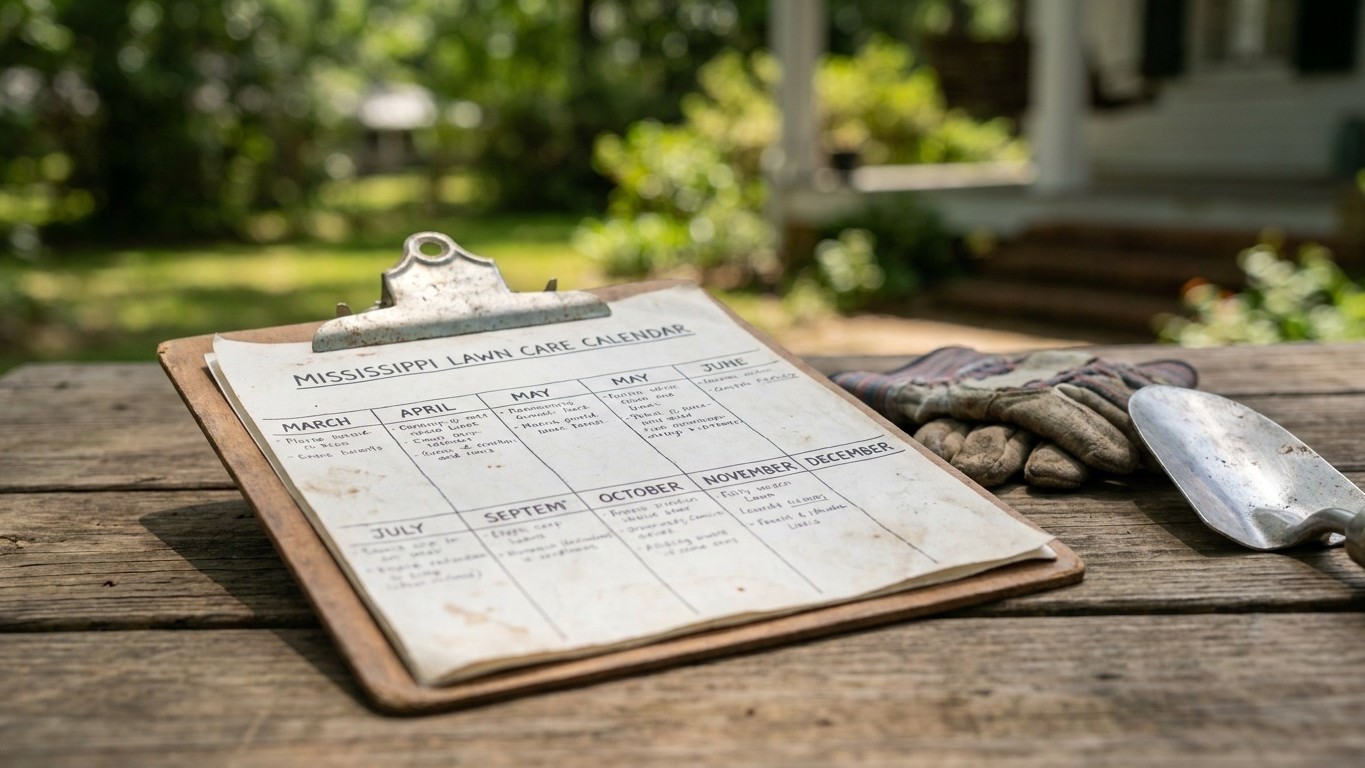

What should you actually be doing to your lawn right now, this month? It depends on which grass is growing under your feet, because Bermudagrass, Zoysiagrass, Centipedegrass and St. Augustinegrass each move on their own timetable, not one shared Mississippi schedule. Start by walking out and identifying the grass you actually have, before you touch a mower or a bag of fertilizer. Get that one thing right first, because every mowing height, feeding date, and watering rule below is going to branch off from it, and using the wrong grass’s calendar is how a lawn gets weaker instead of thicker.
The short answer for Mississippi
If you want the one-line version: Mississippi has no cool-season lawn window. The species Clemson’s HGIC 1214 lists as suited to this climate, Bahiagrass, Bermudagrass, Carpetgrass, Centipedegrass, Seashore Paspalum, St. Augustinegrass and Zoysiagrass, are all warm-season grasses that green up in spring, grow hardest in the heat of summer, and go dormant and brown after the first hard frost. Tall fescue, Kentucky bluegrass and other cool-season species will germinate here in a wet fall, but they cannot survive a Mississippi summer and are not a lawn choice for this state.
That answer depends on which of the seven species you actually have in the ground, because the calendars diverge from each other by weeks at every stage: green-up, first mow, first feed, and the date you stop feeding before frost. It also depends on where in the state you garden. The figures in this piece are measured at or near Jackson, and a lawn on the Gulf Coast or in the hill country of north Mississippi will run on a shifted version of the same calendar, not an identical one.
Finally, the answer depends on soil and moisture more than the calendar admits. A warm-season lawn on sandy soil dries out and wants water sooner in spring than the same species on Delta clay. Use the calendar below as the order of operations, and use your own lawn’s color and growth to fine-tune the exact week.
Working through the year

Each of the four major species grown in Mississippi has its own Clemson Cooperative Extension maintenance calendar, and the mowing height, nitrogen rate and irrigation figure for your lawn come from whichever one matches your grass, not from a generic Mississippi schedule. Below is the order those calendars follow, season by season.
Late winter into spring
This is pre-emergent season for crabgrass and other warm-season weeds, timed to soil warming rather than a calendar date. It happens before green-up, while the lawn is still brown and dormant, because a pre-emergent applied after the grass has already broken dormancy is too late to matter and can injure new growth. Once green-up is underway and the lawn is mowing regularly, the first nitrogen feeding of the year follows. Clemson’s Bermudagrass Maintenance Calendar (HGIC 1216) and Zoysiagrass Maintenance Calendar (HGIC 1217) both time this first feeding to full green-up rather than a fixed date, and the exact pounds of nitrogen per 1,000 square feet is spelled out on each species page rather than being one figure for every lawn.
Summer
Summer is when a warm-season lawn does its heaviest growing, and it is also when mowing height and irrigation matter most. Centipedegrass, covered in Clemson’s Centipedegrass Maintenance Calendar (HGIC 1215), is a low-input grass that wants far less nitrogen through the season than Bermudagrass does, and pushing it with the same feeding schedule you’d use on Bermuda is one of the fastest ways to weaken a centipede lawn. St. Augustinegrass, in Clemson’s HGIC 1218 calendar, tolerates more shade than the others but wants deeper, less frequent watering rather than a daily sprinkle. Aeration, where the lawn needs it, is done in this active growing window so the grass can heal the plugs quickly, never in spring before green-up or in fall as the lawn is shutting down.
Fall
Fall feeding stops well ahead of dormancy. Around Jackson, with NOAA’s 1991-2020 normals putting the first freeze between November 7 and November 22, the last nitrogen application of the year needs to be finished long before that window opens, because nitrogen pushes soft new growth that a frost then kills outright. The final mow of the season, at the grass’s normal cutting height, comes as growth visibly slows.
Winter
Once frost hits, the lawn browns and goes dormant. This is not damage. Bermudagrass, Zoysiagrass, Centipedegrass and St. Augustinegrass all lose their green color after a hard freeze and hold that straw color until spring green-up, and mowing or feeding a dormant lawn accomplishes nothing until growth resumes.
| Species | Clemson calendar | Growth habit | Cold behavior |
|---|---|---|---|
| Bermudagrass | HGIC 1216 | Fast-spreading, aggressive | Among the first to go dormant after frost |
| Zoysiagrass | HGIC 1217 | Dense, slow-growing | Holds green color later into fall than Bermuda |
| Centipedegrass | HGIC 1215 | Slow-spreading, low-input | Moderate; thins on soils it dislikes before frost even arrives |
| St. Augustinegrass | HGIC 1218 | Coarse-textured, shade-tolerant | Least cold-hardy of the four, browns earliest |
Before choosing a species at all, it’s worth reading through The Best Grass Seed for Mississippi Lawns, since the calendar you follow for the rest of the year is set by that decision. Bahiagrass, Carpetgrass and Seashore Paspalum are also listed among Mississippi’s recommended species by Clemson’s HGIC 1214, though none of the four HGIC maintenance calendars above cover them directly, so a lawn in one of those grasses needs to lean on general warm-season timing and a call to your county extension office for specifics.
What changes across Mississippi
The Nov 7-22 frost window above is measured at Jackson, roughly the middle of the state, and it does not hold everywhere. The Gulf Coast, moderated by the water, typically holds its first freeze later than Jackson does, which stretches the growing season and can push the last feeding date later into the year as well. The hill country of north Mississippi, further from that moderating influence and at somewhat higher elevation, tends to see frost arrive earlier than the Jackson window, which means the growing season closes sooner and any fall feeding needs to stop earlier than it would around Jackson.
Soil is the other variable that changes the calendar without changing the frost date. The heavy clay of the Delta holds water longer than the sandy soils of south-central Mississippi, so irrigation needs during a dry summer stretch differ block to block even at the same latitude. A lawn on sand will show drought stress, thinning and a dull gray-green cast, well before an identical species on clay in the same week.
None of this means the state splits into different grass choices. Mississippi sits solidly in the warm-season zone Clemson’s HGIC 1214 describes, and the same seven species apply from the coast to the hills. What shifts is timing, not the plant list: when green-up starts, when the last safe feeding falls before frost, and how long the mowing season runs. A gardener in DeSoto County at the state’s northern edge should expect to compress the growing season relative to Jackson, and a gardener near Gulfport should expect to stretch it.
The mistakes this climate punishes
Feeding warm-season grass too late in the year
Nitrogen applied close to the first fall frost pushes tender new growth that has no time to harden off before the cold arrives. Around Jackson, where NOAA’s 1991-2020 normals put that first freeze between November 7 and November 22, a feeding in late October or early November is exactly the kind of late-season push that shows up the following spring as dead patches where the lawn should be greening back up. The fix is to stop feeding well ahead of that window and let the grass slow down on its own.
Seeding a cool-season grass here at all
Tall fescue and Kentucky bluegrass seed sold at any garden center will germinate in a cool, wet Mississippi fall and look like a lawn through winter. It cannot survive the following summer. Clemson’s HGIC 1214 places Mississippi in warm-season turf country for a reason, and a cool-season stand here dies out by mid-summer, leaving bare, weedy ground exactly when a lawn is under the most stress.
Mowing too short in summer heat
Scalping a warm-season lawn during the hottest weeks removes the leaf area the grass needs to shade its own root zone and retain moisture. The damage doesn’t always show the day you mow. It shows up a week or two later as scorched, thin patches, particularly on St. Augustinegrass, which is the least tolerant of the four major species of being cut short.
Aerating or dethatching at the wrong end of the season
These jobs work by giving the lawn room and time to heal, which only happens while it’s actively growing. Doing either job:
- In early spring, before green-up, when the grass has no growth to recover with
- In fall, as the lawn is slowing down ahead of frost
- On a lawn already stressed by drought or disease
leaves bare, torn ground that weeds move into before the grass can close back over it.
Checking this against your county
Every figure above is measured at or near Jackson, and Mississippi is a large enough state that a county on the coast or in the hills will run on a shifted version of this same calendar. For a reading specific to your own county, including current-year timing that adjusts for that year’s weather, contact your local office through Mississippi State University Extension before you commit to a fertilizing or seeding date. For the broader picture of how these species behave once established, Mississippi Lawn Care covers the ground this calendar builds on.
Common questions
Can I grow a cool-season lawn in north Mississippi where it’s cooler?
No. Even the coolest parts of Mississippi stay in warm-season turf territory by Clemson’s HGIC 1214 classification, and a fescue or bluegrass lawn will still burn out in summer heat regardless of which county you’re in.
Why is my lawn brown right now, did it die?
Almost certainly not. Warm-season grasses like Bermudagrass, Zoysiagrass, Centipedegrass and St. Augustinegrass all brown off after the first frost and stay that color through winter dormancy, then green back up on their own once soil warms in spring.
Do I need to overseed with ryegrass for winter color?
That’s a cosmetic choice, not a lawn health requirement. Overseeding a dormant warm-season lawn with annual ryegrass keeps it green through winter, but it adds a mowing and feeding routine on top of your main species’ calendar and needs to be timed to stop well before spring green-up so the ryegrass doesn’t compete with the grass underneath.
My neighbor’s Bermuda lawn is already green and mine isn’t, what’s wrong?
Probably nothing wrong, just a difference in sun exposure, soil, or even which Bermuda cultivar is planted. Green-up timing varies lawn to lawn even on the same street, and feeding a still-dormant lawn to try to force it green early usually wastes the fertilizer rather than speeding anything up.