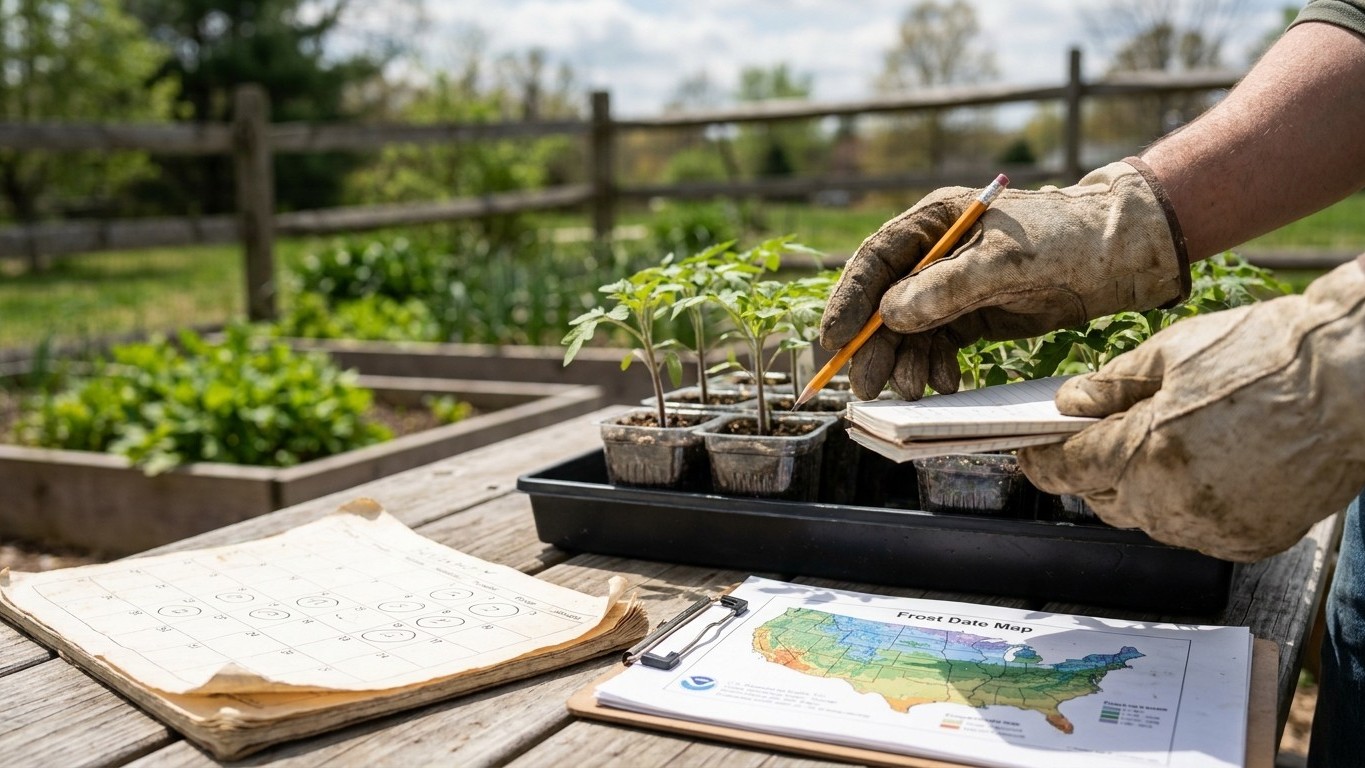

April 3 through April 16 marks the stretch when Baltimore-area frost usually finishes for the season, and that two-week spread is the whole reason a single planting date doesn’t exist here. Push your tomatoes into the ground on the early end and you’re gambling on a warm run; hold off until the window shuts completely and you sacrifice a few weeks of fruit for a much safer bet.
What this comes down to in Maryland

Near Baltimore, NOAA’s 1991-2020 climate normals place the last spring frost between April 3 and April 16. That thirteen-day spread already tells you something useful: it is a probability band, not a single morning, and the years fall on either side of it as often as they land inside it. Growers who transplant tomatoes right at the early edge of that window are betting the season runs warm. Growers who wait until the window has fully closed are trading a slightly shorter harvest for a lot less risk of losing a flat of seedlings to one cold night.
For a rundown of cultivars suited to the length of a Maryland season, see Tomato Varieties That Ripen in Time in Maryland, and for what to watch for once the plants are in the ground, see Tomato Pests in Maryland: Which Ones Actually Show Up Here. What belongs here is the arithmetic that turns a frost date into a transplant date, and then into a harvest date, because that arithmetic is what actually decides whether a given plant finishes before the season ends.
The core idea is simple even though the numbers involved are ranges rather than fixed points. You start from the last spring frost window, add a buffer for soil that is still cold even after the air has warmed, and that gives you a transplant window. You then add the cultivar’s days to maturity, counted from the day it goes into the ground, and check the result against the first fall frost window at the other end of the season. If the resulting date falls comfortably before that window opens, the variety works for your garden. If it lands close to it or past it, you are gambling on a warm autumn.
Working it out for your own garden
Start with NOAA’s 1991-2020 normals for Baltimore: last spring frost April 3 to April 16, first fall frost October 26 to November 5. Subtract nothing from the spring end yet, because that is the frost date itself, not the transplant date. Gardeners typically wait one to two weeks past the top of that window, which puts transplanting somewhere around mid-April to late April for most of the state. That’s already a range built from a range, and it should stay one. Don’t collapse it into a single Saturday just because a calendar is easier to read than a window.
A cultivar that finishes with room to spare
Take Sun Gold, a small-fruited, indeterminate cherry variety listed at 57 days from transplant. Set it out in the mid-April to late-April window and it typically ripens its first fruit in late June. Count forward from a late-April transplant to a first-frost window of October 26 to November 5, and there are roughly 122 days of margin before the season closes. That’s a wide cushion. Even a slow, cool start to the summer is unlikely to push it into frost risk.
A cultivar that eats most of that margin
Now take Amish Paste, an indeterminate paste tomato at 85 days from transplant. The same mid-April to late-April transplant window gives a first ripe fruit around late July, with about 94 days of margin left before the first fall frost. That is still enough in an ordinary year, but it is a third less buffer than Sun Gold carries. Push the transplant date later because of a cold, wet spring, and that 94-day cushion is the one that starts to matter. This is the calculation to redo for any longer-season cultivar you’re considering: transplant window, plus days to maturity, checked against the fall frost window, not assumed.
What changes across the state
The April 3 to April 16 window belongs to Baltimore, and Maryland is not one climate. USDA’s Plant Hardiness Zone Map, using the same 1991-2020 data, spans zone 5b through zone 8a across the state, which is a wide enough spread to matter to a tomato grower deciding when to buy seedlings.
Western Maryland, in Garrett and Allegany counties, sits at real elevation and runs weeks later than the Baltimore figures in both directions: the last spring frost arrives later, the first fall frost arrives earlier, and the growing season between them is noticeably shorter. A cultivar that comfortably clears the frost windows near Baltimore can run tight in the mountains, especially a longer-season paste or beefsteak type.
The Eastern Shore runs the opposite direction. Proximity to the Chesapeake Bay and the Atlantic moderates temperature swings, so the last spring frost tends to arrive earlier than the Baltimore figure and the first fall frost tends to hold off longer. Growers there often have a few extra weeks of margin on both ends of the season compared with the Baltimore reference point.
None of this changes the method, only the numbers you plug into it. If you garden outside the Baltimore area, treat the April 3 to April 16 window as a starting reference, not your actual local frost date, and adjust the transplant timing earlier or later based on where your county sits relative to that reference point.
The mistakes this state punishes

The most common one is transplanting on the strength of a single warm week rather than the frost window itself. Maryland springs regularly throw a run of 70-degree days in late March or early April, right inside NOAA’s last spring frost window, and a cold night can still follow it. Tomato seedlings have no tolerance for that, and a single freeze can wipe out a whole flat overnight. Wait out the full window rather than reacting to a warm forecast.
The second is choosing a long-season cultivar without running the arithmetic against the fall end of the calendar. An 85-day paste tomato like Amish Paste still works from a mid-to-late-April transplant near Baltimore, but stack a late, cold spring on top of a variety at the long end of the maturity range and the margin gets thin fast. Check the days-to-maturity figure against the fall frost window before you commit garden space to a slow variety, not after.
A third mistake is planting into cold, waterlogged soil right after the calendar says the frost risk has passed. Air temperature and soil temperature don’t move together, especially after a wet Maryland spring, and a tomato root sitting in cold, soggy ground stalls out even if the air overhead feels warm enough. That stall eats into the same margin the days-to-maturity arithmetic just gave you, for no gain at all. Wait for the soil to catch up rather than trusting the air temperature alone.
Checking this against your county
Before you lock in a transplant date, check your county’s own extension office through UMD Extension, which maintains local guidance closer to your actual growing conditions. If you’re still deciding what to plant once your dates are set, the variety and pest pages on this site cover the rest of growing tomatoes in Maryland in more depth than a planting-date page has room for.
Common questions
Can I just transplant tomatoes as soon as the frost date passes?
You can, but most Maryland gardeners wait a week or two past the top of NOAA’s last-frost window before setting out transplants, because the window itself is a probability range and cold soil lingers after the air warms. Transplanting right at the earliest edge of the range is the riskiest version of this decision.
What if I want tomatoes earlier than the mid-to-late April window?
Some growers push transplants earlier using row cover or wall-o-water style protection against a late frost, which is a separate decision from the calendar date itself. That equipment doesn’t change the frost window, it just buys the plant some protection if a cold night does arrive before the window closes.
Does the frost date matter for direct-seeded tomatoes?
Almost nobody direct-seeds tomatoes in Maryland, because the state’s frost-free season is too short for seed-to-harvest timing to work reliably for most cultivars. Nearly all the days-to-maturity figures on seed packets assume a transplant grown indoors or bought as a seedling.
How much does the transplant date actually change my harvest date?
By roughly the same number of days you shift the transplant, since days-to-maturity is counted from the transplant date, not the calendar. Move your transplant two weeks later than the earliest point in the window and your first ripe fruit shifts about two weeks later too, all else being equal.
Some gardeners also time this by the Moon: when to plant tomatoes by the moon, as almanac tradition rather than fact.