
Maryland’s tomato pests follow the same calendar as the frost. NOAA’s 1991-2020 climate normals put Baltimore’s last spring freeze at April 3 to April 16, and within a few weeks of that window flea beetles are already chewing new transplants, with aphids, hornworms, spider mites, stink bugs and fruitworms arriving in turn as the season warms. Scout your plants at least twice a week from transplant through August, since most of these insects do their worst damage in the stretch of time before anyone actually notices them.
What this comes down to in Maryland

Flea beetles are usually the first sign that something’s wrong, not the hornworm everyone braces for. They show up while transplants are still tender, before the calendar says pest season has even started, riddling leaves with pinholes that can stunt a young plant in weeks. Maryland’s mix of humidity and early warmth pulls in a specific lineup — flea beetles, then aphids, then Colorado potato beetles drifting over from nearby nightshades — each on its own schedule, not the one gardeners expect.
Flea Beetles
These show up first, often before transplants have fully hardened off. Adults are tiny, shiny black beetles about a sixteenth of an inch long that jump like fleas when disturbed, chewing small round holes through leaves in a pattern gardeners call shot-holing. Seedlings can be stunted or killed outright if flea beetles hit hard in the first two to three weeks after transplant, so this is the pest worth checking for immediately.
Aphids
Aphids build up through late spring and early summer, clustering on the undersides of leaves and along new growth. They’re small, soft-bodied, pear-shaped insects, usually pale green but sometimes black, and they move in groups rather than alone. They damage plants by sucking sap and excreting sticky honeydew that grows sooty mold, and a heavy colony can curl and yellow leaves within a couple of weeks.
Colorado Potato Beetle
This one moves onto tomatoes from nearby potatoes or nightshade weeds in late spring. Adults are rounded, yellow-orange beetles about three-eighths of an inch long with ten black stripes running down the wing covers, and the larvae that follow are humpbacked, reddish-orange grubs marked with two rows of black spots. The larvae do the real feeding damage, stripping leaves down to bare veins.
Tomato Hornworm
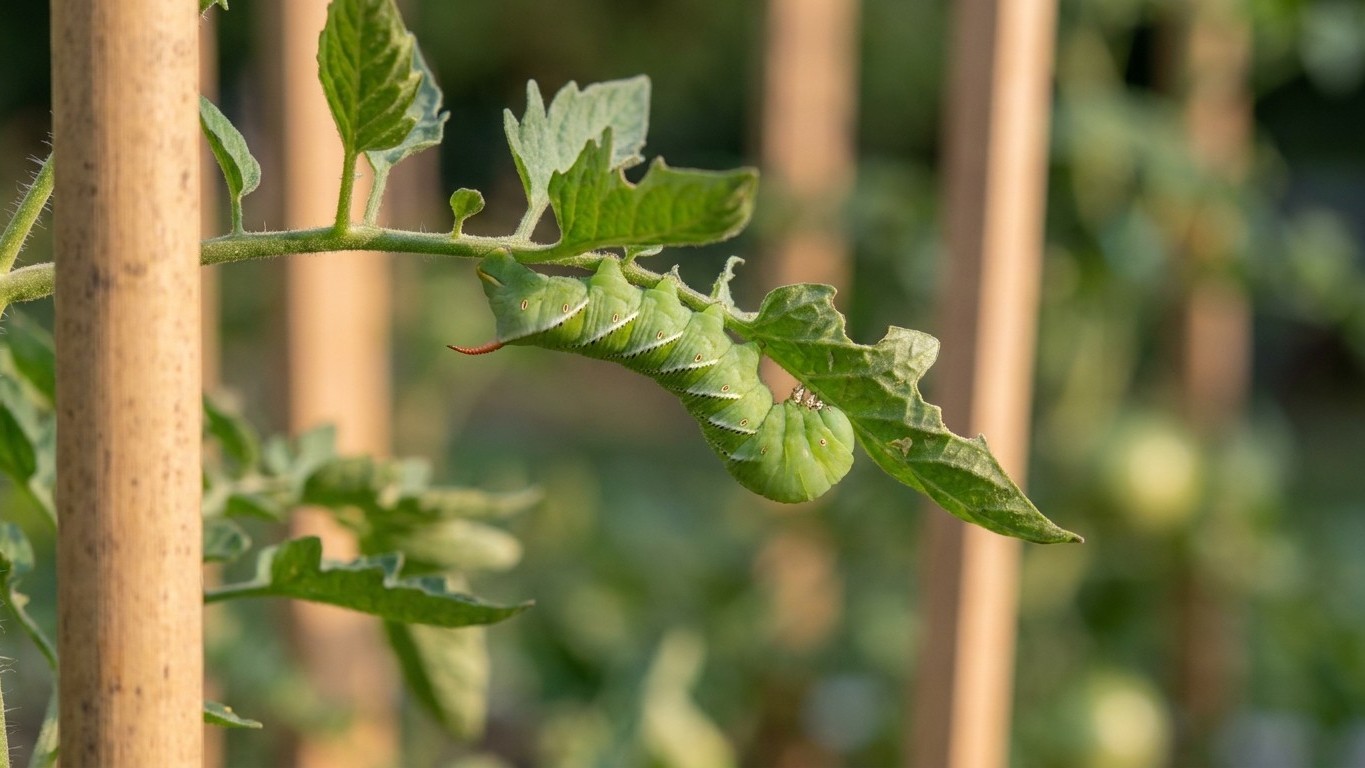
By mid-summer, the hornworm is the pest most home gardeners actually find, usually by the damage before they spot the caterpillar itself. It’s a large green caterpillar, up to four inches long by the time it’s finished feeding, marked with pale diagonal stripes and a curved horn, black or reddish, at the tail end. The caterpillar stage does all the damage, stripping whole branches of foliage overnight and sometimes chewing into green fruit.
Spider Mites
Hot, dry stretches in July and August favor spider mites, which are barely visible without a hand lens and appear as tiny reddish or pale specks on the undersides of leaves. Feeding shows up first as fine yellow stippling on the upper leaf surface, and heavy infestations spin visible webbing across leaves and stems. They spread fastest during drought stress, so consistent watering does more to prevent them than any spray.
Brown Marmorated Stink Bug
This one arrives as fruit starts ripening and stays through fall. Adults are shield-shaped, mottled brown, about three-quarters of an inch long, with alternating light and dark bands along the antennae and the edge of the abdomen. Both nymphs and adults feed by piercing fruit, leaving pale or cloudy blotches under the skin that only show up once you slice the tomato open.
Tomato Fruitworm
Also called the corn earworm, this caterpillar shows up from midsummer into fall, varying in color from green to brown to pink with pale stripes running the length of its body. It bores directly into fruit near the stem end, leaving a clean entry hole and a hollowed-out feeding tunnel inside, which usually means the fruit is a loss by the time you spot it.
Working it out for your own garden
Match the damage first
Matching damage to the right pest saves a wasted spray. Start with where on the plant the damage shows and what it looks like, since several of these insects leave similar symptoms at a glance.
- Small round holes scattered across young leaves: flea beetles, most likely within two to three weeks of transplant.
- Curled, yellowing leaves with sticky residue: aphids, check the undersides and new growth first.
- Leaves stripped to the veins, black-spotted orange grubs present: Colorado potato beetle larvae.
- Whole branches defoliated overnight, dark droppings on leaves below: tomato hornworm.
- Fine yellow speckling with webbing during a dry spell: spider mites.
- Cloudy blotches inside ripe fruit, shield-shaped bugs nearby: brown marmorated stink bug.
- A clean entry hole near the stem end of the fruit: tomato fruitworm.
The fruitworm and the stink bug both damage fruit, but the fruitworm leaves an obvious hole you can find by eye, while stink bug feeding often shows nothing on the outside until you cut the tomato open, so a clean-looking tomato is not proof it’s undamaged.
Then match the timing
Timing tells you almost as much as the damage does. Since Tomato Planting Dates in Maryland: Counting Back From Your Frost Window works from the same NOAA frost window, count forward from whenever you actually set out transplants. Flea beetle pressure peaks in the first two to three weeks after transplant, aphids and Colorado potato beetle build through late spring into early summer, and hornworms, spider mites, stink bugs and fruitworms all become the bigger risks once fruit starts setting in midsummer.
Scouting twice a week covers most of these, but hornworms need closer attention once fruit sets, since one caterpillar can strip several branches in a single night and is easy to miss against the foliage until the damage is done. Aphid and mite damage tends to start low on the plant and work upward, so check the lower leaves first before assuming a plant is clean.
What changes across the state
The seven-pest lineup above holds statewide, but when each one shows up shifts with geography. Baltimore’s frost window is the reference point this whole page uses, and USDA’s hardiness map puts Maryland across zones 5b to 8a, a wide enough spread that a single pest-emergence date for the whole state does not really exist.
Garrett and Allegany counties, up in the mountains of the west, sit at the cold end of that range. Frost lingers weeks later there than at Baltimore, soil stays cooler into spring, and every pest on this list shows up correspondingly later, sometimes skipping a generation that a longer, warmer season elsewhere in the state gets in.
The Eastern Shore and the areas closest to the Chesapeake Bay run milder and more humid than Baltimore. Warmer soil earlier in spring lets flea beetles and aphids get moving sooner, and stink bugs in particular are drawn to structures, often showing up in the heaviest numbers around buildings and wood lines near the water. The humidity there tends to favor the fungal diseases that get confused with pest damage more than it favors spider mites.
Southern Maryland and the counties around Baltimore sit closer to the middle of the state’s range, and the pest calendar described above tracks fairly well for that band. Anywhere outside it, treat the timing here as a starting point, not an instruction, and adjust by however many weeks your local frost window runs ahead of or behind Baltimore’s.
The mistakes this state punishes

Wrong pest, wrong spray
The most common mistake is treating for the wrong pest because the damage looks similar to something else. Flea beetle shot-holes get mistaken for early blight lesions, and stink bug blotches inside a fruit get blamed on blossom end rot, so gardeners spray for a pest that was never there while the actual problem keeps feeding.
Timing missteps
The second mistake is skipping scouting once fruit sets, which is exactly when hornworms and fruitworms do the most damage. A hornworm can strip a branch bare between one evening check and the next morning, and the two weeks after first fruit set are the highest-risk window of the whole season, not the two weeks after transplant that most gardeners are watching closely instead.
The third is planting into cold, wet soil after an early warm spell, which stresses transplants right when flea beetles are most active. A stressed, slow-growing seedling takes far more damage from the same beetle pressure than a vigorous one does, so matching a transplant date to the actual frost window matters as much for pest resistance as it does for avoiding a late freeze.
The fourth is choosing a long-season cultivar without accounting for the extra weeks of exposure to fruitworm and stink bug pressure that come with a later harvest. A cultivar picked for flavor rather than timing, such as Amish Paste at 85 days from transplant, spends noticeably more of the season as a target for fruit-feeding pests than something in the 55 to 65 day range, which is one more reason to check Tomato Varieties That Ripen in Time in Maryland before committing to a long-season paste tomato.
Checking this against your county
Everything above is anchored to Baltimore’s frost window and describes a statewide pattern, not a guarantee for your specific yard. Soil type, nearby wooded edges, and even what your neighbors are growing all shift which of these seven pests hits hardest where you garden.
Your county office of the University of Maryland Extension tracks pest reports specific to your area and can confirm an identification if you’re not sure what you’re looking at. That local check is worth the phone call before you spray anything.
Common questions
Do I need to spray on a schedule or only when I see damage?
Only when you see damage or find the insect itself. Scheduled spraying on tomatoes usually kills off the parasitic wasps and lady beetles that would otherwise keep aphids and hornworms in check, so it tends to make pest problems worse over the season rather than better.
Are the pests different if I’m growing in containers on a patio?
Mostly the same insects show up, but flea beetles and spider mites tend to hit container plants harder because the soil warms and dries out faster than an in-ground bed. Check container plants a little more often during hot, dry stretches for that reason.
Can I tell hornworm damage from stink bug damage without seeing the insect?
Usually yes. Hornworms strip leaves and stems, leaving bare branches and dark droppings on the foliage below, while stink bugs feed on the fruit itself and leave the leaves alone. If the leaves look fine but the tomatoes have cloudy spots under the skin, look for stink bugs rather than a caterpillar.
Do resistant tomato varieties help with any of these insects?
Not directly. The disease-resistance codes on tomato seed packets, things like resistance to Fusarium Wilt or Tobacco Mosaic Virus, refer to pathogens rather than insects, so a resistant variety will not stop flea beetles or hornworms on its own. A vigorous, healthy plant does recover from insect feeding faster, which is part of why matching a cultivar’s days to maturity to the season still matters.