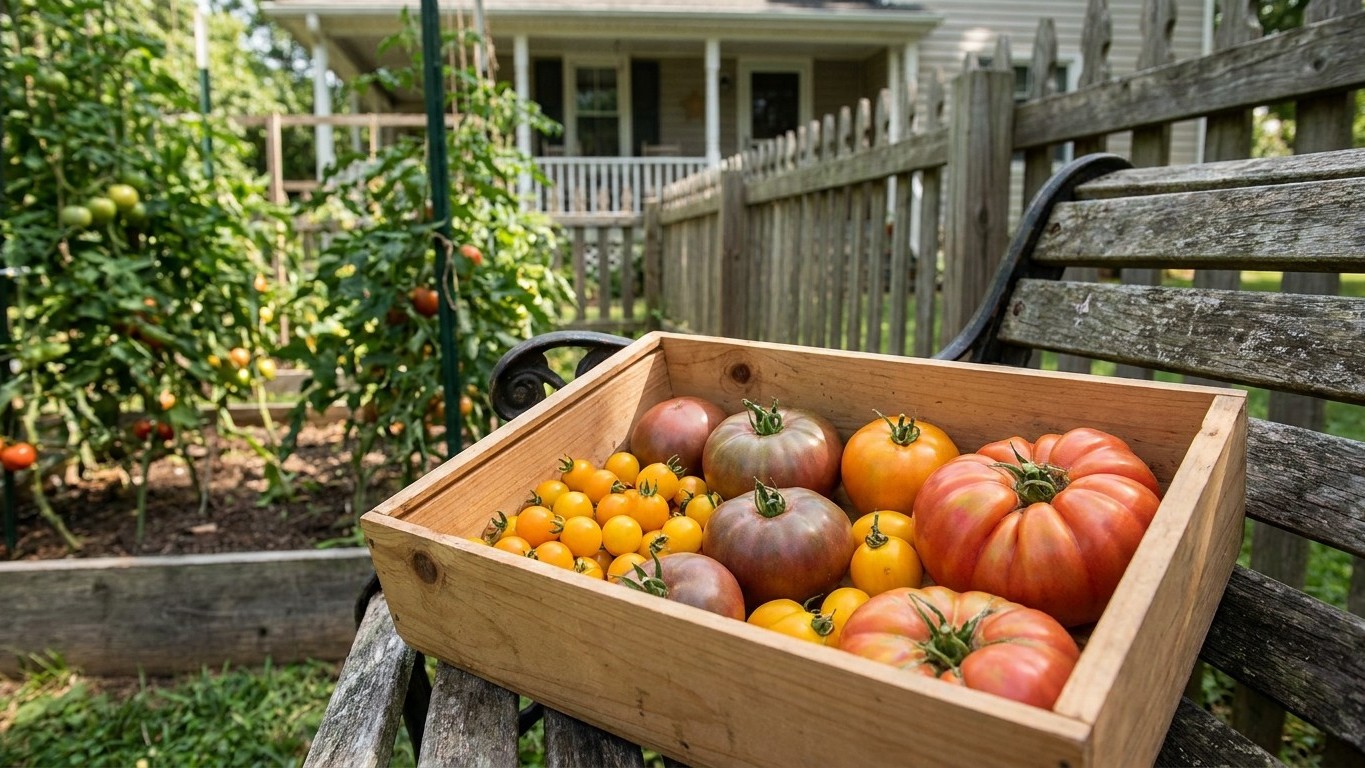

Yes — nearly every tomato you’d plant in Maryland has time to ripen before frost finds it. Even in the coldest pockets near Baltimore, where that first fall frost holds off until late October or early November, a mid-to-late April transplant leaves you three to four months of open runway. The plants aren’t what run out of time — slow paste tomatoes and heirlooms are. So before you order seed, hold the days-to-maturity number on the packet up against your own county’s frost dates, not after the seedlings are already in the ground.
What this comes down to in Maryland

Near Baltimore, NOAA’s 1991-2020 climate normals put the last spring frost between April 3 and April 16, and the first fall frost between October 26 and November 5. That gives a frost-free window of roughly six and a half months, long enough that every variety named here fits inside it when set out mid-April to late April, the standard transplant window once soil has warmed past frost risk. The season length rarely causes trouble here. What decides the outcome is matching a specific cultivar’s days-to-maturity against that window, and against your own microclimate. Once you’ve worked through growing tomatoes in Maryland as a project for the year, the variety list below sorts from fastest to slowest so you can see exactly where your own risk tolerance sits.
The list also mixes plant habits. Amalfi is determinate, meaning it sets fruit over a shorter, more concentrated window and suits a gardener canning in one or two big batches. The rest of the list is indeterminate and keeps producing until frost, better suited to eating fresh through the summer. Matching habit to how you’ll use the harvest matters, but it doesn’t decide whether a variety fits Maryland’s calendar in the first place. That’s what days-to-maturity and frost margin decide, and both are listed for every cultivar below.
Ten cultivars appear below, ordered by days from transplant to first fruit, from 55 days at the fast end to 85 days at the slow end.
Sakura

Sakura is a 55-day indeterminate cherry tomato, the fastest cultivar on this list, bred for snacking and salads. Set out mid-April to late April near Baltimore, it typically has its first ripe fruit by late June and finishes with about 124 days of margin before frost, more cushion than any other variety here. Its resistance to nematodes, tomato mosaic virus and two races of Fusarium wilt makes it a forgiving choice for a first-time grower.
Sun Gold

Sun Gold is a 57-day indeterminate cherry tomato prized for its sweet, golden-orange fruit. It reaches first ripe fruit by late June from a mid-to-late April transplant, leaving 122 days before the first fall frost near Baltimore. It resists Tobacco Mosaic Virus and one race of Fusarium wilt, and its speed makes it one of the safest bets for a short or interrupted growing season.
Supersweet 100

Supersweet 100 is a 60-day indeterminate cherry tomato that produces long clusters of small, glossy red fruit through the whole season. First ripe fruit arrives by late June, with 119 days of margin before frost. It carries resistance to Verticillium wilt and one race of Fusarium wilt, useful in beds that have grown tomatoes for several years running.
Juliet

Juliet is a 60-day indeterminate grape tomato, bred for a crack-resistant skin that holds up through a wet spell. It ripens by late June from the same mid-to-late April transplant, with 119 days of margin, and its intermediate resistance to both early and late blight helps it hold its foliage through Maryland’s humid summers.
Jasper

Jasper is a 60-day indeterminate cherry tomato bred specifically for high resistance to late blight, with intermediate resistance to early blight as well. It ripens by late June and carries 119 days of margin before frost near Baltimore, a solid choice for a grower who lost a planting to blight in a previous, wetter year.
Amalfi

Amalfi is a 68-day determinate paste tomato, bred for sauce and canning rather than fresh eating. It ripens by early July from a mid-to-late April transplant, with 111 days of margin before frost, and its intermediate resistance to both early and late blight plus nematodes suits it to a raised bed that has carried tomatoes before.
Cherokee Purple
Cherokee Purple is a 72-day indeterminate heirloom beefsteak, grown for flavor rather than disease resistance, since it carries none of the coded resistances bred into the hybrids on this list. It ripens by mid-July with 107 days of margin before frost near Baltimore, comfortable room for a heat wave or a cloudy August to slow it down.
Big Beef Plus
Big Beef Plus is a 72-day indeterminate slicing tomato bred for a large, uniform, all-purpose fruit. It ripens by mid-July with 107 days of margin, and its resistance to nematodes, gray leaf spot and tomato mosaic virus makes it a steadier choice than Cherokee Purple in a bed with a history of soil-borne disease.
San Marzano II
San Marzano II is a 78-day indeterminate paste tomato, the classic long red plum shape used for canned sauce. It ripens by mid-July with 101 days of margin before the first fall frost near Baltimore, still comfortable, but this is where the margin starts to matter more for a grower whose soil warms late or who transplants on the later end of the window.
Amish Paste
Amish Paste is an 85-day indeterminate heirloom paste tomato, the slowest variety named here. It ripens by late July with 94 days of margin before frost near Baltimore, the tightest of any cultivar on this list. It carries no coded disease resistance, so it depends on the grower’s own rotation and spacing to stay ahead of foliar disease through a long summer.
| Variety | Days from Transplant | Habit | First Ripe (near Baltimore) | Margin Before Frost |
|---|---|---|---|---|
| Sakura | 55 | Indeterminate | Late June | 124 days |
| Sun Gold | 57 | Indeterminate | Late June | 122 days |
| Supersweet 100 | 60 | Indeterminate | Late June | 119 days |
| Juliet | 60 | Indeterminate | Late June | 119 days |
| Jasper | 60 | Indeterminate | Late June | 119 days |
| Amalfi | 68 | Determinate | Early July | 111 days |
| Cherokee Purple | 72 | Indeterminate | Mid July | 107 days |
| Big Beef Plus | 72 | Indeterminate | Mid July | 107 days |
| San Marzano II | 78 | Indeterminate | Mid July | 101 days |
| Amish Paste | 85 | Indeterminate | Late July | 94 days |
Working it out for your own garden
The method behind every date in the table above is simple subtraction, and it works whether or not you grow anything on this list. Start with the frost-free window: near Baltimore, NOAA’s 1991-2020 normals put it between the last spring frost of April 3 to April 16 and the first fall frost of October 26 to November 5. Subtract a cultivar’s days-to-maturity, counted from the date it goes into the ground as a transplant, not from seed, and you get a rough date for first ripe fruit. Subtract that ripening date from the fall frost window and you get the cultivar’s margin, the number of days of slack it carries if the season runs cold or the plant gets a slow start.
Before you choose a variety, check these against your own address rather than a regional average:
- Your local frost dates, from your county extension office or the nearest NOAA station
- The cultivar’s days-to-maturity, counted from transplant, not from seed
- Whether you can transplant on the mid-April to late-April schedule or expect a delay
- How much margin is left once you subtract days-to-maturity from your actual frost window
An example that finishes with room to spare
Take Cherokee Purple, a 72-day indeterminate heirloom. Set out mid-April to late April, after Baltimore’s last spring frost window has passed, it reaches first ripe fruit by mid-July and still has 107 days of margin before the first fall frost arrives between October 26 and November 5. That’s more than three months of cushion, plenty for a cool, wet August to slow ripening without costing the harvest.
An example that cuts it close
Now take Amish Paste, an 85-day indeterminate paste tomato. From the same transplant window, first ripe fruit doesn’t arrive until late July, and the margin before frost drops to 94 days, the tightest of any variety named here. That’s still a safe finish near Baltimore, but it shows where the line starts to matter: a cultivar rated much past 85 days, or a transplant pushed into late May by cold, wet soil, starts eating into that cushion fast, and the effect is worse the further you are from Baltimore’s relatively mild frost dates. For the transplant-date math applied to your own last-frost estimate, Tomato Planting Dates in Maryland: Counting Back From Your Frost Window walks through it county by county.
What changes across the state
The figures above are measured at or near Baltimore, and Maryland’s geography spreads out a lot from there. Western Maryland, in Garrett and Allegany counties, sits at higher elevation and runs weeks later on both ends of the frost calendar than the Baltimore normals suggest, so a variety with a tight margin near Baltimore has even less room to work with there. The Eastern Shore, closer to the Chesapeake Bay and the Atlantic, tends to run milder, with a longer effective season on both ends and more room for a slow-maturing paste tomato or heirloom to finish comfortably.
Elevation and distance from water are the two forces doing most of the work. A garden in a low valley or a frost pocket, even close to Baltimore, can run colder at night than the regional average suggests, since cold air drains downhill and settles there. Urban and close-in suburban gardens, with more paved surface holding heat, sometimes see a slightly later first fall frost than surrounding open countryside. None of this changes which cultivar is fastest or slowest on the seed packet, but it changes how much margin that cultivar actually has once it’s growing in your own yard rather than in a regional average.
The mistakes this state punishes

The most common mistake is transplanting into cold soil after a run of warm spring days, chasing a stretch of warm afternoons that doesn’t mean the soil four inches down has caught up. Tomato roots stall in cold soil even if the leaves look fine, and a stalled start eats into the same margin the table above spent so much effort establishing. Wait for the season, not the forecast, and treat the mid-April to late-April window as a starting point rather than jumping early because a warm week arrived.
The second mistake is choosing a variety for its flavor reputation without checking whether its season fits. Amish Paste and San Marzano II are excellent for canning, but they also carry the least margin of any cultivar named here, and a grower in a cooler pocket of the state, or one who transplants late because of a wet spring, can find that margin gone entirely. A shorter-season cultivar like Sakura or Jasper gives the same garden a wider buffer to work with.
The third mistake is planning the whole season around the frost date alone and forgetting what shows up in between. A long ripening window also means more time exposed to whatever arrives once fruit sets, and Tomato Pests in Maryland: Which Ones Actually Show Up Here covers what to watch for and when, separately from the variety choice made here.
Checking this against your county
Every figure here comes from one weather station near Baltimore, and it’s a starting point, not an instruction for your own garden. Your county’s actual frost dates can run a week or two earlier or later depending on elevation, water, and the specific site of your beds. The University of Maryland Extension maintains a network of county offices that track local conditions and can confirm a realistic transplant date for your address, and it’s worth a call before you commit a season’s budget to a slow-maturing heirloom.
Common questions
Can I still plant tomatoes in June in Maryland?
Yes, for the faster varieties named here. A 55- to 60-day cultivar like Sakura, Sun Gold or Jasper set out in June near Baltimore still has enough of the frost-free window left to ripen before the first fall frost between October 26 and November 5, though the margin shrinks compared with a mid-to-late April transplant. An 85-day paste tomato like Amish Paste is a much riskier bet that late in the season.
Do disease-resistant varieties actually ripen faster?
No, resistance codes and days-to-maturity are separate traits. A variety like Big Beef Plus carries resistance to nematodes, gray leaf spot and tomato mosaic virus, but it still needs its full 72 days from transplant to first fruit. Resistance protects the harvest from disease pressure during the season. It doesn’t shorten the season itself.
What if my transplants go in late because of a cold, wet spring?
Recalculate the margin using the date you actually transplant, not the target window. A cultivar that had 107 days of margin from a mid-April transplant loses roughly however many days the transplant was delayed, so a three-week delay on Cherokee Purple still leaves a comfortable finish, while the same delay on Amish Paste starts to matter a lot more.
Is Cherokee Purple worth growing if it has no disease resistance?
Many gardeners think so for flavor, but it comes with a tradeoff worth naming. No coded resistance to nematodes, wilts or leaf spots means it depends entirely on rotation, spacing and clean soil to avoid the diseases that a resistant hybrid like Big Beef Plus or Celebrity Plus is bred to shrug off. It’s a reasonable trade for flavor, but plan for it rather than being surprised by it midseason.