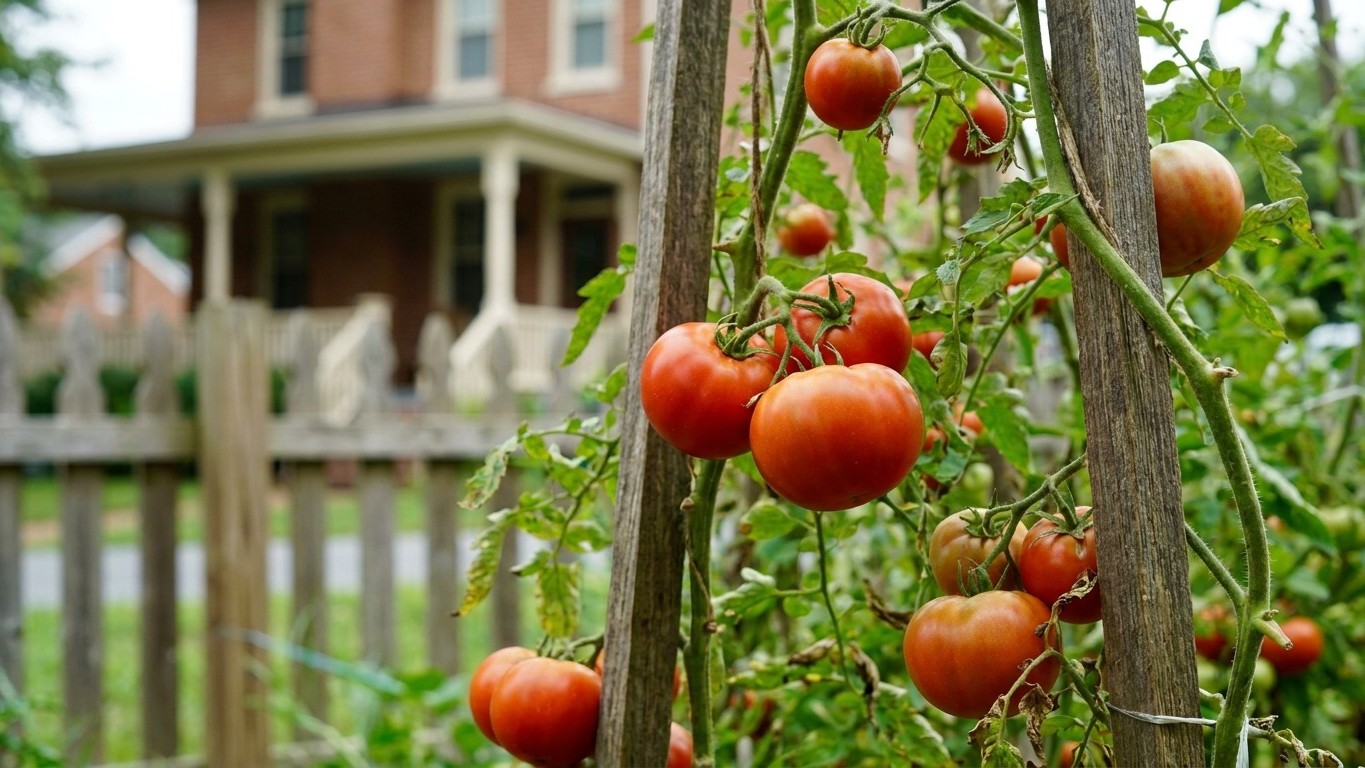

Baltimore’s last-freeze window, April 3 to April 16, gets treated like a single planting day circled in marker, but it’s really a probability band, and it barely applies once you leave the corridor. Garrett and Allegany counties carry frost risk for weeks longer; the Eastern Shore often clears earlier. Count backward six to eight weeks for seed-starting from either end of that range and you land in early February, not some fixed date a calendar app can hand you.
When to plant Tomatoes in Maryland

The planting calendar for tomatoes in Maryland runs backward from a single moving target: the last spring freeze. NOAA’s NCEI 1991-2020 climate normals put that date, for the Baltimore area, in the range of April 3 to April 16, based on the 30-70% probability band for a 32°F freeze. That’s not one day you can circle on a calendar. It’s a window, and it shifts by region: gardeners in Garrett and Allegany counties, up in the mountains of western Maryland, should expect their frost risk to linger for weeks past that Baltimore range, while growers on the Eastern Shore often see it clear earlier. If you garden outside the Baltimore corridor, treat this range as a starting point and adjust with your own observation of past seasons.
Starting seed indoors
Tomato seed needs six to eight weeks under lights or on a bright windowsill before it’s ready to go into the garden as a sturdy transplant. Counting back six to eight weeks from the early end of the Baltimore frost window, April 3, lands in early February. Doing the same from the late end, April 16, lands closer to early March. That gives most Baltimore-area gardeners a seed-starting window of early February to early March, sown in cell trays or small pots under grow lights kept close to the leaves so seedlings don’t stretch.
Hardening off and transplanting outside
Before transplants go in the ground, they need seven to ten days of hardening off: short stretches outside in filtered light and wind, gradually lengthened, so the soft indoor growth toughens up enough to survive sun and breeze without wilting or scorching. Skip this step and you’ll watch a flat of healthy seedlings go pale and floppy within a day of transplanting.
Transplant outside only after the frost window has closed. In the Baltimore area that means waiting until mid-April at the earliest, and gardeners who want a wider safety margin should aim for the later end of the range, around April 16, rather than the earlier one. Soil temperature matters as much as air temperature. Tomato roots stall in cold, wet ground, so a transplant set out the day frost risk clears often sits and sulks until the soil itself warms. Gardeners in colder states face a much tighter calculation. In Minnesota, where the frost-free season starts weeks later and ends weeks earlier, the whole tomato calendar compresses, making early varieties and season-extension tricks far more important than they are here.
Soil and site preparation
Tomatoes want at least six to eight hours of direct sun a day, more if you can give it, and a spot with decent air movement so foliage dries quickly after rain or dew. Low, shaded corners of the yard where water pools after a storm are the wrong choice. Standing water around tomato roots for even a day or two invites root rot and sets plants back for the rest of the season.
Start bed prep weeks before you plan to transplant, not the weekend of. Work compost or well-rotted manure into the top six to eight inches of soil as soon as the ground is workable in spring, which gives it time to integrate before roots arrive. Tomatoes do best in loose, well-drained soil with a good amount of organic matter. Heavy clay benefits from raised beds or mounded rows, since they warm faster in spring and drain the excess water clay tends to hold.
Get a soil test done before you guess at fertilizer needs. Tomatoes are heavy feeders, but piling on nitrogen without knowing your baseline often produces a jungle of leaves and few fruit. A test also flags soil pH, and tomatoes prefer slightly acidic to neutral conditions. If lime or sulfur is needed to correct it, work it in well ahead of planting, since pH shifts take time to take effect.
Space plants generously. Indeterminate varieties, which keep growing and producing until frost, need 24 to 36 inches between plants and at least 3 feet between rows to leave room for staking and airflow. Determinate varieties, which grow to a set size and ripen their fruit over a shorter window, can be planted a bit closer. Crowded plants trap humidity in the foliage, which is exactly the condition fungal diseases like early blight need to take hold.
Varieties that suit Maryland
The trait that matters most for Maryland’s growing season is not exotic. It’s disease resistance, because the humidity that makes the mid-Atlantic summer sticky is exactly what fungal and viral tomato diseases need to spread. After that, days to maturity decides how much insurance you have against a cool, wet spring that delays transplanting, or a wet stretch that knocks out an early planting and forces a replant.
Catalogue days-to-maturity figures are counted from the transplant date, not from seed, and they shift by a week or two depending on the weather that particular season. Cross that figure against your own transplant date, calculated from the Baltimore frost window above, to get a rough harvest estimate rather than a fixed one.
| Variety | Days to maturity | Habit | Notable resistance | Best for |
|---|---|---|---|---|
| Sun Gold | 57 | Indeterminate | Tobacco Mosaic Virus, Fusarium Wilt race 1 | Early cherry tomatoes, snacking |
| Sakura | 55 | Indeterminate | Nematodes, Tomato Mosaic Virus, Fusarium Wilt races 1 & 2 | Fastest-maturing option under disease pressure |
| Jasper | 60 | Indeterminate | Late Blight (High), Early Blight | Cherry tomato with strong blight resistance |
| Celebrity Plus | 78 | Determinate | Nematodes, Gray Leaf Spot, Tomato Mosaic Virus | Reliable slicer, compact plant |
| Big Beef Plus | 72 | Indeterminate | Nematodes, Gray Leaf Spot, Tomato Mosaic Virus | Classic slicing tomato, heavy yield |
| Amish Paste | 85 | Indeterminate | None listed | Sauce and paste, needs a long season |
Sakura and Jasper mature fastest of the varieties above, giving a wide margin against a late transplant, and Jasper’s high resistance to late blight is worth having in any season with a wet August. For slicing tomatoes, Celebrity Plus and Big Beef Plus both carry resistance to gray leaf spot and tomato mosaic virus, and Celebrity Plus’s determinate habit means a shorter stake and a more concentrated harvest, useful for anyone canning in a single push rather than picking a handful all summer.
Heirlooms like Cherokee Purple and Brandywine carry no listed disease resistance, which is the tradeoff for their flavor. They’re worth growing, but plan on more attentive scouting for blight and wilt symptoms through the season, and don’t count on them if you’ve had a bad disease year in that bed recently.
What to plant alongside
Basil is the classic tomato companion, and it earns the spot: it doesn’t compete heavily for the same nutrients, its dense growth shades the soil around tomato roots, and many gardeners find it improves airflow at ground level compared to bare soil. Borage and other pollinator-attracting flowers nearby draw in the bees that improve fruit set, especially useful in a season with a slow, cool start when pollinator activity is already reduced.
Marigolds are worth planting near tomatoes, but not for the folklore reason most people repeat. The claim that their scent repels insect pests above ground has little real evidence behind it. What does hold up is their effect on root-knot nematodes: certain marigold varieties, planted as a cover crop and tilled in before the following season, can measurably reduce nematode populations in the soil. Planted as a border the same season as your tomatoes, expect them to look nice and support pollinators, not to act as a pest shield.
Keep tomatoes away from members of the brassica family, like cabbage and broccoli, which compete for similar nutrients and prefer cooler soil than the ground tomatoes are planted into. More importantly, avoid planting tomatoes near potatoes, eggplant or peppers, or in the same bed those crops occupied the previous year. All four belong to the nightshade family and share susceptibility to early blight, late blight and verticillium wilt, so rotating them together does nothing to break the disease cycle a real rotation would.
Corn is another one to keep at a distance. It shares a major pest, the corn earworm, which is the same insect as the tomato fruitworm, and a stand of corn nearby can build up populations that then move into your tomato patch once the ears are done. Cucumbers and squash aren’t harmful neighbors, but they sprawl aggressively enough to shade out shorter tomato varieties if planted too close, so give them their own dedicated ground.
Watering, feeding and support
Tomatoes want consistent moisture, roughly an inch to an inch and a half of water a week between rain and irrigation, delivered deeply and infrequently rather than a light sprinkle every day. Shallow, frequent watering trains roots to stay near the surface, where they dry out fast and where the plant becomes more vulnerable to the calcium uptake problems behind blossom end rot. A soaker hose or drip line at the base, run long enough to soak six to eight inches down, does more good than any amount of overhead watering, and it keeps foliage dry, which matters more than almost anything else for disease prevention.
Mulch and feeding
Mulch heavily once the soil has warmed, with straw, shredded leaves or grass clippings, to hold soil moisture even and to stop rain from splashing soil, and the fungal spores it carries, up onto the lower leaves. A three-to-four-inch layer also suppresses weeds that would otherwise compete for the same water and nutrients.
Feed at planting with a balanced fertilizer worked into the hole, then hold off on additional nitrogen until the first fruit sets. Tomatoes given too much nitrogen too early put their energy into leafy growth and delay flowering. Once fruit is forming, a feed higher in phosphorus and potassium supports fruit development, applied every few weeks through the height of the season.
Staking, caging and pruning
Indeterminate varieties, which keep growing all season, need a support system tall enough to keep up. A sturdy stake driven in at planting time, or a heavy-gauge cage, keeps fruit off the ground and improves airflow through the plant. Determinate varieties can usually get by with a smaller cage since they stop growing once they set their fruit load.
Prune suckers, the shoots that emerge in the crotch between the main stem and a branch, on indeterminate varieties to keep the plant to one or two main stems. This channels energy into fruit rather than an ever-expanding tangle of foliage, and it opens the plant enough that sprays and sunlight reach the fruit and lower leaves. Determinate varieties should not be pruned this way. Removing their suckers cuts into the fixed number of fruiting branches they’re built to produce, which lowers total yield rather than improving it.
Common problems

Blossom end rot shows up as a flat, sunken, leathery brown-to-black patch on the bottom of the fruit, opposite the stem. It’s caused by a localized calcium shortage in the developing fruit, which is usually a watering problem rather than a soil problem: inconsistent moisture interrupts calcium uptake even when there’s plenty in the soil. The fix is even watering, not necessarily more calcium.
Fruit cracking, either in rings around the top of the fruit or splitting down the side, happens when a dry spell is followed by a heavy rain or deep watering. The fruit takes up water faster than the skin can stretch to accommodate it. Mulching to even out soil moisture, and picking fruit as it nears full color rather than waiting for dead ripe right before a rainstorm, both reduce how often this happens.
Leaf curl and wilt
Leaves that curl upward and feel leathery, without discoloration, are often just a heat and moisture response and not a disease at all. Leaves that yellow, wilt, or die starting from the bottom of the plant and working up point toward a soilborne fungal wilt, either Fusarium or Verticillium, both of which persist in soil for years and have no cure once a plant is infected. The only real management is resistant varieties, marked with an F or V on seed packets, and rotating tomatoes out of infected ground for several years.
Early blight and late blight both cause leaf spotting and dieback, but they behave differently. Early blight starts as small brown spots with a target-ring pattern on the lower, older leaves and works upward slowly through the season. Late blight moves fast, especially in cool, wet weather, producing large, water-soaked, greasy-looking patches that can take down a whole planting within days. Good airflow, drip irrigation instead of overhead watering, and resistant varieties like Jasper or Amalfi all reduce the risk, though neither disease is fully avoidable in a humid climate.
Poor fruit set, where plants flower heavily but few flowers turn into fruit, usually traces back to temperature rather than a pest or a disease. Tomato flowers drop without setting fruit when nighttime temperatures run too warm or too cool for pollen to remain viable, and heavy nitrogen fertilization can make the problem worse by pushing leafy growth at the expense of flowering.
On pests, watch for:
- Tomato hornworms: large green caterpillars with white diagonal stripes, big enough to strip a branch of leaves overnight. Hand-pick them.
- Aphids: small, soft-bodied insects clustered on new growth and the undersides of leaves, causing distorted growth and sticky residue.
- Stink bugs: cause pale, cloudy spots on the fruit under the skin, often not visible until you cut into it.
- Flea beetles: tiny black beetles that riddle young leaves with small round holes, most damaging on seedlings.
Growers further south deal with a longer window for these same pressures. In Mississippi, where the humid season runs longer, disease pressure from early and late blight builds earlier and lasts further into fall than it typically does in Maryland.
Pests that actually show up in Maryland
The University of Maryland Extension Home and Garden Information Center tracks ten pests across the state’s home gardens, but most of them never touch a tomato plant. Squash vine borer and squash bug work squash and other cucurbits. Spotted lanternfly feeds on tree of heaven, grapevines and hardwood trees. Viburnum leaf beetle is specific to viburnum shrubs, and box tree moth, first detected in Maryland in July 2025, goes after boxwood. If you grow a mixed vegetable and ornamental yard, all four are worth knowing, but they will not show up on your tomatoes.
Four pests on that list do matter here. Flea beetles show up first, often before you notice the insect itself: young leaves look peppered with tiny round holes, as if someone shot them with fine buckshot. They emerge in May and hit transplants hardest, when a few days of feeding can stunt a small plant. Floating row cover from transplant until plants are established keeps them off without spraying.
Colorado potato beetle turns up as ragged, chewed leaf margins working inward, sometimes stripping a stem bare within a week. Adults and the humpbacked orange larvae both feed, and egg-laying runs through July. Hand-picking works if you catch it early. Once a plant is defoliated, spinosad is the more reliable control.
Harlequin bug damage looks like white or yellow blotchy stippling on leaves, from the black and orange bugs sucking sap in clusters. They lay eggs through July, and a heavy infestation can wilt a whole plant fast. Crushing the barrel-shaped egg masses on the underside of leaves before they hatch is the single most effective step, since sprays struggle to reach nymphs hidden in leaf folds.
Brown marmorated stink bug leaves a different mark: small, pale, slightly sunken dimples on the fruit itself where it fed, sometimes with a cloudy white area underneath the skin. Eggs go down from June through August, and adults move indoors as fall approaches, so the damage window runs most of the summer. There’s no single spray that clears them out. Netting fruit clusters and removing egg masses, laid in tidy clusters on leaf undersides, does more than any insecticide.
Tomato and tobacco hornworm show themselves as stripped stems and dark green droppings on leaves below the feeding site long before you spot the caterpillar itself, which is often the size of a finger and matches the foliage color exactly. Hand-picking at dusk, when they’re most active, is still the most effective control home gardeners have.
Harvest and end of season
Pick tomatoes when they’ve reached full color and give slightly under gentle pressure. Fruit that colors on the vine develops the best flavor, but a tomato that’s turned from green to showing color, sometimes called the breaker stage, will continue ripening off the vine if picked and kept at room temperature out of direct sun. This is useful for fruit that cracks, or for the last wave before a hard frost threatens the whole planting.
Don’t refrigerate fresh tomatoes if you can help it. Cold storage flattens the flavor and can make the texture mealy, and a tomato that’s already fully ripe holds up fine on a counter for several days out of direct sunlight.
As the season winds down
Maryland’s fall frost date isn’t a single figure that applies evenly across the state. Rather than guess at a date, check with your county office of the University of Maryland Extension for the typical first fall freeze in your specific area, since it varies enough between the mountains, the piedmont and the coast that a statewide number would mislead more than it would help.
Once nights turn consistently cool and a frost is forecast, pull any remaining green fruit before the cold hits rather than risk losing the whole harvest to a hard freeze. Green tomatoes picked at the mature, full-size stage, even without any color showing, will often still ripen indoors over several weeks, wrapped individually in newspaper or laid out in a single layer away from direct sun. Fruit picked too immature, small and hard, is unlikely to ripen well and is better used green, for frying or pickling, than held back for ripening.
At the end of the season, pull spent plants entirely rather than tilling them under, especially any that showed blight or wilt symptoms during the year. Diseased foliage left in the garden, or added to a compost pile that doesn’t reach a high enough temperature to kill off pathogens, carries those same diseases into next year’s soil.
Local help
For county-level planting dates, soil testing services and diagnosis of specific problems in your garden, contact your local office of the University of Maryland Extension. Extension agents can confirm frost timing for your specific county, since the Baltimore-area figures used throughout this guide will run later in the mountains and earlier on the Eastern Shore. For more on gardening elsewhere in the state, browse the rest of our Maryland guides.
Where to Go Next
Everything above comes down to timing, and Maryland’s tomato calendar has a lot of moving parts. If you want the fine detail on when to actually get plants in the ground, counting back from your frost window walks through why Baltimore’s two-week frost spread rules out a single set-in-stone date and how to work backward from it instead.
That same frost window shapes which bugs you’ll be fighting and when. A rundown of the pests that actually show up here lays out how flea beetles and the rest follow the frost calendar almost to the week, so you know what to watch for and when to start watching.
And once your planting date is set, the next question is what to put in the ground. A look at varieties that ripen in time makes the case that almost anything you’d want to grow here has enough season to finish, even in the colder pockets near Baltimore where fall frost holds off until late October or early November.
Common questions
Is it too late to plant tomatoes in June in Maryland?
No, and it can actually work in your favor. A June transplant of a fast-maturing variety like Sakura or Jasper still has plenty of season left, and skipping the unpredictable cool snaps of April means less risk of transplant shock. The tradeoff is a later, more compressed harvest window heading into fall.
Can I grow tomatoes in containers instead of in the ground?
Yes, though the variety matters more in a container than in a garden bed. Determinate varieties like Celebrity Plus or Amalfi stay more compact and suit a large pot better than a sprawling indeterminate vine, which will need a much bigger container and a tall stake to do well. Containers also dry out faster than garden soil, so watering needs checking daily in hot weather.
Should I remove the lower leaves that touch the soil?
Yes, remove any foliage touching or close to the soil once the plant is established. Those bottom leaves are the ones most likely to pick up soilborne fungal spores during watering or rain splash, and taking them off early is one of the simplest ways to slow down early blight before it starts climbing the plant.
Can I save seed from a tomato to grow again next year?
It depends on the variety. Open-pollinated types like Brandywine, Cherokee Purple or Amish Paste will grow true to type from saved seed. Hybrids such as Big Beef Plus, Celebrity Plus or Sun Gold won’t breed true, since their seedlings revert toward one of the parent plants used to create the cross, so saved seed from those often looks and produces nothing like the original.
Why is one plant thriving and the one right next to it dying?
Uneven soil drainage or a pocket of leftover disease in that exact spot is the usual explanation, especially if a nightshade crop grew there in a previous year. Check the struggling plant closely for the specific wilt or blight symptoms described above before assuming it’s simply bad luck, since the answer changes what you do about the bed next season.