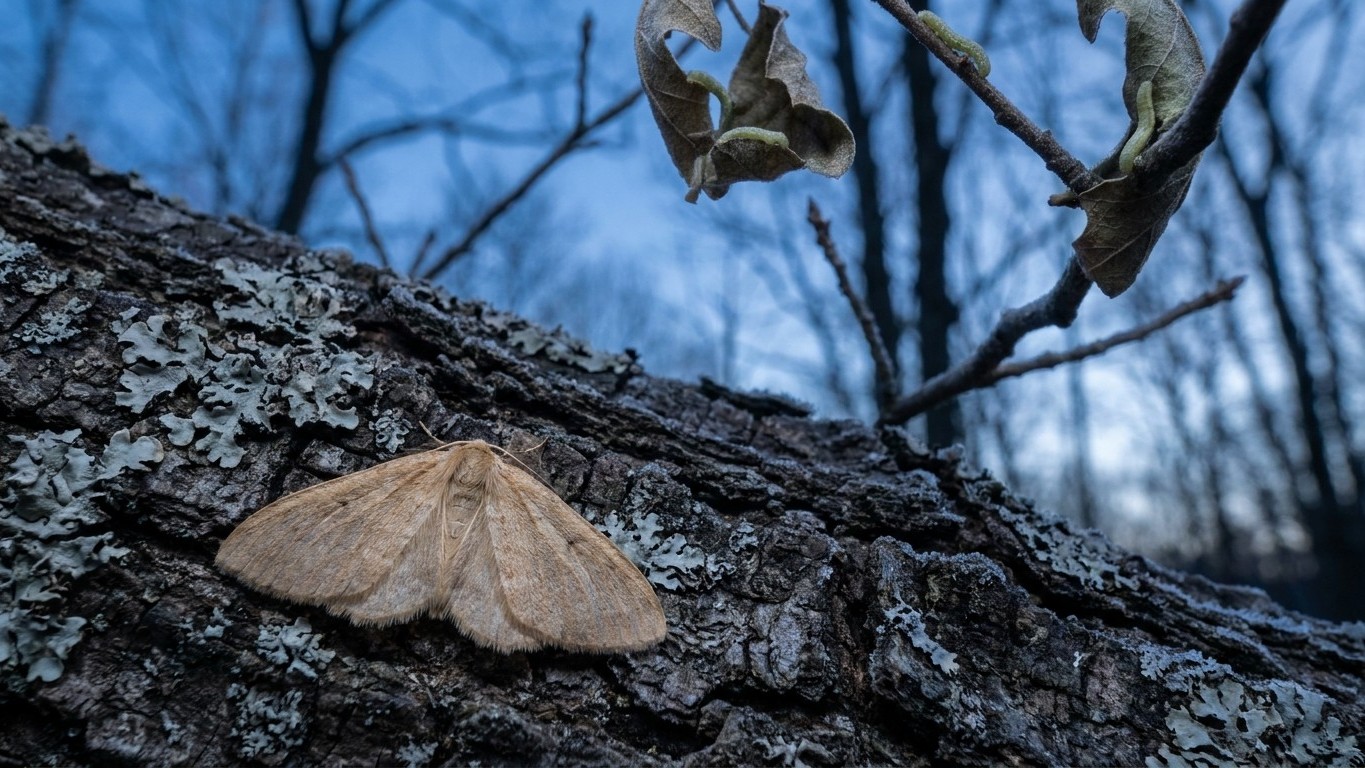

Winter moth adults take flight in Maine from late November through January, crawling and mating during cold nights when most other insects are dormant. The real damage comes later: pale green larvae hatch in early spring, right at bud break, and strip leaves off maples, oaks, and Maine’s wild blueberry barrens before most homeowners notice anything’s wrong. Stopping it means acting on two separate calendars, not one.
Two Different Attacks, One Insect Life Cycle

Winter moth (Operophtera brumata) earned its name honestly. Adult males emerge from the soil and take flight on nights when temperatures climb above roughly 32 to 40 degrees, often between Thanksgiving and New Year’s. They’re tan, unremarkable moths, easy to miss unless you catch one fluttering near a porch light in December, which feels backward for anyone used to insects disappearing once frost hits.
Females don’t fly at all. They’re nearly wingless, and instead of taking off, they crawl up the nearest tree trunk to meet males and lay eggs in bark crevices, under lichen, or in old scale insect casings. A single female can lay 150 eggs or more. Those eggs sit through the coldest stretch of a Maine winter, then hatch in spring, timed almost exactly to when maple and oak buds start to swell.
The larvae are the stage that does the real economic damage. They’re light green inchworms, and they feed inside expanding leaf buds before the leaves even fully unfurl, then move on to open foliage. On a heavily infested tree, an entire canopy can look chewed to lace by late May. Repeated years of this kind of defoliation stress trees that are already dealing with drought, road salt, or old age, and it’s often the combination, not the moth alone, that eventually kills a weakened tree.
Where Winter Moth Has Taken Hold in Maine
Winter moth isn’t native to North America. It arrived from Europe, showed up first in Nova Scotia decades ago, and worked its way down the coast. In Maine, established populations turned up around 2012 in coastal communities in Cumberland and Sagadahoc counties, with Harpswell frequently cited as one of the earliest and hardest-hit towns. Island and peninsula communities along the midcoast, including areas around Vinalhaven and other Casco Bay islands, saw some of the heaviest early infestations, likely because the moderating coastal climate suits the insect’s cold-tolerant but frost-sensitive life cycle.
The pest’s spread pattern tracks the coastline more than it moves inland, which matches what researchers have seen in Massachusetts and coastal New England generally. Cold winter air, without the buffering effect of the ocean, seems to knock back populations further inland, though that hasn’t stopped isolated detections from showing up in other counties as infested nursery stock or firewood gets moved around.
What made winter moth a statewide concern rather than a local nuisance is Maine’s wild blueberry industry. The state grows the vast majority of the country’s wild blueberries, and winter moth larvae feed readily on blueberry foliage and flower buds. A bad infestation during bloom can cut yield significantly, which is part of why University of Maine Cooperative Extension entomologists have tracked this insect closely since it first appeared, rather than treating it as just another backyard tree pest.
What Actually Stops Winter Moth
Control works best when it’s matched to the right stage of the life cycle. Spraying in July does nothing, because by then the larvae have already dropped to the soil to pupate. Effective management clusters around three windows: fall banding, dormant-season oil, and a narrow spring spray window timed to larval hatch.
Sticky Banding in Fall
Because female winter moths can’t fly, wrapping tree trunks with sticky tree bands from mid-November through December intercepts them on their way up. This won’t save a heavily infested landscape tree on its own, but it’s a low-cost way to reduce local egg-laying, and it doubles as a monitoring tool. If a band fills up with dozens of trapped females in a single season, that’s a clear signal the property has a real infestation worth treating the following spring.
Dormant Oil and Precisely Timed Bt Spray
Horticultural oil applied while trees are still dormant, before bud break, can smother overwintering eggs directly on the bark. Once larvae hatch, the standard treatment is Bacillus thuringiensis var. kurstaki, a bacterial insecticide that’s selective for caterpillars and considered low-risk for bees and other pollinators when applied correctly. Timing matters more than the product choice: Bt needs to go on while larvae are still small and actively feeding on open foliage, typically a window of just a week or two around bud break in April or early May. Spraying too early or too late wastes the application. Homeowners managing a handful of ornamental trees can watch for the buds swelling and treat accordingly; commercial blueberry growers rely on degree-day models and scouting reports from extension offices to hit that window precisely.
Biological Control: A Parasitic Fly Doing the Long Work
The most durable fix isn’t a spray at all. Researchers, working with the same biological control program used successfully in Nova Scotia and coastal Massachusetts, have released a parasitic fly called Cyzenis albicans at several Maine sites. The fly lays eggs on leaves that winter moth larvae eat; the fly larvae then develop inside the caterpillar and eventually kill it. It’s slow. Establishing a self-sustaining population of this fly at a release site can take several years, and results vary by location, but where it has taken hold in other states it’s driven winter moth populations down dramatically over time without any ongoing chemical input. It’s the closest thing to a permanent solution, even though it doesn’t offer the instant satisfaction of a spray that knocks caterpillars off a tree in 48 hours.
Telling Winter Moth Apart from Native Cankerworms
One complication for Maine property owners: winter moth larvae look almost identical to native fall cankerworms and spring cankerworms, both of which also show up as green inchworms feeding on hardwood leaves in spring. Misidentifying the pest leads to wasted spray timing or unnecessary treatment of a native species that usually stays in balance with its own natural predators.
The clearest field distinction isn’t the caterpillar itself but the adult moth’s behavior the previous fall. Cankerworm females also crawl rather than fly, but the flight timing and geographic pattern differ, and extension diagnostic labs can confirm species from egg masses or adult moths submitted for identification. Anyone seeing heavy defoliation on ornamental maples or backyard blueberry bushes in a coastal Maine town, especially in a county with documented winter moth history, has good reason to send a sample to a local extension office before committing to a treatment plan.
Property owners further from the coast, in interior counties where winter moth hasn’t been confirmed, are statistically more likely dealing with a native cankerworm outbreak, which tends to be cyclical and often fades on its own within a couple of seasons as natural predators catch up.