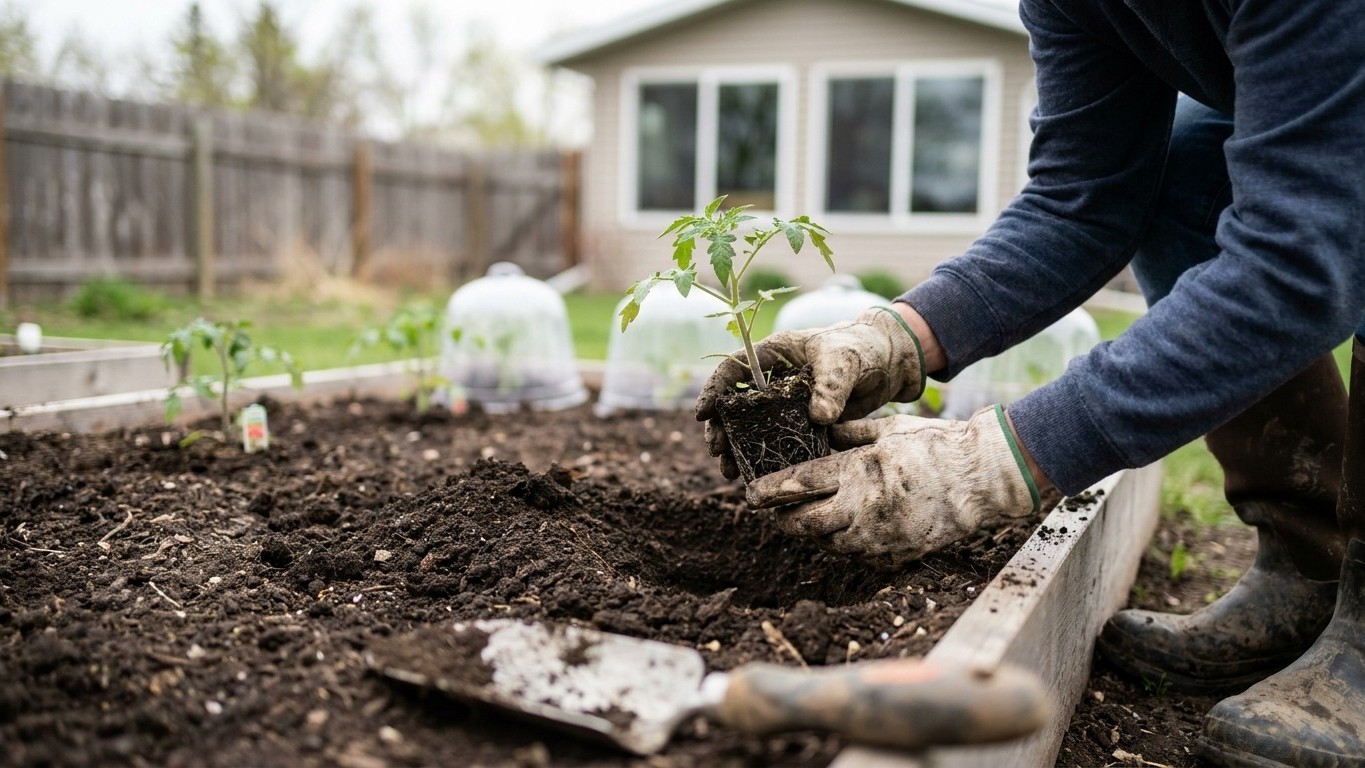

NOAA’s 1991-2020 climate normals put Fargo’s last spring frost between May 4 and May 15, and the first fall frost between September 25 and October 5. That gives the Fargo area something like four and a half months of frost-free growing, the frame every tomato date in this state has to fit inside. Before you set a transplant date, pull your own county’s frost history and compare it against Fargo’s, since most gardens run later in spring and earlier in fall than an airport station does.
What this comes down to in North Dakota

May 15 is the honest planting date for North Dakota tomatoes, not early May, not “after the last frost” left vague. NOAA’s Fargo-area frost window runs May 4 to May 15, and tomatoes carry zero frost tolerance at any age — they’ll sulk in cold soil even without a freeze touching them. That window’s back half is where you actually want to land unless you’re covering plants. North Dakota’s zone 3a to 4b range is why this runs later than gardeners transplanting from milder states expect.
The practical question isn’t “when do I plant tomatoes,” it’s “when does my soil and air stop threatening to kill a tomato transplant.” Tomatoes are tropical natives with zero frost tolerance at any growth stage, and they sulk in cold soil even without a freeze. USDA’s hardiness map places North Dakota across zones 3a to 4b, a range that reflects how much colder the state’s growing season runs than most of the country, and it’s the reason local guides push transplanting later than gardeners moving here from milder states expect. If you haven’t already worked through the basics of growing tomatoes in North Dakota, that’s the place to settle site selection and season-extension basics before you fix a date.
The safe transplant window starts only after the local last-frost date has passed, not before it, and given how the Fargo-area figure spans nearly two weeks, “after May 15” is a more honest target than “in early May” for anyone without season-extending cover. Gardeners who push earlier than that are betting against the back half of NOAA’s own probability window, not just being efficient.
Working it out for your own garden
Counting backward from the frost window
Start with NOAA’s Fargo-area last spring frost window, May 4 to May 15, and treat it as a range the whole way through the calculation, not a single day. Tomato seedlings generally need about six to eight weeks indoors before they’re ready to go into the garden as sturdy transplants, so Counting Back From “May 4 to May 15” by six to eight weeks lands you somewhere in mid-March to early April for starting seed indoors. That’s a range crossed with a range: don’t collapse it into “March 20,” because neither the frost data nor the seed-starting guideline supports that kind of precision.
Working forward instead of backward: if you transplant into the garden anytime the local frost window allows, count the cultivar’s catalogue days to maturity from that transplant date, not from seed-sowing, to see whether it reaches ripe fruit before NOAA’s Fargo-area first fall frost window of September 25 to October 5. Take ‘Early Girl‘, a slicing tomato commonly listed at around 50 to 60 days to maturity. Transplanted anytime in the Fargo-area window of May 4 to May 15, it should reach maturity somewhere between late June and mid-July, weeks ahead of the fall frost window, with a comfortable margin even in a slow, cool season.
Now run a long-season cultivar through the same math. ‘Cherokee Purple‘, an heirloom beefsteak often listed at 80 to 90 days to maturity, transplanted on that same May 4 to May 15 window would mature roughly late July through mid-August in a normal year, which still clears the fall frost window on paper. But catalogue figures assume warm, consistent conditions; a cool, cloudy stretch anywhere in the season can push real maturity out by a week or two, and that’s exactly the kind of cultivar where a slow August leaves you racing the first fall frost instead of beating it comfortably. That’s the difference a couple of weeks of days-to-maturity makes in this state, and it’s worth working through cultivar by cultivar before you buy seed; the Tomato Varieties That Ripen in Time in North Dakota page runs more cultivars through this same arithmetic.
What changes across the state
NOAA’s frost figures above come from a station near Fargo, and North Dakota is a big enough state that the timing shifts meaningfully as you move away from it. Elevation matters: higher ground in the western part of the state tends to hold cold air longer into spring and collect it earlier in fall, since cold air drains downhill and pools in low spots overnight. Gardens on a valley floor or in a natural low point can see frost on nights when a garden a few hundred feet up a slope stays clear.
Distance from open water matters too, though in the opposite direction from what people expect on a coast: a large lake or reservoir can moderate temperature swings nearby, delaying both the first fall frost and, to a lesser degree, the last spring one, while low areas away from any water body swing colder and faster in both directions. USDA’s hardiness zone map spans 3a to 4b across the state, and that half-a-zone-or-more difference between the coldest and mildest parts of North Dakota generally tracks with how far north and how much higher in elevation a given spot sits relative to the Fargo reference station.
None of this gives you a second precise date to work from. What it means practically is that a gardener in a colder pocket of the state should treat the Fargo-area window as an earliest-case estimate and lean toward the later end of it, or later still, rather than assuming the same dates apply unchanged. There’s no substitute here for tracking a few springs of your own frost history against what NOAA reports for the nearest full weather station.
The mistakes this state punishes

The most common mistake is planting into cold soil right after a warm spring stretch. A few 70-degree days in late April can trick a gardener into thinking the season has turned, but soil temperature lags air temperature by days to weeks, and a tomato transplant set into cold soil will sit stunted even if no frost ever touches it. Wait for the ground, not just the air, to warm before you transplant, regardless of how tempting an early warm stretch looks.
The second is choosing a cultivar whose catalogue days to maturity don’t leave margin against the Fargo-area fall frost window of September 25 to October 5, especially in a state where NOAA’s own data shows that window can arrive on its earlier edge. A 90-day beefsteak planted on the late end of the spring frost window is exactly the kind of gamble that a cool, wet August turns into a loss. Running the arithmetic shown above before buying seed catches this before it costs you a harvest.
The third is losing track of when the state’s known tomato pests actually show up, which matters because timing a check for them wrong means finding damage after it’s already done. Rather than guess at what’s chewing your plants, compare what you’re seeing against the Tomato Pests in North Dakota: Which Ones Actually Show Up Here page, which orders them by when they appear in the season rather than by how common they are nationally.
- Transplanting on the strength of a warm week instead of a stable forecast
- Picking a long-season heirloom without checking its days to maturity against the fall frost window
- Skipping hardening-off, which leaves tender greenhouse-grown transplants exposed to wind and cold snaps they haven’t adjusted to
Checking this against your county
Everything above uses a single reference point near Fargo, and NOAA is explicit that this is one station’s data, not a statewide guarantee. Before you commit to a transplant date, check your own county’s frost record against it, and cross-check local guidance through North Dakota State University’s extension service, which maintains county offices with local tomato and vegetable timing advice.
A state-wide frost figure is a starting point, not a substitute for a few seasons of watching your own garden.
Common questions
Can I just plant on the same date every year once I know it?
No, because the Fargo-area frost window itself spans May 4 to May 15 in a normal year, and individual years run earlier or later than that normal. Treat any date you calculate as a target range to confirm against the current year’s forecast, not a fixed calendar entry.
What if I want to plant earlier than the frost window allows?
You’ll need frost protection, such as row cover or wall-of-water style plant protectors, since NOAA’s data describes typical freeze probability, not a hard cutoff. Even with protection, cold soil will still slow a tomato transplant down, so earlier isn’t automatically better.
Does starting seed earlier indoors get me an earlier harvest?
Not much, and it can backfire. A tomato transplant that’s been indoors too long before the outdoor frost window clears gets root-bound and leggy, and it often performs worse after transplanting than a younger, stockier seedling started on a more normal six-to-eight-week schedule.
How do I know if my particular yard is colder than the Fargo figures suggest?
Low spots, open fields, and areas away from buildings or windbreaks tend to run colder than the Fargo reference station, sometimes by a week or two on both ends of the season. The most reliable way to know is to track your own frost dates for a season or two and compare them against NOAA’s normals for the nearest full weather station.
The Moon calendar is a separate, older custom: see when to plant tomatoes by the moon, written as tradition rather than fact.