
Seven insects account for nearly all the tomato damage reported in Ohio gardens, and OSU Extension’s Columbus-area frost window, last frost falling between May 5 and May 15 and first fall frost between October 5 and October 15, sets the rhythm for when each one shows up. Cutworms and flea beetles hit young transplants in the first weeks after planting, while hornworms, stink bugs and fruitworms don’t appear until the plants are carrying fruit in mid to late summer. Walk the bed and check the base of each stem for damage within two weeks of setting plants out, since that early check catches the pest most gardeners miss until it’s already toppled a transplant.
What this comes down to in Ohio

When your tomatoes start looking pockmarked or bitten just as fruit sets, the culprit almost always matches the calendar, not bad luck. Cutworms and flea beetles go after brand-new transplants in the first couple weeks, while hornworms, stink bugs, and fruitworms wait until there’s actual fruit on the vine to bother showing up. So the one thing worth doing right now is walking your bed and checking the base of each stem for damage within two weeks of planting — that’s the window most people miss, and it’s the one that costs you a whole transplant if you skip it.
The seven pests below are ordered the way they actually arrive in a typical Ohio garden, from the ones that threaten a two-week-old transplant to the ones that show up only once fruit is ripening on the vine. Identifying the pest correctly matters more than reacting fast, since the wrong response, usually a broad spray applied too early, tends to remove the beneficial insects that would have handled the problem without any input from you.
Cutworms

Cutworms are dull gray-brown caterpillars, plump and 1 to 2 inches long, that curl into a tight C-shape the moment you touch them. They feed at night, and the damage is unmistakable: a transplant stem sliced clean through at or just below the soil line, the whole plant lying flat by morning. A cardboard or aluminum-can collar pushed an inch into the soil around each stem stops them completely, and it works far better than any spray applied after the fact.
Flea Beetles

Flea beetles are tiny, shiny black beetles, barely 1/16 inch long, that jump like fleas the instant you brush the foliage. They riddle young leaves with small round holes, and on a fresh transplant that damage can stall growth for weeks before the plant catches up. Floating row cover over the bed until plants are established keeps them off without a single spray, and larger, established plants tolerate the same damage without much yield loss.
Aphids

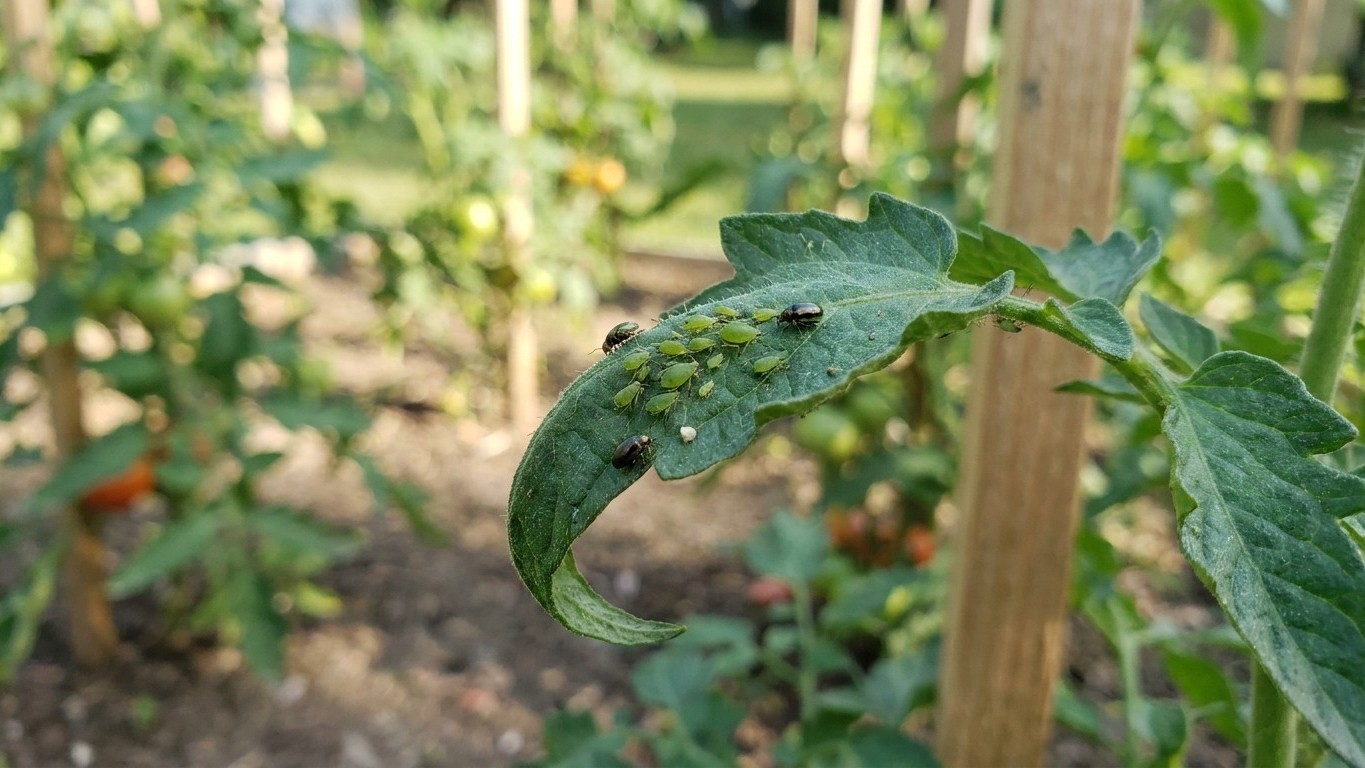
Aphids are small, soft-bodied insects, pear-shaped and typically pale green to yellow-green, clustered on the undersides of leaves and along new growth. They suck sap and leave behind a sticky honeydew that turns black with sooty mold, and heavy colonies can spread viruses from one plant to the next. A hard jet of water knocks most colonies off, and insecticidal soap handles the rest. Ladybird beetles and lacewings usually move in on their own if nothing broad-spectrum has already cleared them out.
Colorado Potato Beetle

The adult is oval, about 3/8 inch long, yellow-orange with ten black stripes running down its wing covers. Its larvae do the real damage: humpbacked, orange-red grubs with two rows of black spots that strip leaves down to bare veins in a matter of days. Hand-picking adults and crushing the bright yellow egg clusters on leaf undersides before they hatch is usually enough to keep a home garden ahead of them.
Tomato Hornworm

This is the pest most gardeners actually spot: a green caterpillar up to 4 inches long, with pale diagonal white stripes down each side and a single dark horn at the rear, camouflaged well enough against the foliage that the first sign is usually a stripped branch rather than the worm itself. One hornworm can defoliate a section of plant in a couple of days. Hand-picking works if you check daily, and Bacillus thuringiensis handles a population that’s gotten ahead of you. Leave any hornworm covered in small white cocoons alone, since those are parasitic wasp pupae already doing the work for you.
Stink Bugs

Stink bugs are shield-shaped, mottled brown or green, and about 1/2 to 5/8 inch long. They pierce ripening fruit to feed, leaving pale, cloudy spots underneath the skin that show up after the tomato has colored, an injury that’s easy to mistake for a ripening disorder rather than an insect problem. There’s no reliable home treatment once fruit has already set, so keeping the bed edges free of weeds where they overwinter is the more useful long-term move.
Tomato Fruitworm
Also called the corn earworm, this caterpillar is pale yellow-green to brown with faint stripes, growing to about 1.5 inches, and it bores directly into green and ripening fruit instead of feeding on leaves. A single worm can ruin several tomatoes as it moves from one to the next. Check developing fruit clusters weekly from midsummer on, and pull any tomato with an entry hole before the worm inside gets any bigger.
Working it out for your own garden
The fastest way to identify what’s damaging your tomatoes is to work backward from where the damage sits and when it started, rather than guessing from memory. Stem damage at the soil line early in the season points to cutworms, while shot-holes in leaves on a plant that’s only been in the ground a week or two point to flea beetles. Damage that shows up later, once the plant is carrying fruit, narrows things fast: stripped foliage means hornworms, cloudy spots under ripening skin mean stink bugs, and a hole bored straight into the fruit means tomato fruitworm.
The timing question ties directly to the same frost window that sets when you can plant in the first place. If your transplants went in during the window that Tomato Planting Dates in Ohio: Counting Back From Your Frost Window works out for your garden, then damage in the first two to three weeks after that is almost always a seedling-stage pest, cutworms or flea beetles. Damage eight to ten weeks later, once fruit is set, is a fruiting-stage pest, hornworms, stink bugs or fruitworm. Aphids and Colorado potato beetle can turn up at either end of the season, so those two have to be ruled in or out by sight rather than by calendar position alone.
Quick diagnostic key
| Pest | Where you find damage | What it looks like | Typical timing |
|---|---|---|---|
| Cutworms | Stem, at soil line | Stem severed, plant toppled | First 2-3 weeks after transplant |
| Flea beetles | Leaves | Small round shot-holes | First few weeks after transplant |
| Aphids | Leaf undersides, new growth | Sticky honeydew, curled leaves | Any point in the season |
| Colorado potato beetle | Leaves | Stripped down to bare veins | Early to mid season |
| Tomato hornworm | Foliage and stems | Large sections of leaf missing | Mid to late summer, once fruiting |
| Stink bugs | Ripening fruit | Cloudy spots under the skin | Mid to late summer |
| Tomato fruitworm | Inside the fruit | Bored entry hole | Midsummer onward |
Once the location and timing narrow the field to one or two candidates, the visual details settle it for good, the shape of a hornworm’s horn against the ten stripes on a Colorado potato beetle, or the soft cluster of an aphid colony against the jumping habit of a flea beetle.
What changes across the state
Ohio spans USDA hardiness zones 5b to 6b, and that spread changes when pests get active more than it changes which ones show up. Southern Ohio, along the Ohio River, warms up earlier in spring than the Columbus reference point, so flea beetles and cutworms can be active before the general frost window even closes there. Northern Ohio, closer to Lake Erie, holds cooler air longer into spring and often stays cooler into early summer, which pushes the whole pest calendar back by a similar margin in the other direction.
Elevation and local microclimate matter within a single county too. A garden sitting in a low frost pocket warms up slower in spring and cools faster in fall than one on higher, more open ground a mile away, and that shifts both the safe transplant date and the arrival of fruiting-stage pests like hornworms and stink bugs. None of this changes which insects live in Ohio, only when each one becomes the thing worth watching for in a particular garden.
The lake effect near Erie also tends to hold humidity higher for longer into the growing season, and that favors aphid colonies, which build up fastest in damp, still air on the undersides of leaves. Gardens further from the lake, especially in the drier interior of the state, tend to see aphid numbers stay lower unless plants are stressed or pushed hard with nitrogen fertilizer.
The mistakes this state punishes

The most common mistake is spraying before identifying, treating every leaf hole as an emergency and reaching for a broad-spectrum insecticide that also wipes out the ladybird beetles and parasitic wasps that would otherwise keep aphids and hornworms in check on their own. Identify the pest first, using the location and timing of the damage, before choosing any treatment at all.
The second is skipping the daily walk-through during the two windows that matter most: the first two to three weeks after transplant, when cutworms and flea beetles do their damage, and the run-up to first fruit, when a hornworm can strip a branch before you notice it’s there. A five-minute check each morning during those stretches catches almost everything early enough to hand-pick rather than spray.
The third is choosing a long-season variety and assuming pest pressure is the only thing standing between the transplant and a ripe tomato. A cultivar that needs 80 or more days from transplant is already spending most of the season’s margin against the frost window on its own, and any pest setback that costs even a week of growth can push the harvest past what Tomato Varieties That Ripen in Time in Ohio shows will actually finish here. A shorter-season cultivar with built-in resistance to nematodes or common leaf diseases leaves more room to absorb a bad pest week without losing the crop entirely.
Checking this against your county
The Columbus-area frost window and the pest timing built on it are a starting point, not a fixed schedule for every county in Ohio. Your county’s OSU Extension office tracks local conditions, including which pests are actually being reported in gardens and traps that season, and can tell you whether your area is running ahead of or behind the Columbus reference point. Find your local office and the state’s tomato pest guidance through OSU Extension, and check in early in the season rather than after the damage has already shown up.
Common questions
Do I need to spray my tomatoes every year even if I don’t see pests?
No. Spraying without a pest actually present kills off the ladybird beetles, lacewings and parasitic wasps that keep populations like aphids and hornworms low on their own. Check plants a few times a week instead and treat only what you actually find.
How do I tell aphids apart from flea beetles on my tomato leaves?
Aphids are soft-bodied, pear-shaped and sit in still clusters on the undersides of leaves and new growth. Flea beetles are hard-shelled, shiny black, and jump the instant you touch the plant, leaving small round holes rather than a stationary colony.
Will planting marigolds around my tomatoes keep the pests away?
There’s no reliable evidence that marigolds reduce insect pests on tomatoes specifically, whatever the garden folklore says. Row cover during the seedling stage and a daily walk-through once fruit sets do far more to keep the seven pests above under control.
Can I still eat a tomato that had a hornworm or fruitworm on it?
Yes, as long as you cut away the damaged section, since the caterpillar itself doesn’t contaminate the rest of the fruit. Check for soft, rotting tissue around the entry hole first, since a bored fruit left too long on the vine often starts rotting from that point before you pick it.