
Home plumbing problems fall into three groups: the ones that waste water without anyone noticing, the ones that block or back up, and the ones that fail suddenly under pressure. Most start small, a wobbly flapper, a slow drip, a faint hiss behind a wall, and turn expensive only when ignored. National data on wasted water shows why homeowners should treat those small signs seriously. This page maps the territory: what leaks actually cost, which problems show up most, the one step to take before anything breaks, and where DIY should stop.
What leaks actually cost
The numbers from the U.S. EPA WaterSense program are worth sitting with. “Household leaks can waste nearly 1 trillion gallons of water annually nationwide.” Spread across every home in the country, “the average household’s leaks can account for more than 9,300 gallons of water wasted every year,” and “nine percent of homes have leaks that waste 50 gallons or more per day.” That’s not a rounding error. That’s a household running its own private waterfall, quietly, month after month.
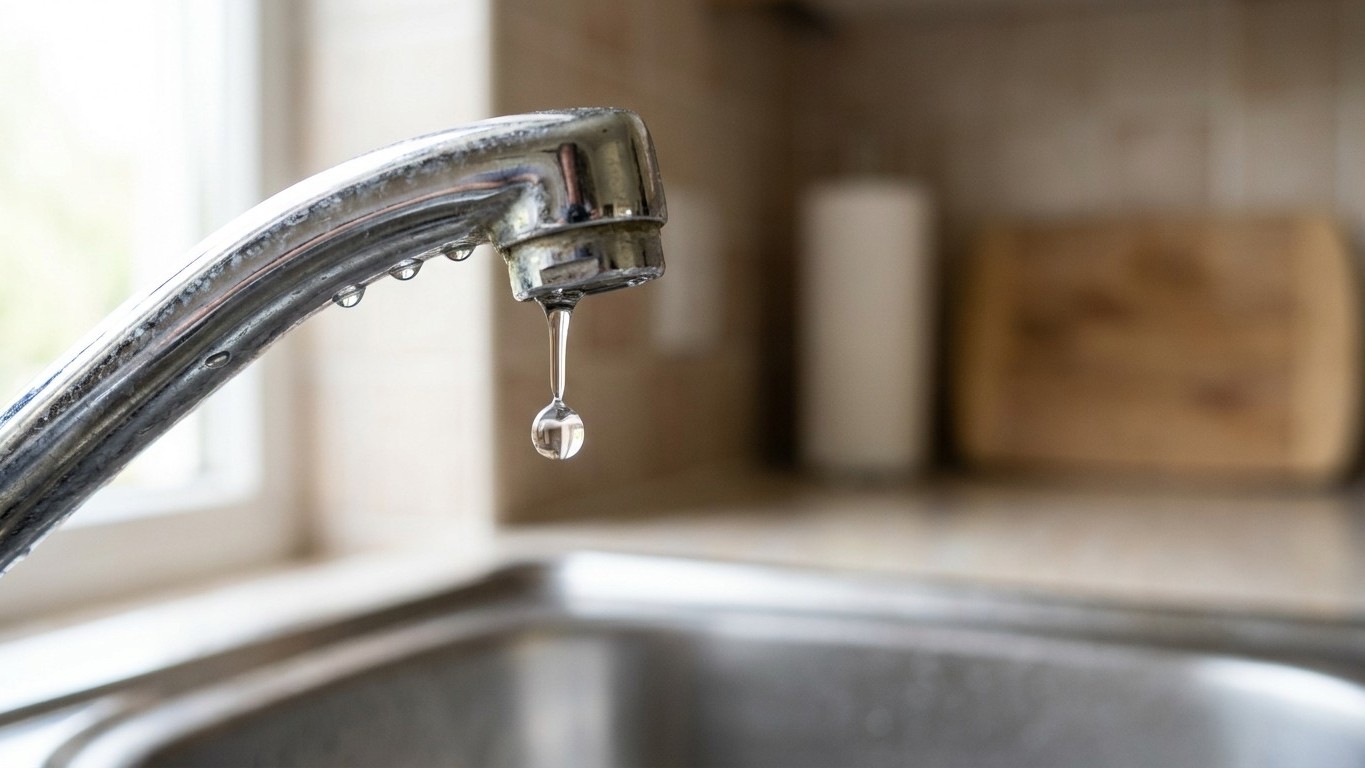
Those totals come from somewhere specific. “A leaky faucet that drips at the rate of one drip per second can waste more than 3,000 gallons per year.” A showerhead barely dripping, “10 drips per minute,” wastes “more than 500 gallons per year.” And the biggest single offender in most houses isn’t visible at all: “An old or worn flapper can cause your toilet to flush on its own or silently leak thousands of gallons a year.” One worn rubber part, sitting at the bottom of a tank, can outspend every other fixture in the house combined.
These figures are national aggregates from a water-conservation campaign, not a diagnosis of any single house. They explain scale, not your bill. To find out what your own plumbing is actually losing, the meter does the real work, read it before bed and again in the morning with no water used, and the difference tells the truth better than any national average can.
The upside is proportional to the problem. WaterSense notes that “fixing easily corrected household water leaks can save homeowners about 10 percent on their water bills.” That’s real money for the cost of a rubber flapper or a washer. If a toilet keeps refilling on its own, the running toilet page walks through the fix. If a faucet won’t fully shut off, the dripping faucet page covers it. If the water bill has crept up with no obvious source, the hidden leak page explains how to track down water that’s disappearing somewhere you can’t see.
The problems that come up most
Plumbing trouble tends to sort itself into three families, and each one behaves differently enough to need its own approach.
Problems that waste water quietly
These are the ones that never announce themselves. A running toilet keeps the fill valve cycling long after anyone notices the sound. A dripping tap seems minor until the math above catches up with it. A hidden leak, inside a wall, under a slab, behind a dishwasher, can run for months before a stain or a spike in the water bill gives it away.
Problems that block
Drains and disposals fail differently. A slow drain usually means grease, hair, or soap buildup narrowing the pipe over time. A jammed or struggling garbage disposal is often mechanical, not a clog at all, and forcing it can make things worse.
Problems that fail under pressure
Low water pressure, frozen pipes, and a sump pump that won’t kick on share one trait: they tend to show up at the worst possible moment, a holiday morning, the first hard freeze, a storm. That timing is exactly why they belong on a homeowner’s radar before the season that triggers them.
| Problem | Warning sign | Where to look next |
|---|---|---|
| Running toilet | Tank refills without a flush, faint hiss | Running toilet page |
| Dripping faucet | Steady drip even when shut fully | Dripping faucet page |
| Hidden leak | Rising water bill, no visible cause | Hidden leak page |
| Clogged drain | Water pools, slow to disappear | Clogged drain page |
| Garbage disposal issue | Humming with no grinding, or dead silence | Garbage disposal page |
| Low water pressure | Weak flow at multiple fixtures | Low water pressure page |
| Frozen pipes | No flow, cold snap, exposed pipe | Frozen pipes page |
| Sump pump failure | Doesn’t activate, or runs constantly | Sump pump page |
The one thing to do before anything goes wrong
Find the main water shut-off valve. Today, while everything is dry and calm, not during a burst pipe at midnight.
Every house has one point where the main supply line enters, and a valve nearby that stops water to the entire building. In many homes it sits near the water heater, in a basement, a crawlspace, or a utility closet, sometimes in an outdoor box near the street. The exact spot varies by house age and region, which is exactly why it needs to be found in advance rather than guessed at under pressure.
Fixture-level shut-offs matter too. Under most sinks and behind most toilets, small valves control just that one line. Knowing where those are means a leaking supply hose under a sink doesn’t require shutting off water to the whole house while someone hunts for the main valve.
The reason this matters isn’t hypothetical. A burst supply line can move a lot of water in a short time, and every minute spent searching for the shut-off is a minute of water finding its way into flooring, drywall, and whatever sits below. Homeowners who know the valve’s location and have tested that it actually turns, some haven’t been touched in years and can seize, cut that response time from panicked minutes to a few seconds.
Test the valve once, gently, and note whether it turns freely. If it’s stiff or won’t budge, that’s worth addressing before it’s the only thing standing between a dripping pipe and a flooded basement. The water shut-off valve page covers how to locate it, how to test it safely, and what to do if it’s seized shut.
What is not a DIY job
Plumbing rewards a confident amateur right up until it doesn’t. There’s a real line between a fix that saves a service call and a fix that turns a $200 repair into a $20,000 one.
Anything behind a wall belongs to a professional. Opening drywall to chase a pipe without knowing exactly where the leak originates, or without understanding what’s routed through that wall (electrical, gas, structural framing), risks turning a small repair into a much bigger one. A licensed plumber has the tools to find the source without guessing.
The main supply line is the same story at a larger scale. Working on the pipe that feeds the entire house means working on something that, if it fails, floods everything downstream of it. That’s not a place for trial and error.
Gas water heaters deserve their own caution. Anything involving a gas line, a burner assembly, or venting carries a risk that has nothing to do with water: carbon monoxide and gas leaks are dangerous in ways a wet floor isn’t. A licensed plumber or gas technician has the training and the equipment to do this safely; a homeowner with a wrench doesn’t.
And any leak that has already wetted structure, subfloor, drywall, insulation, framing, changes the job entirely. At that point it’s not just a plumbing repair, it’s a moisture and mold problem, and it needs assessment before anyone patches the visible symptom. When in doubt, that’s the moment to call a licensed plumber rather than push further.
Common questions
How do I know if I have a hidden leak?
A jump in the water bill with no change in usage is the most common clue. Reading the water meter with all fixtures off, then checking again after a couple of hours of no use, will show movement if water is escaping somewhere unseen.
Which plumbing problem wastes the most water?
A worn toilet flapper is usually the biggest single source in a home, since it can leak silently and continuously, unlike a faucet drip that’s at least visible and audible.
Can I fix a running toilet myself?
In most cases, yes. It’s typically a flapper or fill valve issue and both are low-risk, inexpensive parts to replace. The running toilet page walks through the steps.
When should I stop and call a plumber instead of continuing myself?
As soon as the fix requires opening a wall, touching the main supply line, working on a gas water heater, or the area is already wet with visible damage to structure. Those situations call for a licensed plumber, not a weekend project.