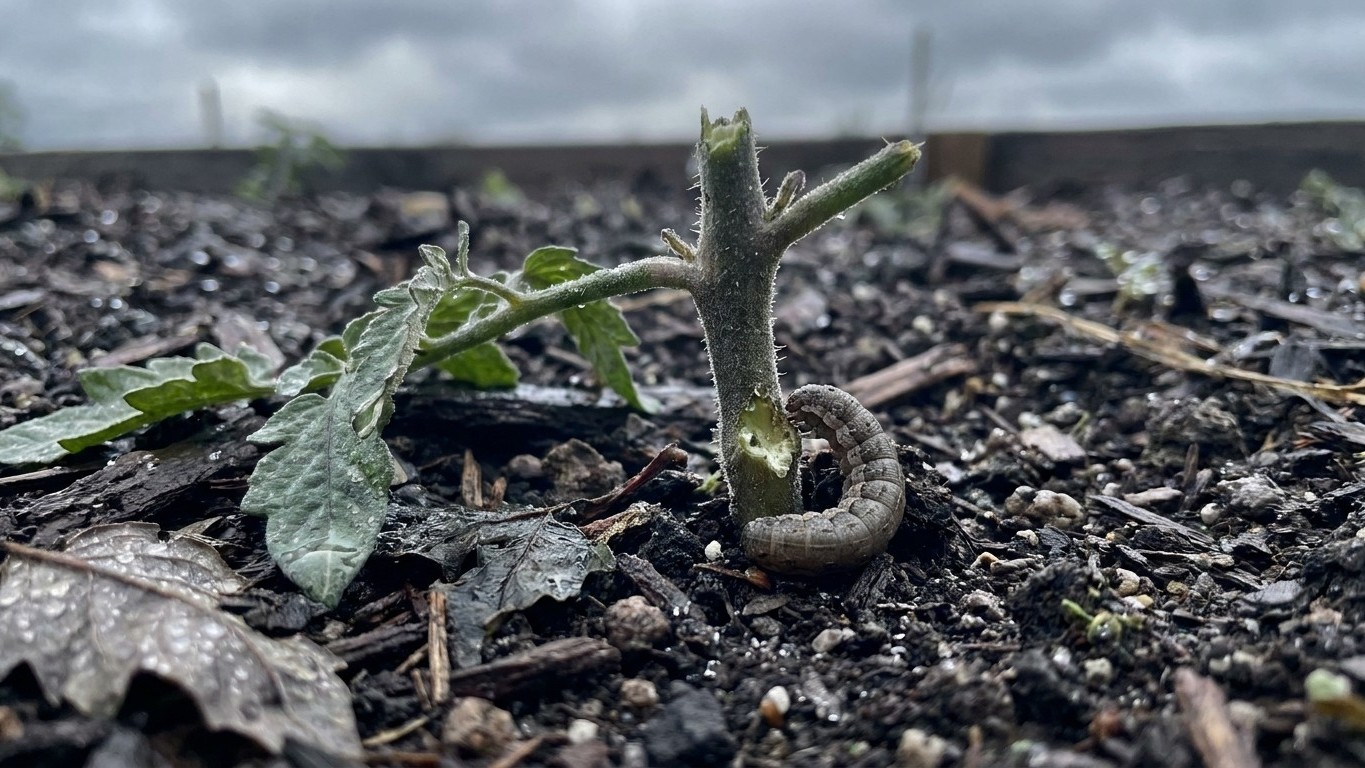

Six insects account for nearly every tomato problem gardeners report on Prince Edward Island, and they don’t all show up at once. Knowing which one you’re looking at, and when to expect it, matters more here than in warmer provinces, because the Island’s short, humid growing season leaves little room to lose plants to something that could have been caught early.
What this comes down to in Prince Edward Island

In Prince Edward Island, tomato pests follow a schedule set by the frost window at Charlottetown, where the average last spring frost falls May 16 and the average first fall frost falls October 17. Six months, roughly, of cool and often damp weather, and that combination favors a fairly consistent lineup of pests rather than the wide variety you’d see further south. The same humidity that makes PEI’s soil so good for potatoes also keeps slugs active and aphids comfortable, and the province’s potato acreage means one beetle in particular is never far from a tomato patch.
Six pests turn up often enough on Island tomatoes to matter, and they arrive in a rough order from transplant to harvest. Below, each gets its own visual description, because identifying the insect correctly is what determines whether the treatment does anything at all.
Cutworms
Cutworms are gray-brown caterpillars, roughly 1 to 2 inches long, that curl into a tight C-shape when disturbed and hide in the top inch of soil during the day. It’s this larval stage that does the damage, chewing through a young transplant’s stem right at soil level, often overnight, so a healthy seedling is simply gone by morning. A cardboard or foil collar pushed an inch into the soil around each stem at transplanting stops them cold, and hand-picking after dark works if the collars go on too late.
Flea beetles
These are tiny, shiny black beetles, about 1/16 inch, that jump like fleas when a leaf is brushed. Adults chew small round shot-holes across the leaves of young transplants, and the damage is worst in the first two or three weeks after plants go into the ground, before they’ve built up size. Row covers over freshly transplanted tomatoes keep the beetles off during that vulnerable stretch, and established, vigorous plants generally outgrow moderate feeding without help.
Colorado potato beetle
An oval beetle about 3/8 inch long, yellow-orange with ten black stripes down its back, is the adult; the larvae are humpbacked, brick-red grubs with rows of black spots. Both stages feed on foliage, and on an island built around potato farming, beetle pressure on tomatoes (a close relative) tends to run heavy. Overwintering adults emerge as soil warms through late May and June and lay clusters of bright orange eggs on the undersides of leaves. Checking leaf undersides and squashing egg clusters before they hatch does more good than spraying adults later, since it’s the larvae that strip the most foliage.
Aphids
Aphids are small, soft, pear-shaped insects, a fraction of an inch, green or pinkish, that cluster on new growth and the undersides of leaves. Both nymphs and adults feed by sucking sap, curling and yellowing leaves and leaving a sticky honeydew residue that can grow sooty mold. They rarely kill a tomato plant outright but weaken it steadily, and a strong jet of water or a shot of insecticidal soap usually knocks a colony back before it spreads.
Slugs
Soft-bodied, grey-brown, and leaving a telltale silvery slime trail, slugs feed at night and during damp stretches, and PEI’s coastal humidity keeps them active longer into the summer than in drier regions. They chew irregular holes in leaves and, worse, in fruit that’s resting on or near the soil. Staking plants to keep fruit off the ground, watering in the morning rather than the evening, and setting out iron phosphate bait handle most infestations.
Tomato hornworm
The largest of the group by far, tomato hornworm caterpillars reach up to 4 inches, bright green with white diagonal stripes and a curved horn at the tail end. They show up late in the season and can strip a branch bare of leaves within a couple of days, leaving behind dark, pellet-like droppings as the giveaway. They’re big enough to hand-pick easily once spotted, and any hornworm carrying small white cocoons on its back should be left alone: those are parasitic wasp eggs already doing the control work.
Working it out for your own garden
Matching a symptom to the right pest comes down to three questions asked in order: when in the season is it happening, where on the plant is the damage, and what does the culprit actually look like.
Start with timing. A stem severed at soil level within days of transplanting, in mid to late May on the Island, points to cutworms almost automatically, since nothing else causes that specific injury that early. Small round holes riddling young leaves in that same window, without any stem damage, points to flea beetles instead. Move into June and defoliation paired with orange egg clusters on leaf undersides means Colorado potato beetle, especially if the garden sits anywhere near a potato field or was in potatoes the year before. Curling, yellowing new growth through the middle of summer, with a sticky residue on the leaves below it, is the aphid pattern. Ragged holes in leaves or fruit that appear after a run of wet nights, any time from June onward, are almost always slugs, and the slime trail confirms it. Wholesale defoliation of a branch in August, with dark droppings on the leaves underneath, is tomato hornworm.
Where the damage sits on the plant narrows things further. Damage at the base of the stem is cutworm territory only. Damage on new leaves at the top of the plant usually means aphids or flea beetles, while damage on fruit itself, particularly fruit close to the ground, is a slug signature. Damage that clears whole branches in a matter of days, working from the top down, is the hornworm’s scale of appetite, since nothing else on this list eats that fast.
If two candidates still fit, the visual check settles it: pull a leaf close and look for the insect itself rather than guessing from the damage alone. A shiny black speck that jumps is a flea beetle; a soft green caterpillar the length of a finger is a hornworm; anything striped yellow and black the size of a fingernail is the Colorado potato beetle. That thirty-second look prevents treating for the wrong pest, which wastes a week the Island’s short season doesn’t really allow for.
What changes across the state
Prince Edward Island isn’t one climate, even though it’s small. The frost window above comes from Charlottetown, near the middle of the Island, and the north shore, facing the Gulf of St. Lawrence, tends to warm up more slowly in spring than the more sheltered south shore along the Northumberland Strait. That slower spring warm-up pushes Colorado potato beetle emergence and cutworm activity later on the north side, since both depend on soil temperature climbing past a threshold before adults become active.
Coastal humidity runs higher near the water on both shores compared with inland farmland, and that extra dampness is exactly what slugs need. Gardens close to the coast, or in low, poorly drained spots anywhere on the Island, tend to see heavier and longer-lasting slug pressure than gardens on higher, better-drained inland ground. Aphid buildup follows a similar pattern, since aphid populations explode fastest in still, humid air rather than in a garden exposed to steady wind off the water.
None of this shifts the pest lineup itself. The same six insects show up whether the garden sits on the north shore, the south shore, or inland, since PEI is too small and too uniformly cool for a genuinely different pest to enter the picture in one region and not another. What moves is timing and severity, not the cast of characters, so a gardener transplanting the checklist above to a specific county should expect the same pests, arriving a bit earlier or later and pressing a bit harder or softer, depending on how close the garden sits to the water and how well the soil drains.
The mistakes this state punishes
The costliest mistake on PEI tomatoes is skipping cutworm collars because the transplants went in during a warm stretch in mid-May. A few warm days don’t mean the soil, or the cutworm population living in it, has settled down, and a batch of unprotected transplants can be cut down in a single night right when the season is too short to easily start over.
The second is planting tomatoes into ground that grew potatoes the year before, or sits next to a potato field, without expecting heavy Colorado potato beetle pressure. Skipping the egg-check on leaf undersides in late May and early June lets a beetle population multiply past the point where hand-picking still works, forcing a heavier response later in the season.
The third is treating fruit rot or holey fruit as a disease problem when it’s actually slugs, especially in a wet stretch. Spraying a fungicide does nothing for slime trails and ragged fruit damage; staking plants so fruit clears the soil, and switching morning watering for evening watering, is the fix that actually works. Waiting too long to hand-pick tomato hornworms is the fourth, since a caterpillar that size can clear a branch within two or three days of being noticed, and the Island’s growing season doesn’t leave much slack to regrow lost foliage before the October frost window closes in.
Checking this against your county
Everything above is anchored to Charlottetown, and Prince Edward Island’s coastline, drainage, and distance from the water shift the timing and severity of each pest from one county to the next. Before treating anything, it’s worth checking current pest reports and identification help through Prince Edward Island’s own agriculture resources, and calling a local extension contact for anything that doesn’t clearly match the descriptions here. A province-wide pattern is a starting point for identification, not a guarantee for a specific backyard.
Common questions
Do tomato hornworms actually show up on PEI, or is that a warmer-climate pest?
They do appear on the Island, typically in August, though not every garden sees them every year. They’re easy to miss until the damage is already extensive, since the caterpillar’s green coloring blends into the foliage it’s eating.
Is the Colorado potato beetle worse for tomatoes near potato fields?
Generally yes. Beetles overwinter in soil and move into the nearest suitable host in spring, so tomato gardens close to potato ground, or planted on ground that grew potatoes the year before, tend to see heavier pressure than gardens further removed.
Why do slugs seem worse in some PEI gardens than others?
Drainage and humidity are the main factors. Low, damp spots and gardens close to the coast hold more moisture and stay cooler at night, which is exactly the environment slugs need to stay active.
Can row covers handle more than one pest at once?
Row covers placed over young transplants help against both flea beetles and, to a lesser extent, egg-laying Colorado potato beetle adults, since both need direct access to the leaves. They need to come off once plants flower, though, to allow pollination.