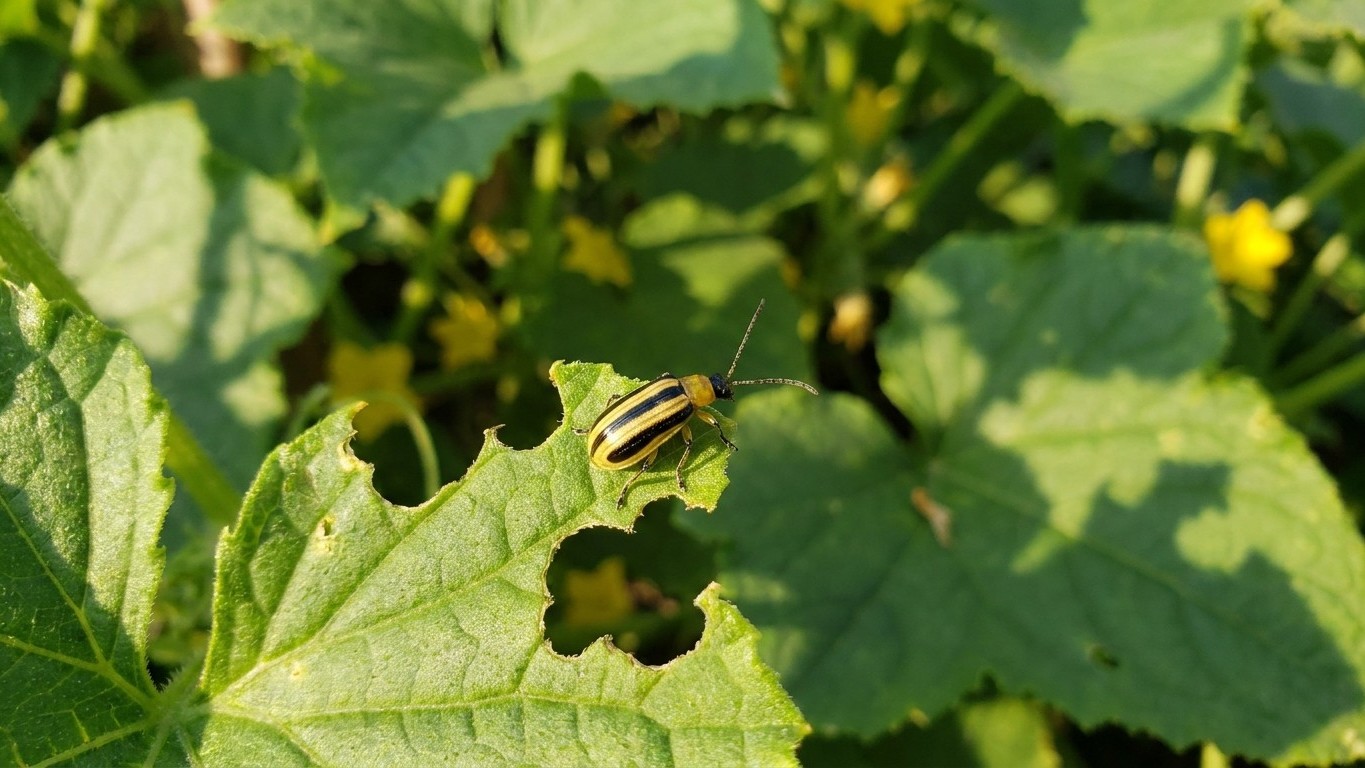

Striped cucumber beetle activity in Quebec typically begins in late May to mid-June, right when cucumber, squash, and melon seedlings emerge from the ground, and the insect stays active through August. The most effective controls combine timing your planting to dodge peak emergence, physical barriers like row covers, and targeted organic treatments once beetles show up on the leaves.
This isn’t a beetle you can ignore for a season and hope it sorts itself out. Beyond the chewed leaves and scarred fruit, it carries a bacterium that can wipe out an entire cucumber patch in about two weeks. Quebec’s shorter growing season actually works in gardeners’ favor here, but only if you know the beetle’s calendar.
Life Cycle and Timing in Quebec’s Climate

The striped cucumber beetle (Acalymma vittatum) overwinters as an adult, tucked into leaf litter, mulch, or the top few inches of soil near where cucurbits grew the previous year. In most of southern Quebec, including the Montreal, Montérégie, and Estrie regions, adults start stirring once soil temperatures climb past roughly 50°F. That usually lines up with the last week of May or the first two weeks of June, though a cold, wet spring can push emergence into late June.
Unlike states farther south where two full generations can cycle through a single summer, Quebec’s compressed warm season generally limits the beetle to one full generation, sometimes a partial second wave in exceptionally warm years like 2023 and 2025. That single-generation pattern matters for control: if you can protect seedlings during that first four-to-six-week emergence window, you’ve dodged the worst of it for the year.
Adults are easy to spot once you know what to look for: about a quarter-inch long, bright yellow-to-orange wing covers with three bold black stripes running lengthwise. They fly readily, which is why row covers need to be sealed at the edges rather than just draped over hoops. Larvae, which feed underground on roots and stems, are less commonly seen but do their own damage, particularly to squash and melon transplants set out early.
Why This Beetle Does More Damage Than Its Size Suggests
A quarter-inch beetle shouldn’t be able to kill a mature squash plant in under three weeks. But striped cucumber beetle isn’t just a chewing pest, it’s a vector for Erwinia tracheiphila, the bacterium behind cucurbit bacterial wilt. The beetle picks up the pathogen while feeding on an infected plant, then deposits it in fresh feeding wounds on healthy plants through its frass. Cucumbers and muskmelons are highly susceptible; squash and pumpkins tend to tolerate the disease better, though certain squash varieties still wilt fast.
Bacterial wilt symptoms show up as sudden daytime wilting of individual leaves or entire vines, even when soil moisture looks fine. There’s no cure once a plant is infected. That’s the real reason growers in the Beauce and Lanaudière regions treat cucumber beetle control as prevention-first rather than damage-control-after-the-fact.
Young seedlings face the highest risk because they have less leaf tissue to spare and their stems are thin enough for larvae to girdle. A cucumber seedling that loses 25 percent of its cotyledon leaves to beetle feeding in the first ten days after emergence often never catches up in yield, even if it survives.
What Actually Stops It
No single tactic handles this beetle on its own. Growers who get consistent results in Quebec gardens layer two or three methods depending on how many cucurbit plants they’re protecting and whether pollination timing allows for covers.
Physical Barriers and Timing
Floating row covers made of spunbonded polyester, sealed tight at soil level with stakes or soil, block adult beetles from reaching seedlings entirely. The catch: cucurbits need pollinators to set fruit, so covers have to come off once female flowers appear, typically three to four weeks after transplanting. That timing window is exactly why delayed planting helps: pushing transplant dates to mid-June instead of late May, after the first beetle emergence wave has already searched for food elsewhere and started dying off, cuts exposure significantly.
Perimeter trap cropping is the other timing-based trick worth knowing. Planting a ring of Blue Hubbard squash, which beetles find far more attractive than most cucumber or zucchini varieties, around the edge of a cucurbit bed draws adults away from the main crop. Some Quebec market gardeners report the trap crop absorbing 70 to 80 percent of beetle pressure when planted a week or two before the main crop and treated with an insecticide once beetles concentrate on it.
Monitoring and Organic Treatments
Yellow sticky traps placed at plant height give an early warning that beetles have arrived, usually a few days before visible feeding damage shows up on leaves. That head start matters because most effective organic treatments work best applied right as beetles establish rather than after a population has already fed for a week.
Kaolin clay, sold under the OMRI-listed name Surround WP among others, coats leaves in a fine white film that beetles find irritating to walk and feed on. It needs reapplication after rain but causes no harm to pollinators, which makes it a solid choice once flowers open and covers have to come off.
Spinosad-based insecticides, derived from a naturally occurring soil bacterium, kill beetles on contact and through ingestion within a day or two, and they’re approved for organic production in Canada. Pyrethrin sprays offer another botanical option with faster knockdown but shorter residual activity, meaning more frequent applications during heavy pressure.
Beneficial nematodes applied to soil around transplants target the larval stage before it can girdle roots. This tactic works best as a preventive soil drench at planting time rather than a rescue treatment once adults are already swarming the leaves.
Reducing Pressure Year Over Year
Crop rotation matters more for this beetle than for many other garden pests, because adults overwinter close to where cucurbits grew the season before. Moving cucumber, squash, and melon plantings to a different part of the yard or garden each year, ideally at least 50 feet from the previous location, forces overwintered beetles to search farther for a host, and some simply won’t find one before conditions turn unfavorable.
Cleaning up plant debris in the fall removes overwintering sites directly. Beetles tuck into old squash vines, fallen leaves, and mulch left in place through winter, so a thorough fall cleanup in cucurbit beds, followed by tilling the top few inches of soil, disrupts a chunk of the local population before it ever gets a chance to overwinter.
Variety selection plays a smaller but real role. Some cucumber and squash cultivars produce lower levels of cucurbitacins, the bitter compounds that make cucurbit leaves attractive to striped cucumber beetle in the first place. Seed catalogs don’t always flag this trait explicitly, but growers who’ve tracked beetle counts across varieties in the same bed often notice certain squash types drawing noticeably fewer beetles than others planted just a few feet away.
One detail that surprises a lot of home gardeners: adult beetles can survive a light frost, tucked into leaf litter, and still emerge functional the following spring. A single mild Quebec winter with limited snow cover, which insulates less than a deep, consistent snowpack, can actually increase overwintering survival rates compared to a colder but more consistently snow-covered winter. That’s part of why beetle pressure varies noticeably from one growing season to the next, independent of anything a gardener did differently in their own plot.
Related guides
- Striped cucumber beetle in Ontario: When It Shows Up and What Stops It
- Striped cucumber beetle in New Brunswick: When It Shows Up and What Stops It
- Striped cucumber beetle in South Carolina: When It Shows Up and What Stops It
- Striped cucumber beetle in Connecticut: When It Shows Up and What Stops It