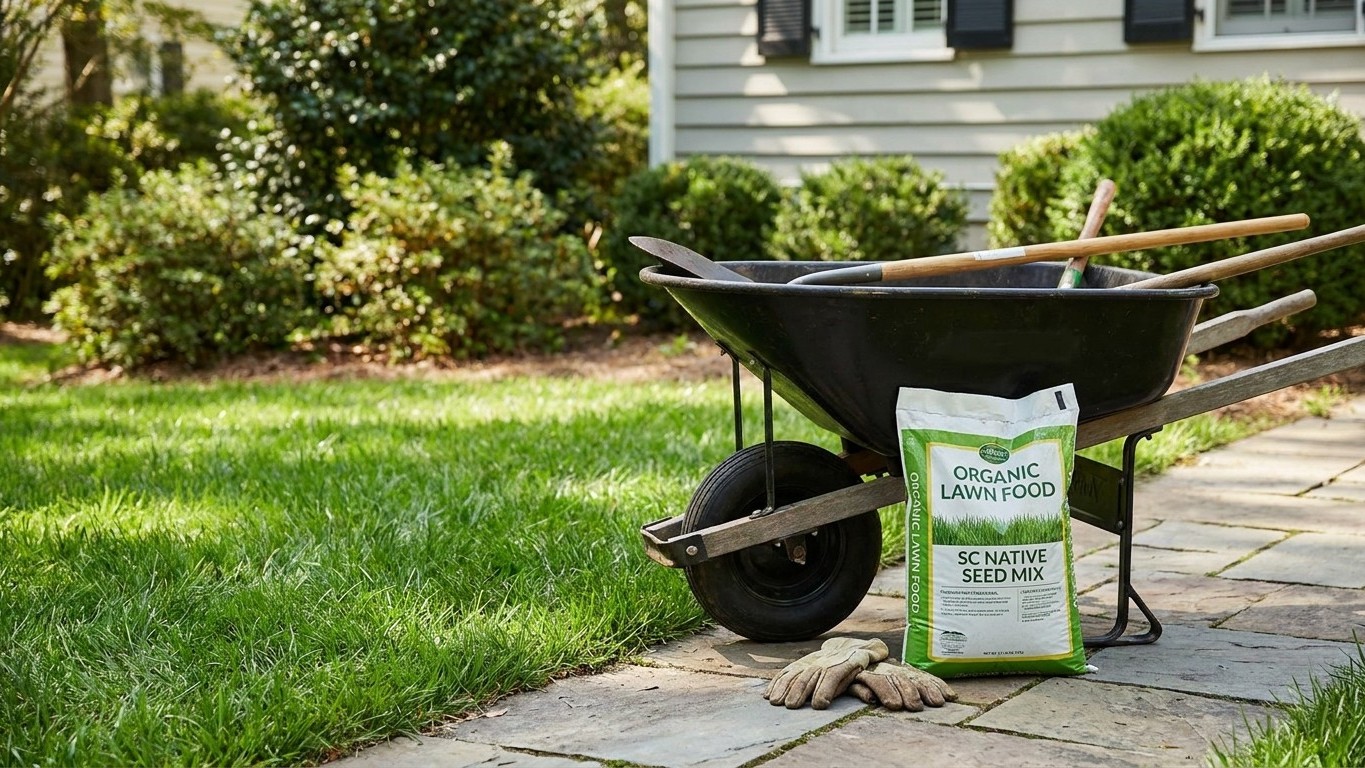

What grass belongs in your yard? Bermuda, Zoysia, Centipede, or St. Augustine — whichever one is already growing there, because South Carolina’s hot summers and mild winters rule out fescue and bluegrass before you even start. Walk your yard now and identify which of the four is actually rooted in, since that’s what decides everything after this: when you feed it, how often you mow it, and how much water it wants through the summer — the South Carolina lawn Best grass guide breaks down how to make that call. Get the grass right first, then the calendar makes sense — see the full South Carolina lawn Calendar for what to do and when.
Which grass belongs in South Carolina

South Carolina lawns run on warm-season grass, and the record from Charleston explains why. NOAA’s NCEI 1991-2020 climate normals put the number of days a year at or above 90°F at 55.1, and the mean minimum for the coldest month at 37.5°F. That combination, real heat paired with mild winters, is exactly what warm-season turf is built for and exactly what rules out a cool-season lawn: fescue and bluegrass thin out and go patchy through a summer with that many 90-degree days.
The two numbers that decide it
Fifty-five days above 90°F a year is enough heat stress to wear down a cool-season lawn’s root system before fall even arrives. At the other end, a coldest-month minimum of 37.5°F rarely produces a hard, sustained freeze, so warm-season grass here does not need the deep winter dormancy that colder inland stations force on it. Both figures come from the Charleston reference station. Inland and upstate counties run cooler in winter and drier in summer, and a lawn near the North Carolina line can sit closer to the transition climate that a state like Tennessee deals with, where neither warm-season nor cool-season grass has a clean advantage.
Seven species built for this heat
Clemson Cooperative Extension’s HGIC 1214 fact sheet names seven grasses for this climate: Bermudagrass, Centipedegrass, St. Augustinegrass, Zoysiagrass, Bahiagrass, Carpetgrass and Seashore Paspalum. Bermudagrass takes full sun and heavy foot traffic and recovers fastest from damage. St. Augustinegrass tolerates shade a Bermuda lawn would thin out under. Centipedegrass asks for the least fertilizer and mowing of the group, which is why it shows up so often on sandy Lowcountry soil. Zoysiagrass builds the densest turf of the seven but grows in slowly from sprigs or plugs. None of the seven is a universal choice: the right one depends on how much sun the yard gets, how much wear it takes, and how much mowing and feeding the owner wants to keep up with.
When to seed or sod here
Clemson Cooperative Extension’s HGIC 1203 fact sheet sets the general windows: warm-season grasses go in around May, cool-season grasses in mid to late September. Since this state’s climate points to warm-season turf, May is the window that matters here, and it holds because the ground has warmed enough for Bermudagrass, Zoysiagrass, Centipedegrass and St. Augustinegrass to root and establish quickly.
Planting later than that window narrows the runway. NOAA’s NCEI 1991-2020 climate normals put the first fall freeze at the Charleston airport station (USW00013880) in the November 20 to December 5 range, with roughly a 30 to 70 percent probability of a 32°F freeze somewhere in that stretch. A lawn seeded or sodded in late summer has only a few months to build the root system it needs before growth slows for the year, and a lawn planted too late often looks thin through its first winter even though the grass itself is fine. Peninsular Charleston runs milder than that airport figure, and Upstate counties see both frost dates arrive closer together, so the safe planting season is shorter the further inland and uphill you go.
Sod skips some of this risk because it arrives already rooted, so a sodded lawn tolerates a slightly later start than one grown from seed or plugs. Seed and plugs need the full length of the warm growing season to fill in, which is why Clemson’s May date is written as a start, not a deadline. Pushing an install into June or July still works if watering keeps up, but it leaves less margin before fall. A cool-season lawn, of the kind grown further north in Massachusetts, is seeded in that September window instead, because its roots need to establish in cooling soil ahead of winter dormancy rather than summer heat.
The feeding calendar that fits this climate
Nitrogen goes down on a warm-season lawn’s schedule, not a date fixed by the calendar year. That means feeding follows the grass, not the month: a cool-season lawn up north is fed as it heads into fall growth, but every species recommended for South Carolina, Bermudagrass, Zoysiagrass, Centipedegrass and St. Augustinegrass, is fed from late spring through summer, while it is actively growing and can use the nitrogen instead of storing it as thatch.
Rates differ by species
Clemson Cooperative Extension publishes a separate maintenance calendar for each species, and the pounds of actual nitrogen per 1,000 square feet differ enough between them that using one grass’s program on another is a common way to burn a lawn or starve it. The Bermudagrass maintenance calendar (HGIC 1216) and the Zoysiagrass maintenance calendar (HGIC 1217) both call for more nitrogen across the season than the Centipedegrass calendar (HGIC 1215), which is built around a slow-growing, low-input lawn. The St. Augustinegrass calendar (HGIC 1218) sits between the two. Check the calendar for the grass actually growing in the yard before buying fertilizer, since the bag rate printed on the front of a fertilizer bag assumes a species it doesn’t name.
When to stop feeding
Timing the last feeding of the year is where the frost record matters again. Since NOAA’s NCEI normals put Charleston’s first fall freeze in the November 20 to December 5 window, the growing season for warm-season turf closes several weeks before that, as day length and soil temperature drop first. Clemson’s calendars for all four species end nitrogen applications well ahead of that window, not on it, because the goal is grass that has already hardened off by the time a freeze arrives, not grass still pushing new leaf tissue. Stopping on time matters as much as starting on time.
Mowing height and watering here
Each of the four widely grown species, Bermudagrass, Zoysiagrass, Centipedegrass and St. Augustinegrass, carries its own recommended mowing height, published on that species’ own Clemson maintenance calendar rather than as one number for the whole state. What holds across all four is the one-third rule: never remove more than a third of the leaf blade in a single pass. Skipping a mowing and then scalping the lawn back down to its target height stresses the grass more than mowing slightly too high ever would.
Mowing frequency should track growth, not the calendar. A lawn growing hard in the flush of late spring needs cutting more often than the same lawn in the flat heat of August, when growth slows even though the grass is still green.
An inch of water a week, from rain and irrigation combined, is the baseline figure most extension programs use for an established warm-season lawn. Charleston’s climate pushes that baseline up rather than down: NOAA’s NCEI 1991-2020 normals put 55.1 days a year at or above 90°F at the reference station, and that much heat drives evaporation and transpiration hard enough that a lawn on sandy Lowcountry soil, which drains fast and holds little reserve, often needs water more than once a week to hit the same inch-a-week total. Clay-heavier soil inland holds moisture longer and can go a full week between waterings without the grass showing stress. Watering deeply and less often beats a light daily sprinkle, since shallow watering trains roots to stay near the surface where heat and drought reach them first.
What goes wrong on lawns in South Carolina

Fungal disease in humid weather
The humidity that makes this state good for warm-season grass also makes it good for the fungus that attacks it. Large patch disease, still often called brown patch, shows up on Zoysiagrass, Centipedegrass and St. Augustinegrass during warm, wet stretches, usually as roughly circular patches of collapsed, tan-brown grass that spread outward at the edges. It tends to appear in spring and fall rather than the height of summer, when nights are humid but not yet consistently hot.
Dormant, not dead
A hot, dry stretch causes a different problem that isn’t a disease at all. Warm-season grass goes dormant and turns brown as a drought response, and brown dormant turf is not dead turf. The crowns below the soil line are usually still alive and will green back up once rain or cooler temperatures return. The mistake is treating that browning like an emergency and dumping fertilizer on a lawn that is conserving resources, not starving.
Weeds that never stop over winter
Winter here is where the region’s biggest weed problem shows up. NOAA’s NCEI 1991-2020 normals put Charleston’s coldest-month minimum at 37.5°F, mild enough that cool-season weeds like annual bluegrass and chickweed keep germinating and growing through winter instead of being killed back the way a hard freeze farther north would manage. That leaves a warm-season lawn dormant and undefended for months while weeds around it keep growing, which is why a pre-emergent herbicide applied before weeds germinate matters more in this climate than in a state with a harder winter.
Centipedegrass in particular struggles with a problem tied to how it is often fed. It is sensitive to high soil pH and to nitrogen applied heavier than its own low requirement, showing yellow, stunted growth that looks like a nutrient deficiency but is actually the opposite: too much fertilizer for a grass built to run lean.
Local help
A soil test through Clemson Cooperative Extension answers the pH and nutrient questions no article can, since results depend on the specific yard, not a state average. Contact the county office of the Clemson Cooperative Extension service for the current soil test kit and to get advice tuned to your county rather than the Charleston-area figures used here. County agents also know which species are already doing well on lawns nearby, which is often a faster answer than working from climate figures alone.
Choosing the Right Grass for Your Yard
Before you plant or feed anything, the first question is always which grass actually belongs in your South Carolina yard. That comes down mostly to sun. If you take a hard look at how much light your lawn gets each day, a guide to picking the right grass seed for a South Carolina lawn lays out why full sun changes everything, letting Centipedegrass thrive on little fertilizer or water, and what shifts once oak canopy starts cutting into those six hours. Start there to match the grass to the light your yard actually has, and the feeding and care decisions that follow will make a lot more sense.
Common questions
Will tall fescue survive in South Carolina?
Not reliably in most of the state. It’s a cool-season grass, and the summer heat that this climate produces wears it down over several seasons even where it can be kept alive with heavy watering and shade. Higher, cooler pockets of the Upstate are the exception, not the rule.
What’s the best grass for a shady South Carolina yard?
St. Augustinegrass tolerates more shade than the other species on Clemson’s recommended list, and Zoysiagrass handles moderate shade reasonably well. None of the seven species Clemson names for this climate holds up in deep, all-day shade, so a heavily wooded yard often does better with a shade-tolerant groundcover than with any turf grass.
Should I overseed with ryegrass for green color in winter?
You can, and plenty of South Carolina lawns do it for appearance, but it comes with a trade-off. The ryegrass competes with the warm-season lawn underneath as it tries to green up in spring, and mowing and feeding have to serve two grasses at once for a few weeks each year.
How long does new sod take to root in?
It depends more on watering than on the calendar. Sod needs consistent moisture in the first few weeks after installation to knit its roots into the soil below, and skipping even a few days of watering during that window can set it back noticeably, especially on sandy soil that drains fast.
Does Bermudagrass spread into flower beds and other grass?
Yes, and this is the most common complaint about it. Bermudagrass spreads by both above-ground stolons and below-ground rhizomes, which is exactly what makes it so good at recovering from wear and so hard to keep out of adjoining beds without a physical edging barrier.