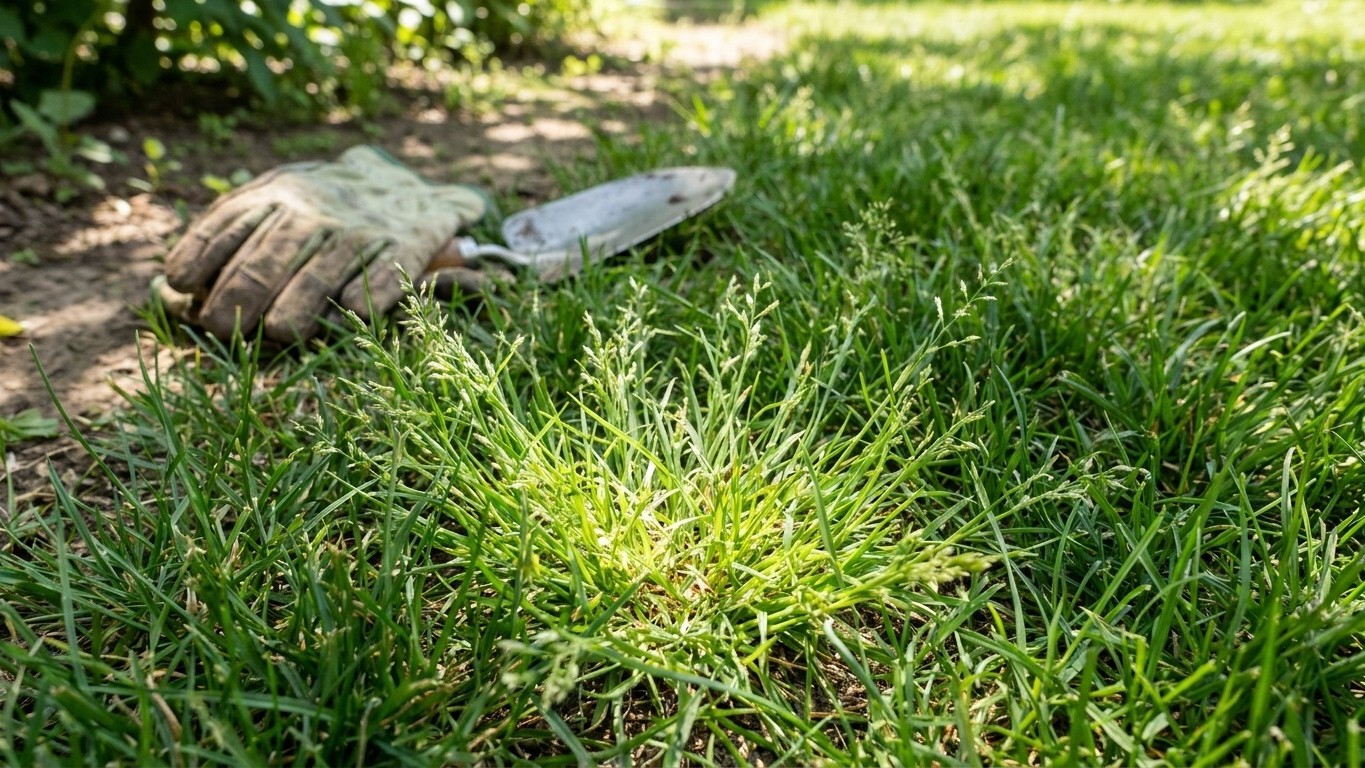

Annual bluegrass, Poa annua, is a cool-season grassy weed that mimics turfgrass so well most homeowners mow it for months before noticing the pale, seed-covered patches it leaves behind. It grows in dense clumps of lighter green than the turf around it, and it sets seed even at putting-green mowing heights, which is the one habit that gives it away. Check your lawn in early spring for whitish, grainy seed clusters sitting low in patches that look a shade lighter than the rest of the yard: that’s your confirmation.
How to be sure that is what you have

Annual bluegrass grows as a low, dense clump with folded, boat-shaped leaf tips and a light, almost yellow-green color that stands out against darker turf. It has a shallow, fibrous root system and no rhizomes, so a patch spreads by seed rather than by creeping underground. The tell nobody misses once they know it: Poa annua sets seed heads even when mowed at a fraction of an inch, so a patch that looks fine in March can be studded with whitish, grainy clusters by April, days before the rest of the lawn has thought about flowering.
In late fall and winter it stays green while warm-season lawns go dormant, which is often the first time a homeowner notices it at all: a network of bright green patches sitting in an otherwise straw-colored yard. Through spring it thickens and seeds, then in early summer heat it dies back fast, leaving thin brown patches that look like disease but are really just the plant finishing its one-year life cycle.
Told apart from Kentucky bluegrass and rough bluegrass
The two plants people confuse it with are Kentucky bluegrass and rough bluegrass (Poa trivialis), both of which share the same folded leaf tip. The difference is persistence, not shape: Kentucky bluegrass is a perennial that spreads by rhizomes and holds its color through summer, while annual bluegrass has no rhizomes and typically dies out once summer heat arrives. Rough bluegrass, sometimes sold as a shade-tolerant turf species itself, has a glossy underside to the leaf and spreads by above-ground stolons rather than seed alone, and it tends to sit as a distinct light green patch year to year rather than collapsing all at once. If you’re unsure which of the three you’re looking at, pull a small tuft in early spring: shallow fibrous roots, no rhizome, and a seed head already forming point to annual bluegrass. For weeds generally, that same close look before you treat is worth the extra minute, as covered in our broader guide to Lawn Weeds.
Why it is in your lawn
Annual bluegrass does not invade a healthy, dense lawn. It moves into whatever gap the existing turf leaves open: compacted soil, low spots that stay wet, or a canopy thinned by mowing too short for the species you’re growing. Its seed needs light to germinate, so any bare or thinned patch, especially one that’s still moist after summer stress, is an invitation.
Where it takes hold
Compaction is the most common cause on residential lawns, particularly along paths, near gates, and anywhere foot traffic or a mower turns repeatedly. Compacted soil holds more surface moisture and drains poorly, exactly the conditions annual bluegrass seed prefers over deeper-rooted turf. Mowing height matters just as much: cutting a cool-season lawn shorter than its species tolerates thins the canopy and lets light reach the soil surface where dormant Poa annua seed is waiting.
| Grass | Recommended mowing height | Shade tolerance | Drought tolerance |
|---|---|---|---|
| Kentucky Bluegrass | 2 to 3 in | Fair | Fair |
| Fine Fescues | 2.5 to 3.5 in | Excellent | Good |
| Tall Fescue | 2.5 to 3.5 in | Good | Fair |
| Perennial Ryegrass | 2 to 3 in | Fair | Fair |
Mowing heights and tolerance ratings above come from Penn State Extension’s Lawn Establishment guide. A lawn mowed below the low end of that range loses density fast, and a thin cool-season lawn in late summer or fall is exactly when annual bluegrass seed germinates into the gaps. The same thinning pattern is what lets chickweed establish over winter, so if you’re seeing one you may well have both.
The window that decides everything
Annual bluegrass is controlled before it germinates or while it’s young and actively growing, not once it’s set seed. A pre-emergent herbicide has to go down before the seed sprouts, and by the time you can see the weed, that window has usually closed for the season.
Clemson Cooperative Extension’s tall fescue maintenance calendar (HGIC 1219) times pre-emergent applications to bloom stages of forsythia and dogwood rather than a calendar date, because soil temperature, not the calendar, triggers Poa annua germination. Watching those two shrubs bloom in your own yard is a more reliable signal than any date printed on a bag of product, since bloom timing already reflects your local soil warming.
Why a date on the bag isn’t enough
That bloom trigger arrives weeks apart across the country. A forsythia in the Deep South can flower well before one in the upper Midwest or New England, so a national product label that says to apply “in early spring” is really describing a moving target. Treat the bloom stage as the signal, not a specific week, and check your own state extension’s calendar for the grass species you’re actually growing, since cool-season and warm-season lawns run on different timelines entirely.
Warm-season lawns face the same weed on the opposite clock: annual bluegrass moves in while Bermudagrass, Zoysiagrass, St. Augustinegrass or Centipedegrass sit dormant and pale for winter, and the pre-emergent window has to close before the lawn greens back up rather than before a spring bloom. Clemson’s species-specific calendars, HGIC 1216 for Bermudagrass, HGIC 1217 for Zoysiagrass, HGIC 1218 for St. Augustinegrass and HGIC 1215 for Centipedegrass, each time that application differently, so checking the calendar for your actual species matters more than checking the calendar for the lawn down the street.
If you missed the pre-emergent window and the weed is already up, a post-emergent application is your remaining option, and it works best while the plant is young and still growing rather than after it has flowered and set seed. Once seed heads have formed, killing the plant does nothing to stop the seed already dropped into the soil, so late-season control is mostly about limiting this year’s plants rather than next year’s population.
Getting rid of it
Pulling annual bluegrass works, and as with most lawn weeds, mechanical removal is the right first move on a small patch. Because it has no rhizomes, a pulled clump does not regrow from a left-behind root fragment the way a creeping perennial weed can. The catch is timing: pull it before the seed heads open, or you’ll scatter next year’s population across the same patch of lawn while removing this year’s plants.
Pre-emergent options
For prevention, the pre-emergent actives most home growers can buy are prodiamine, pendimethalin and dithiopyr, all sold under various lawn-and-garden brand names rather than by active ingredient on the front label, so check the ingredients panel rather than the product name. These stop germinating seed and do nothing for a plant already up and growing, which is why the bloom-stage timing above matters more than the brand you choose.
Post-emergent options
Once annual bluegrass is visible and growing, the safe path for a home lawn is narrower. Some post-emergent actives sold for Poa annua control are labeled for use only on specific turf species and will injure or kill others in the same family, so read the turf-type restrictions on the label before you spray a mixed or unknown lawn. A nonselective active like glyphosate will kill it along with anything green it touches, which limits its use to spot treatment on lawns that are fully dormant, since actively growing turf takes the same damage as the weed. Timing any post-emergent spray to a cool, overcast stretch rather than a hot sunny day reduces the risk of scorching the turf around the treated patch.
Several of the more effective actives are restricted for homeowner purchase in some states, sold only to licensed applicators, so check with your state’s department of pesticide regulation or your extension office before assuming a product on a big-box shelf is the same one a lawn service uses. A local county extension agent can also confirm which actives are labeled for your particular turf species, since a treatment safe on Bermudagrass can be damaging on St. Augustinegrass.
Keeping it out
The lasting fix is a lawn thick enough that annual bluegrass seed never reaches bare soil with light on it. That comes down to three habits: mowing at the right height for your species, feeding on a schedule that builds density rather than just green color, and overseeding thin spots before they turn into open ground.
Mow at the top of the range, not the bottom
Kentucky bluegrass and perennial ryegrass hold up best at 2 to 3 inches, and fine fescues and tall fescue at 2.5 to 3.5 inches, all per Penn State Extension and Clemson’s HGIC 1214 fact sheet on selecting a lawn grass. Mowing at the upper end of that range through the stress months shades the soil surface and keeps light from reaching germinating weed seed, which does more for long-term Poa annua control than any single herbicide application.
For warm-season lawns, the same logic holds even though the numbers are different: Zoysiagrass and Bermudagrass can be mowed as low as 0.75 inches, but keeping them toward the higher end of their own range, and keeping St. Augustinegrass at its recommended 2.5 to 4 inches, preserves the canopy density that crowds weed seed out in the first place.
Fertilizing on the schedule laid out in Clemson’s HGIC 1201 fact sheet, rather than by the calendar alone, builds root and shoot density instead of just a flush of top growth that mows off and thins again. Overseeding bare or thin patches during the cool-season lawn’s own growing season closes the gap before weed seed gets the chance, and it’s the same principle that keeps shade-loving weeds like wild violet from settling into the thin turf under trees.
Common questions
Is annual bluegrass actually a type of grass or a weed?
It’s both, depending on where it’s growing. Poa annua is a true grass species, and on golf course putting greens it’s sometimes tolerated or even managed as turf, but in a home lawn planted to a different species it behaves as a weed because it dies out on its own life cycle and leaves bare patches behind.
Will it come back if I just let the brown patches fill back in?
Only if the surrounding turf is thick enough to close the gap before new seed germinates. If the patch stays thin, the seed that already dropped will fill it right back in with more annual bluegrass rather than with your lawn grass.
Can I just mow it shorter to stop it from seeding?
No, and this is the detail most people miss. Annual bluegrass sets seed heads even under very low mowing, so cutting shorter does not stop reproduction, and it further thins the canopy of whatever turf species you’re actually growing.
Does it die out completely in summer or does some of it survive?
Most of it dies with summer heat, but some biotypes behave more like a short-lived perennial and can persist through mild summers, especially in shaded or consistently damp spots. That’s part of why control that relies only on waiting for it to die back is inconsistent from one lawn to the next.