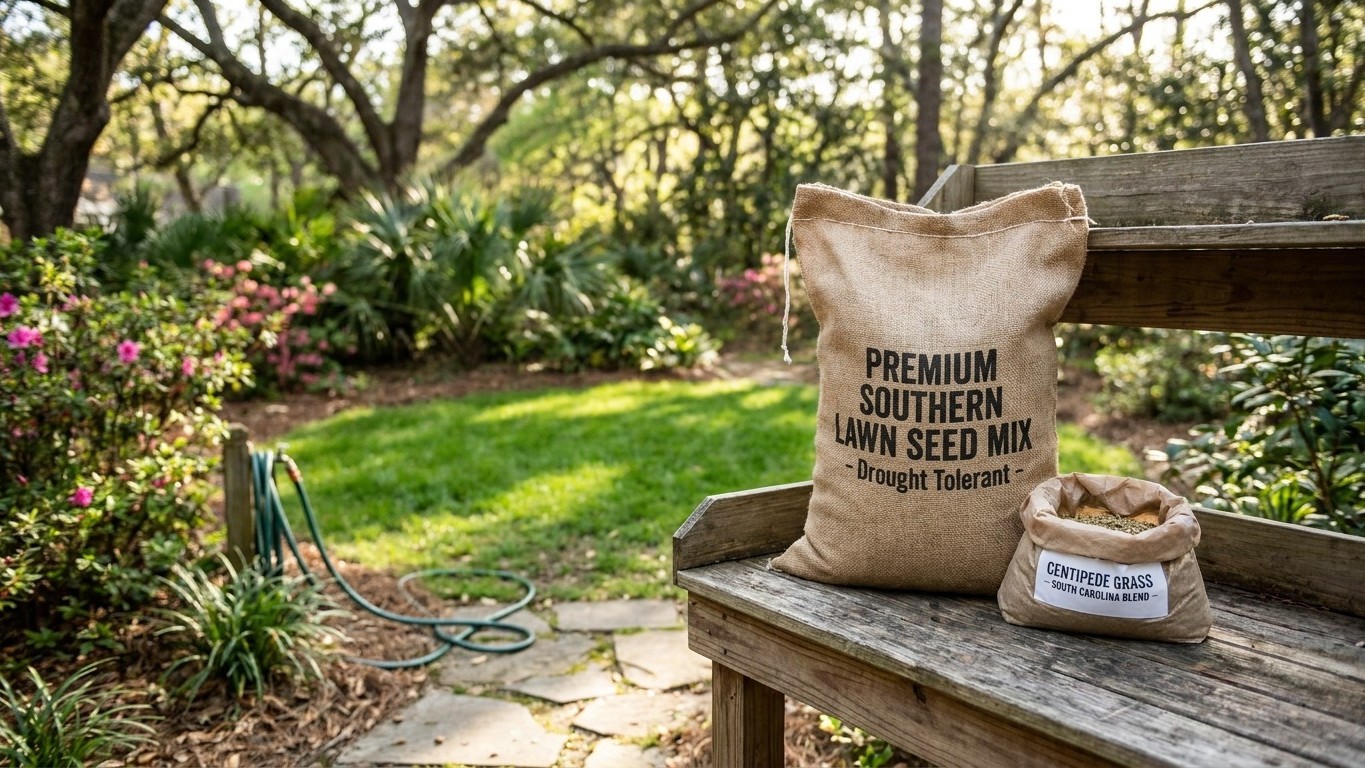

Full sun decides more here than any other factor: give a South Carolina yard six or more hours of it and Centipedegrass will carry the lawn on almost no fertilizer or water. Pull that sun back under oak canopy and Centipedegrass thins fast, handing the win to St. Augustinegrass instead. Move the lawn near tidal salt spray and Centipedegrass fails again, this time to Seashore Paspalum. Traffic and mowing tolerance settle what’s left, often tipping the choice toward Zoysiagrass.
The short answer for South Carolina
For most of South Carolina, the safest all-around pick is Centipedegrass for a low-input lawn in full to partial sun, or Zoysiagrass where you want a denser, more traffic-tolerant turf and are willing to pay more up front. Both are warm-season species, and Clemson Cooperative Extension (HGIC 1214) lists them among the seven grasses proven to hold in South Carolina’s climate:
- Bahiagrass
- Bermudagrass
- Carpetgrass
- Centipedegrass
- Seashore Paspalum
- St. Augustinegrass
- Zoysiagrass
That answer changes with three things: how much direct sun the lawn gets, how much foot traffic and mowing time you can give it, and how close you are to salt spray or standing water. A shaded lot under mature oaks does better with St. Augustinegrass than with Bermudagrass, which thins out badly once shade sets in. A lawn along the coast that takes occasional salt spray does better with Seashore Paspalum than with Centipedegrass, which has poor salt tolerance.
Why not a cool-season grass
The Homestead Post has assigned South Carolina, at the Charleston reference station, to the warm lawn zone, based on how many days run at or above 90F and how mild the coldest month’s overnight lows stay, read against the season tolerances Clemson Cooperative Extension publishes in HGIC 1214. Cool-season grasses such as tall fescue and Kentucky bluegrass are bred to survive a hard winter and go dormant in summer heat. In this zone they scorch and thin through the hot months and never fully recover before the next heat wave, which is why Clemson’s list of recommended species for South Carolina lawns is warm-season only.
Working through the year

Since this is a seed page rather than a maintenance calendar, the ranking below is about what you gain and give up with each species, not a month-by-month task list. For task-by-task timing once your grass is in the ground, Clemson’s species-specific maintenance calendars (HGIC 1215 through HGIC 1218) and The South Carolina Lawn Care Calendar, Month by Month lay out mowing height, feeding and irrigation windows in order.
Ranking the seven species by cost
Centipedegrass costs the least in upkeep. It grows slowly, needs little nitrogen, and tolerates the acidic sandy soils common across the Coastal Plain and Sandhills, but it goes off-color fast if it’s over-fertilized or over-limed, and it has almost no salt or heavy-traffic tolerance.
Bermudagrass costs the least in seed and establishes the fastest from a bag, and takes foot traffic and heat better than anything else on the list. In exchange it demands full sun, frequent mowing at a low height, and it spreads aggressively into beds and neighboring lawns.
Zoysiagrass gives the densest, most wear-resistant turf of the group and tolerates moderate shade better than Bermudagrass, but seeded Zoysia establishes slowly, often taking a full season or more to fill in, and most homeowners plant it as plugs or sod instead of seed.
St. Augustinegrass tolerates shade better than any other species on this list, which makes it the default under mature trees, but it is rarely sold as seed at all. It is almost always established from sod or plugs, and it has the weakest cold tolerance of the group.
Bahiagrass costs little, seeds easily, and shrugs off drought on poor, sandy soil better than the others, but its coarse leaf blades and tall seed heads give it a rougher look than a Bermudagrass or Zoysiagrass lawn.
Carpetgrass tolerates wet, poorly drained soil that would kill Bermudagrass, which makes it useful in low spots and ditch banks, but it has poor drought tolerance and thins out fast the moment a dry summer hits.
Seashore Paspalum is the only species on Clemson’s list bred for salt tolerance, which matters directly on the coast, but it needs more frequent mowing and feeding than Centipedegrass to look as good.
When to actually put seed down
Warm-season seed needs warm soil to germinate, so it goes down well after the last spring frost risk has passed, once the ground has warmed through. It also needs enough growing season left to root in before the lawn goes dormant. NOAA’s 1991-2020 climate normals put the first fall freeze near Charleston, station USW00013880, in the November 20 to December 5 window, so late-summer seeding anywhere near that date leaves too little time for a seedling stand to establish before cold shuts growth down.
What changes across South Carolina
The figures above come from the Charleston-area station used in NOAA’s climate normals, and South Carolina is not one lawn. The Upstate, around Greenville and Spartanburg, sits at a higher elevation on the edge of the Blue Ridge foothills, and NOAA’s data note that this part of the state runs its frost dates several weeks tighter at both ends of the growing season than the Charleston reference point. A Zoysiagrass or Bermudagrass lawn seeded there needs to go down earlier in spring and finishes its fall dormancy earlier too.
The coast runs milder than the airport
Peninsular Charleston itself runs milder than the airport station the normals are drawn from, buffered by the harbor and the Atlantic. Lawns right on the water tolerate a later fall seeding date than the general figure suggests, and see less risk of a hard freeze setting back a young stand of grass.
Salt, sand and the Midlands
Along the immediate coast, salt spray and brackish groundwater push the choice toward Seashore Paspalum over Centipedegrass, which has weak salt tolerance. Inland on the Sandhills and Coastal Plain, the naturally acidic, sandy soil is exactly what makes Centipedegrass cheap to keep, since it needs little lime or nitrogen to stay green. The Midlands and Piedmont carry heavier clay soils that hold water and nutrients longer, which favors Zoysiagrass and Bermudagrass lawns that can use the extra fertility, but also drain slower after a hard rain, which is where Carpetgrass earns its place in the low, wet corners of a yard that stay soggy after a storm.
None of this changes the underlying rule. Every one of these adjustments still starts from a warm-season species, and the zone itself, driven by summer heat and mild winters, does not flip anywhere in South Carolina. Only the degree of it does.
The mistakes this climate punishes
Feeding a warm-season lawn in fall
Warm-season grasses like Bermudagrass, Centipedegrass and Zoysiagrass slow down and store energy for winter as day length shortens, and a dose of nitrogen at that point pushes soft new growth right when the plant should be hardening off. Clemson’s maintenance calendars for these species (HGIC 1215 through HGIC 1218) all stop nitrogen well before the first fall frost window, and a late feeding shows up the following spring as dead patches where the tender growth didn’t survive winter, not as damage you’ll see the day you apply it.
Seeding a cool-season lawn out of season
Fescue seed sown in the heat of a South Carolina summer germinates into seedlings that face weeks of 90-degree afternoons with no root system built up to handle it, and most of the stand dies within a month. This is a timing mistake, not a species mistake. Even where a cool-season patch makes sense, such as a shaded Upstate lawn overseeded for winter color, it belongs in the cooler part of the year, never in the middle of summer.
Mowing too short in the heat
Scalping a warm-season lawn during a July heat wave removes the leaf area the plant needs to shade its own roots and crown, and the stress shows up as browning and thinning within a week or two, right when the lawn should be at its thickest. Raise the mower a notch through the hottest stretch of summer rather than cutting back to a spring height.
Mistaking dormancy for death
A warm-season lawn that browns after the first hard freeze, somewhere in the November 20 to December 5 window near Charleston per NOAA’s 1991-2020 normals, is dormant, not dead, and it comes back with warmer soil in spring. Ripping out a brown lawn in December and reseeding it is the single most common overreaction this climate produces, and it wastes both the seed and the money.
Checking this against your county
Every figure above is tied to the Charleston-area station and to statewide extension publications, and your county office can tell you exactly how it differs. Clemson Cooperative Extension operates through the Home & Garden Information Center and county offices statewide, reachable through the main Clemson Extension portal. A call to your county’s office will confirm local frost timing, soil test results, and which of the seven recommended species does best on your particular soil. If you have not yet walked through the basics of establishing a lawn in this state, South Carolina Lawn Care is the place to start before you choose a species.
Common questions
Can I still plant grass seed in South Carolina in the fall?
Only if you get it down well ahead of the first freeze, and by fall most of that window has already closed for warm-season species. NOAA’s 1991-2020 climate normals put the first freeze near Charleston between November 20 and December 5, and a warm-season seedling needs more than a few weeks of warm soil to root in before cold stops growth. If you’re past that point, wait for soil to warm again in spring rather than seeding into a lawn that’s about to go dormant.
Will Centipedegrass fill in bare spots on its own?
Eventually, but slowly. Centipedegrass spreads by above-ground stolons rather than seed once it’s established, and a bare patch can take most of a growing season to close in, sometimes longer on poor soil. Overseeding the spot directly, rather than waiting on the surrounding grass to creep over, closes it faster.
Can I buy St. Augustinegrass as seed?
Rarely, and most garden centers in South Carolina won’t carry it as seed at all. St. Augustinegrass is almost always established from sod or plugs, which is part of why it costs more up front than a Bermudagrass or Centipedegrass lawn started from a bag of seed.
Why did my new lawn turn brown right after the first frost?
That’s normal dormancy, not a dead lawn. Warm-season species drop their green color once temperatures fall near the first freeze, which NOAA’s normals place between November 20 and December 5 near Charleston, and they green back up on their own once the soil warms in spring. Judge whether a new stand actually failed by checking for green growth the following spring, not by the color it turns in December.