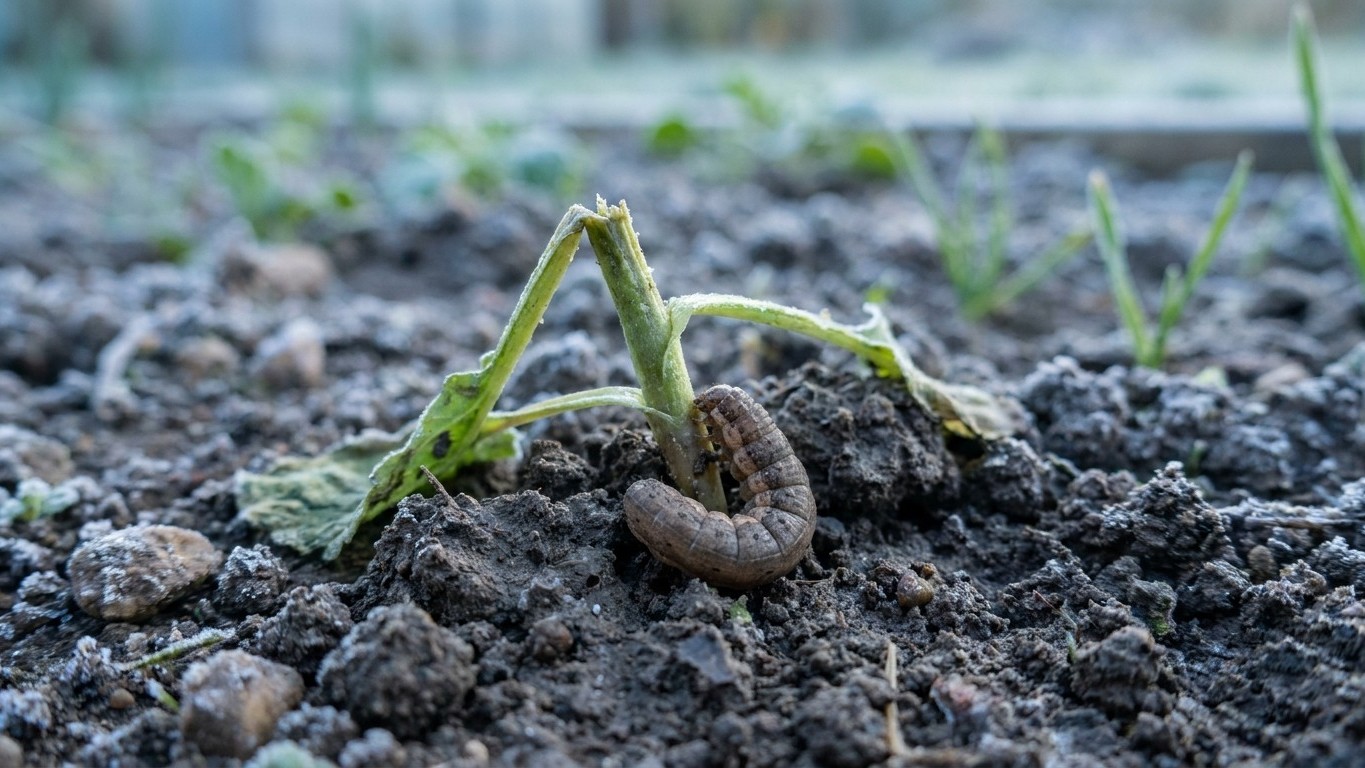

Cutworms show up twice a year in Wyoming: a late-summer to fall hatch that feeds until frost, and a second feeding push in early spring once the ground thaws. The species behind most of the trouble, the army cutworm, spends winter as a partly grown larva tucked a few inches under the soil, then finishes eating in April and May before pupating and turning into the moths Wyomingites know as “millers.” Stopping them means timing your defense to that two-season pattern rather than treating cutworms as a one-shot summer pest.
Physical barriers around seedlings, fall tillage that exposes larvae to freezing temperatures and predators, and targeted insecticide applications in early spring (before larvae get large and hard to kill) are what actually move the needle. Waiting until you see wilted, toppled plants in June means you’re already behind the larvae, which by then have grown thick enough to shrug off a lot of home remedies.
The Army Cutworm Timeline That Defines Wyoming Infestations

Wyoming’s cutworm story is really the army cutworm’s story, and it runs on a clock most homeowners never think about. Female moths lay eggs on soil and plant debris starting in late summer, often in fields of winter wheat, alfalfa, or disturbed ground near gardens. Those eggs hatch within a couple weeks, and the young larvae feed through September and October on whatever green growth is available, chewing leaves and stems close to the ground.
Cold weather doesn’t kill them outright. The larvae dig down and go dormant, riding out winter as partially grown grubs. Come March or April, as soon as soil temperatures climb enough, they resume feeding with an appetite that makes up for lost time. This is the stretch that does the most visible damage to lawns, winter wheat, and early garden plantings, because the larvae are near full size and eating aggressively before they pupate in May or June.
After pupation, the adults emerge as the gray, unassuming moths that flood porch lights and window wells across the state every spring. Those are the “millers” that migrate west into the Bighorns, the Wind River Range, and other high country to feed on nectar through summer, then return to the lowlands in late summer to lay the next generation’s eggs. It’s a closed loop, and understanding it is the difference between spraying at the wrong time and actually breaking the cycle.
Why Wyoming’s Climate Shapes When You’ll See Damage
Elevation and temperature swings across the state stretch or compress that timeline depending on where you live. In the eastern high plains around Cheyenne, Torrington, and the wheat country near the Nebraska line, fall feeding often starts earlier because fields are already established with winter wheat that gives newly hatched larvae something to eat right away. Spring feeding in that region can wrap up faster too, since lower elevations warm sooner.
Head into the mountain valleys or the Big Horn Basin, and the calendar shifts. Cooler soil temperatures in spring delay when overwintered larvae resume feeding, sometimes pushing peak damage into May rather than April. Gardeners in Jackson Hole or the higher elevations around Lander tend to see a narrower, later window of activity compared to those farming in Goshen or Platte County.
Most of Wyoming sits in USDA hardiness zones 3 through 5, and that cold is a double-edged sword. Hard winters do reduce cutworm survival somewhat, but the larvae that make it through are adapted to exactly this kind of climate, which is part of why army cutworm outbreaks are a recurring regional issue rather than a rare fluke. A mild winter followed by a wet spring, conditions that have shown up more often in recent years across parts of the Great Plains, tends to produce heavier larval survival and bigger spring feeding damage.
Identifying Cutworm Damage Before It Spreads
The classic sign is a seedling or young plant cut clean through near the soil line, sometimes lying on the ground a few inches from its own root, as if someone snipped it with scissors. Cutworms feed at night and hide during the day, curled into a tight C-shape just under the soil surface or beneath debris, which is why the damage often looks like it appeared overnight.
Lawns hit by cutworms show irregular brown patches, especially where grass was recently seeded or is under drought stress. In wheat and alfalfa fields, the damage shows up as thin, ragged stands with plants missing entirely in patches rather than evenly stunted growth.
Wyoming hosts a few different cutworm species beyond the army cutworm, including the black cutworm and the variegated cutworm, and telling them apart matters less for control timing than knowing which season you’re in. Fall damage on newly emerged winter wheat or fall-planted vegetables points to the first-generation larvae. Damage that shows up on lawns, garden transplants, or field crops in April and May is almost always the overwintered larvae finishing their growth before pupation.
Checking for Larvae Without Guessing
A quick way to confirm cutworms rather than another pest: dig an inch or two into the soil right next to a damaged plant in late afternoon or early morning. Grayish-brown or dull-colored caterpillars curled up near the base are the giveaway. If you find nothing but the damage is still spreading, wait for dusk and check again with a flashlight, since larvae that fed the night before sometimes retreat farther than a shallow scratch will reveal.
What Actually Stops Cutworms in Wyoming Yards and Fields
Control works best when it lines up with the two feeding windows rather than being applied at random during summer, when most of the damage is already done and larvae are heading toward pupation anyway.
Cultural and Physical Controls
Fall tillage after harvest is one of the more effective, low-cost tools available to anyone managing a garden bed or small field. Turning the soil exposes eggs and young larvae to birds, ground beetles, and freezing temperatures, cutting down the population that would otherwise overwinter. Clearing plant debris and weedy growth in late summer removes the egg-laying sites females prefer in the first place.
For individual garden plants, a simple physical collar (a strip of cardboard, a cut-open can, or plastic tubing pressed an inch into the soil around the stem) blocks larvae from reaching the base of a seedling. This works particularly well for tomatoes, peppers, and brassicas set out in May, right when overwintered larvae are finishing their feeding.
Delaying planting by even a week or two in spring, when practical, lets larvae move further along toward pupation before your seedlings are vulnerable. It’s not always an option for commercial growers on a tight schedule, but for home gardeners it’s a free way to dodge the worst of the damage window.
Biological and Chemical Options
Natural predation does more heavy lifting than most people realize. Ground beetles, birds, and parasitic wasps all take a toll on cutworm populations, and disturbing soil in fall (rather than leaving it undisturbed and residue-covered) gives those predators better access to eggs and young larvae.
Bacillus thuringiensis, sold under various brand formulations as a biological insecticide, works against young larvae when applied in early fall soon after hatching, but it’s far less effective against the larger, overwintered larvae feeding in spring. That timing gap is one reason fall applications tend to outperform spring ones for this particular tool.
Beneficial nematodes applied to moist soil can reduce larval numbers in garden settings, though they need consistent soil moisture and moderate temperatures to establish, which narrows their usefulness in Wyoming’s drier, more variable spring conditions. For larger infestations in field crops, targeted insecticide applications timed to early spring, before larvae reach their final growth stage, remain the standard recommendation from agricultural extension programs across the region.
One detail that surprises a lot of newcomers to the state: the same miller moths causing headaches around porch lights in May and June are the reason grizzly bears in Yellowstone and the surrounding high country spend weeks each summer flipping rocks and digging through talus slopes at elevations above 10,000 feet. The moths migrate up to feed on nectar and cluster under rocks by the thousands, and bears have learned to eat them by the mouthful for the fat content, a food source researchers have tracked as a meaningful part of the late-summer diet for some grizzly populations in the Absaroka and Wind River ranges.