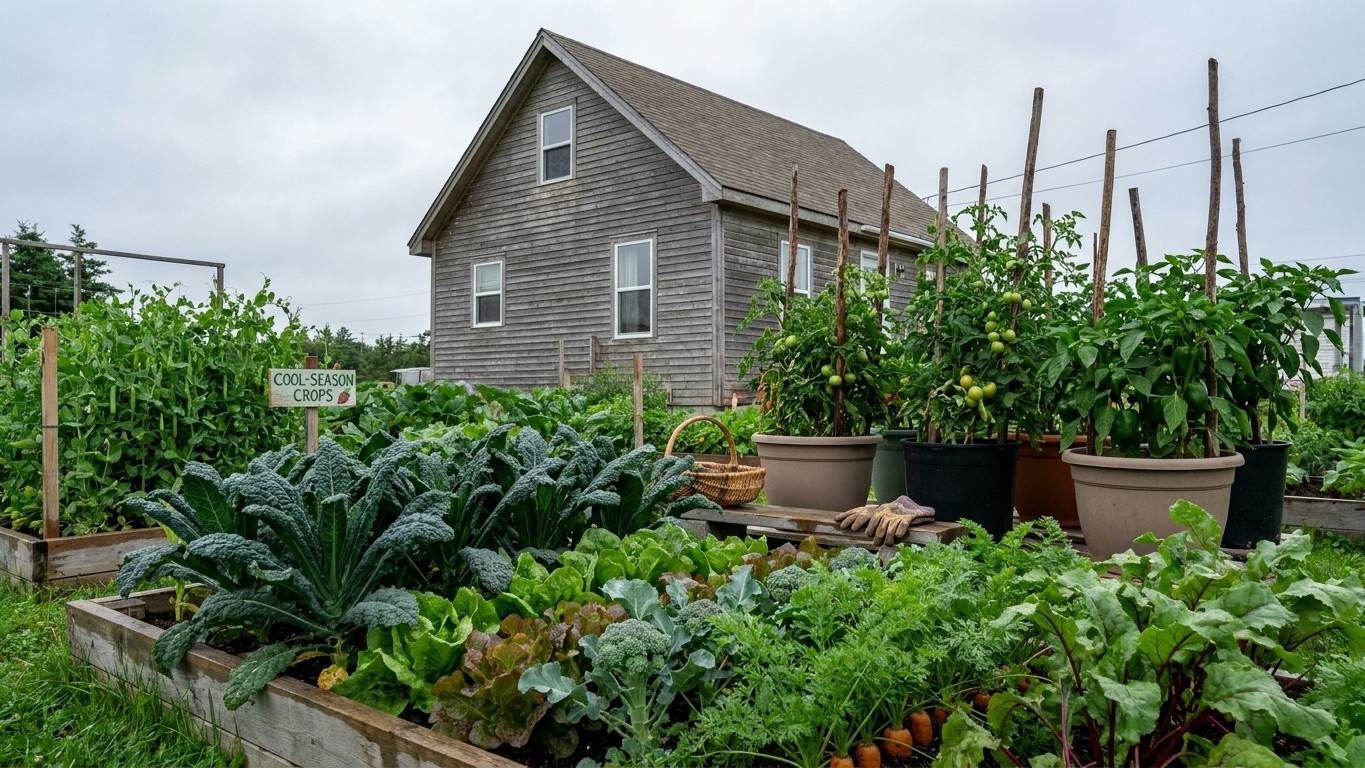

Newfoundland and Labrador gardens work inside a frost-free window that runs from late May to mid-October, roughly 140 days, in a climate that almost never gets hot. That combination, cool summers and a mid-length season, shapes everything from which vegetables ripen to which pests show up and when. Here’s what the numbers actually mean for what you plant.
How long your season really is

The province’s reference city, St. John’s, sits in Canadian hardiness zone 6a. The average last spring frost falls on May 30, and the average first fall frost arrives October 17. Put those two dates together and you get a frost-free window of about 140 days, call it four and a half months.
| Measure | Value |
|---|---|
| Hardiness zone (Canadian system) | 6a |
| Average last spring frost | May 30 |
| Average first fall frost | October 17 |
That 140-day window is not a small season, but it is not a generous one either. It rules out crops that need a long, uninterrupted stretch of warmth to mature outdoors, think field corn, dry beans, or the longest-maturing squash and pumpkin varieties bred for warmer regions, and it also affects When to Carve a Pumpkin in Newfoundland and Labrador, since fruit needs to reach full maturity before the first fall frost. It comfortably fits most cool-season vegetables, a category that includes staples such as those covered in Growing Potatoes in Newfoundland and Labrador, in Growing Carrots in Newfoundland and Labrador, and in Growing Parsnips in Newfoundland and Labrador, along with a good number of standard-maturity tomatoes and peppers, provided they go in as transplants rather than seed, a strategy detailed in Growing Peppers in Newfoundland and Labrador.
Averages are not guarantees
May 30 and October 17 are means, calculated from three decades of Environment and Climate Change Canada data at the St. John’s A station. A mean date is exactly what it sounds like: half the years on record had frost later than that, and half had it earlier. Treat these dates as the midpoint of a window, not a safe line to plant against. A gardener who sets out tomato transplants on May 31 every year will eventually lose a crop to a late frost, because roughly half of all years run behind schedule by definition.
Worth flagging too, the province is not one climate. St. John’s sits on the Avalon Peninsula, moderated by the ocean. Move inland, north, or into Labrador, and both frost dates shift, often by two to three weeks. These figures describe the reference station, not your specific yard.
What the summer does to a garden here
The reference station records zero days a year above 90°F. None. That single fact tells you more about the character of a Newfoundland and Labrador garden than the length of the season does. Heat above roughly 90°F is what causes tomatoes to drop their flowers instead of setting fruit, forces lettuce to bolt, and makes it impossible to keep cool-season crops going through midsummer in warmer parts of the country. None of that happens here, because the heat that triggers it never arrives.
The flip side is that heat-loving crops don’t get the accumulated warmth they need either. Tomatoes, peppers, corn, and melons ripen on heat units as much as calendar days, and a summer that never tops 90°F, and rarely gets close, means these plants mature slower and less reliably than the same varieties would in a hotter region, even given an identical number of frost-free days.
That changes the shape of the gardening year. In places with brutal midsummer heat, gardeners often run two shoulder seasons, a spring planting and a fall planting, with a dead, bolt-and-wilt stretch in between. Newfoundland and Labrador doesn’t have that problem. The season here runs as one continuous, cool stretch from late May to mid-October, which favors crops that tolerate or prefer cool conditions throughout, brassicas, peas, root vegetables, salad greens, over crops that need sustained heat to perform.
The other number worth holding onto is the coldest month’s average daily minimum: 16.4°F. That’s the figure that decides what survives the winter outdoors at all, separate from the growing-season question entirely. It’s not a record low, it’s a typical one, and it’s cold enough to eliminate a wide range of perennials and shrubs that would otherwise be tempting to plant based on the 6a zone rating alone.
What tends to go wrong in Newfoundland and Labrador
No Canadian provincial extension service publishes a home-garden pest list for this province the way US state extensions do. The closest documented reference comes from the University of Maine Cooperative Extension, across the Gulf of Maine but sharing enough climate and cropping overlap that its pest calendar is a reasonable starting point, not a guarantee. The biology tends to cross the border; the exact timing does not always. Confirm anything you find on a leaf or stem with your own provincial agriculture office before acting.
- Cabbage maggot — shows up early in the season, right as brassica transplants (cabbage, broccoli, radish) go into the ground; larvae feed on roots and can kill young plants outright.
- Colorado potato beetle — appears as potato foliage fills in, typically early to midsummer; both adults and larvae strip leaves and can defoliate a planting fast.
- Striped cucumber beetle — arrives as cucumber, squash, and other cucurbit seedlings emerge in early summer; feeds on leaves and can also spread bacterial wilt.
- Lily leaf beetle — active from early spring as lilies push new growth; adults and larvae chew leaves and flower buds through the season.
That’s four pests worth watching for, not twenty to memorize. A short, accurate list beats an exhaustive one, especially since none of this substitutes for an actual diagnosis on your own plants.
Where to check before you plant
Everything above describes conditions at a single reference station in St. John’s. Newfoundland and Labrador spans a huge range of latitude and coastline exposure, from the Avalon Peninsula to interior Labrador, and a planting calendar built around the provincial capital can be off by weeks once you move a few hours in any direction, especially inland or north.
The province’s own land-grant equivalent, the Department of Fisheries, Forestry and Agriculture, is the right first stop for anything specific to your region. From there, your regional agriculture or agrifoods office can speak to local frost patterns, soil conditions, and pest pressure in a way a province-wide average never can.
Use the zone, the frost dates, and the heat numbers to frame your expectations, then check with your regional office, or the crop-specific guides on this site, before committing seed money to anything that needs every one of those 140 days to work.
Where to Go Next
Everything above comes down to timing against a short season and a hard, early cold — and that plays out differently depending on what you’re growing. Garlic actually uses that cold to its advantage: growing garlic in Newfoundland and Labrador means planting a clove in fall so it sits through the freezing ground of October and November before spring pushes it up. Tomatoes have the opposite problem, since the frost-free window is only 139 days long, and growing tomatoes in Newfoundland and Labrador walks through starting indoors and picking a fast variety so there’s time to ripen before that first fall frost shows up. And if it’s not a vegetable bed but the ground around it you’re dealing with, Newfoundland and Labrador lawn care covers why a summer with zero days above 90°F rules out bermudagrass and zoysia entirely, and what a lawn built for 16.4°F winter lows actually needs fed and when. Each one takes the same climate numbers from this page and turns them into planting dates worth following.