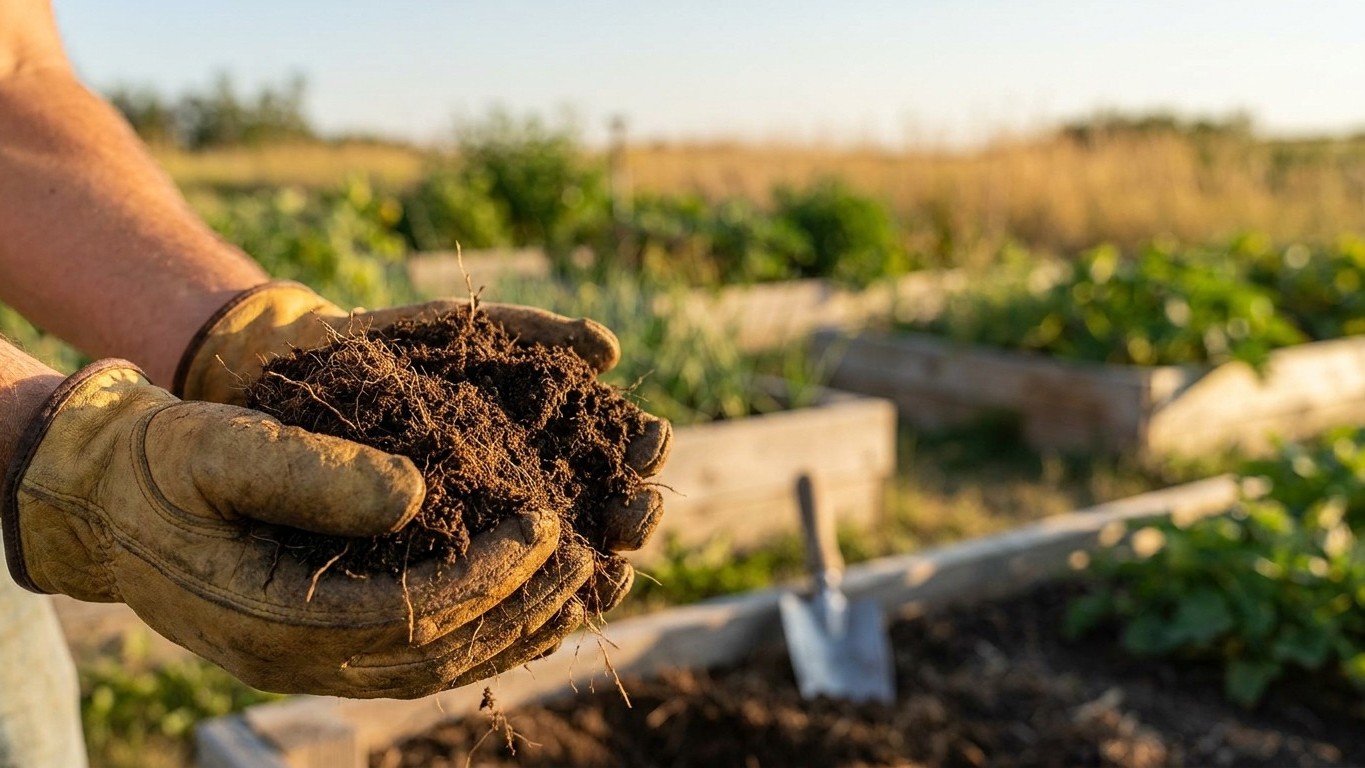

Most gardens in Saskatchewan sit on top of a Chernozem, the deep, dark grassland soil that built the prairie’s reputation for grain. It runs close to neutral, holds a decent amount of organic matter, and drains well. But “most” is not “yours,” and the only way to know what you’re actually digging into is to test it yourself.
What is under your garden

The soil that dominates the mapped agricultural land of Saskatchewan is a Chernozem, covering 68 percent of the surface that Agriculture and Agri-Food Canada has classified, with Solonetzic soils coming in second. A Chernozem is the classic prairie soil: dark, humus-rich, formed under centuries of grassland roots that died back every year and fed carbon into the ground. It’s the reason this province can grow wheat, lentils, and canola across enormous stretches without irrigation.
The numbers behind that reputation, drawn from the surface layer of 3,675 mapped soil components across the province, read like this: a median pH of about 6.8, which sits right around neutral. The texture comes out to 43 percent sand, 22 percent clay, and 35 percent silt, a mix that lands in loam-to-silt territory, neither gritty nor sticky. Organic matter averages about 4.0 percent, and drainage is classified as good.
Here’s the honest caveat. This is the median of agricultural land, not a promise about the dirt behind your house. Solonetzic soils, the runner-up order, often carry a dense, alkaline hardpan a foot or so down that a Chernozem doesn’t have. River bottoms hold more silt and clay than the average. And any lot where a builder scraped topsoil and brought in fill dirt has thrown the whole survey out the window. Treat the numbers above as what the region tends toward, not what your shovel will hit.
Two soils, one province
| Trait | Chernozem (68% of mapped area) | Solonetzic (second most common) |
|---|---|---|
| Color | Dark, humus-rich topsoil | Often lighter, with a hard subsoil layer |
| Typical pH | Near neutral | Can run alkaline at depth |
| Drainage | Generally good | Often restricted by a dense hardpan |
Reading your own dirt in five minutes
Grab a bit of moist soil from the top 6 inches, roll it between your finger and thumb, and try to form a ribbon. Soil that won’t ribbon at all is sandy. A short ribbon under an inch means loam. Anything that stretches out past 2 inches before breaking tells you there’s real clay in the mix. Then fill a straight-sided jar a third full of soil, top it with water, shake hard, and let it sit overnight. Sand drops first and settles on the bottom, silt forms a middle layer, and clay stays suspended longest, often leaving the water cloudy for a day or more. Measure the layers and you’ve got a rough percentage breakdown for free.
Testing before you amend
Dumping lime or sulphur on a garden bed without a test is a bit like adjusting your thermostat with a blindfold on. You might land close, or you might spend money pushing the soil the wrong direction entirely. A lab test measures what your eyes and fingers can’t: exact pH, available phosphorus and potassium, and sometimes salinity, which matters more here than in most places given how common Solonetzic soils are.
Taking a sample that actually means something takes a few extra minutes. Pull soil from six to eight spots across the bed, not just one corner, and dig down to the depth where most roots will actually grow, typically 6 to 8 inches for vegetables. Mix those cores together in a clean bucket, remove rocks and roots, and send in about two cups of the blended soil. One sample per distinct growing area, rather than one for the whole yard, gives you numbers you can act on.
When the results come back, the pH number is the one to look at first, since it governs how available every other nutrient will be. Given that the regional median sits around 6.8, near neutral, you can reasonably expect your result to land somewhere close to that range if your garden is on undisturbed native soil. But expecting isn’t knowing. Fill dirt, old ash piles, years of coffee grounds, or a Solonetzic pocket nearby can all push a specific bed well off that expectation, and the only way to catch it is the test itself.
Amending it
The regional pH of about 6.8 doesn’t point hard in either direction, and that’s actually good news. It sits in the range where most vegetables, from tomatoes to beans to lettuce, take up nutrients without a fight. If your own test comes back close to that number, the honest answer is that you probably don’t need lime or sulphur at all. Save the money and put it toward compost instead.
That said, don’t assume neutral just because the region trends that way. If a test on your specific bed comes back well below 5.5, acid soil starts locking up phosphorus and makes life hard on brassicas like cabbage and broccoli. Lime is the correct tool there, worked in over a full season rather than expected to fix things in weeks, since it reacts slowly through the soil profile. Sulphur would be exactly the wrong move on ground that’s already acid.
If a test instead comes back above 7.3, which can happen on Solonetzic ground or near old concrete foundations, lime should never touch that soil again. Iron becomes hard for plants to absorb at high pH, and yellow leaves with green veins, especially on younger growth, are the classic sign. Elemental sulphur worked in gradually, paired with steady additions of organic matter, is the slower but more honest fix. Expect it to take a couple of seasons, not one application.
Working with the texture you’ve got
The texture numbers, 43 percent sand, 22 percent clay, 35 percent silt, describe a loam that’s reasonably forgiving. If your own soil skews heavier toward that 22 percent clay figure or beyond, the fix is organic matter worked in every season, not sand. Mixing sand into clay is a classic mistake that tends to produce something closer to concrete than loam. Never work clay soil while it’s wet, since that’s when compaction does the most damage.
Sandier ground, closer to that 43 percent figure or higher, drains fast and loses nutrients just as quickly. Organic matter still helps here too, along with watering more often in smaller amounts rather than one deep soak a week. Texture problems on either end take two to three seasons of steady compost additions to really shift. pH problems, by contrast, can sometimes be corrected faster with the right mineral amendment, though even that isn’t instant.
Drainage and compaction
A Chernozem classified as well drained generally means water doesn’t pool for days after a rainstorm, but “generally” leaves plenty of room for a specific yard to behave differently, especially if a Solonetzic hardpan sits underneath. The only real way to know is to test it yourself rather than guess from the survey average.
Dig a hole about a foot deep and roughly the same across, fill it with water, and let it drain completely once to saturate the surrounding soil. Fill it a second time and time how fast the water level drops. An inch or more per hour is solid drainage. Half an inch to an inch is workable for most garden plants. Under half an inch per hour, and you’re looking at a site where water sits too long around roots, which points either toward a hidden clay or hardpan layer or serious compaction from past construction traffic.
Compaction doesn’t need heavy machinery to happen. Repeated foot traffic across the same path, or a wheelbarrow rolled over the same strip of lawn all summer, presses soil particles together and squeezes out the air pockets roots need. Double digging, once the standard fix, has fallen out of favor because it disrupts soil structure and biology more than it helps, and the benefit rarely lasts more than a season.
On ground that fails the percolation test, or on a lot where you already suspect a builder left compacted fill behind, a raised bed is often the more honest answer. Building up 8 to 12 inches of good soil above a slow-draining or compacted base saves years of amendment work that might not fully succeed anyway. There’s no shame in going around a problem instead of digging through it.
Local help
Saskatchewan’s provincial government runs soil and agronomic resources through its agriculture ministry, which connects growers to testing labs and regional advisors. You can find current information and contacts through the Saskatchewan agriculture and agribusiness resources page. Reach out before you buy a single bag of amendment, since a local advisor can read your specific test result against conditions in your area.
Common questions
Is Saskatchewan soil good for gardening?
The dominant Chernozem soil, with its near-neutral pH and 4.0 percent organic matter, is naturally well suited to a wide range of vegetables and ornamentals. Individual lots vary, especially where builders have disturbed the topsoil.
Do I need to add lime to my garden in Saskatchewan?
Not automatically. The regional median pH sits close to neutral, so many gardens need no pH correction at all. Only a test on your own soil can confirm whether lime, sulphur, or nothing is the right call.
Why does my yard have a hard layer a foot down?
That’s often a sign of Solonetzic soil, the province’s second most common order, known for a dense, sometimes alkaline hardpan beneath the topsoil. A raised bed can be a faster fix than trying to break through it.
How often should I test my soil?
Every two to three years for an established garden is reasonable, or immediately after any construction, fill delivery, or persistent plant trouble that amendments haven’t solved.
Related guides
- Alberta Soil: What You Are Digging Into, and How to Improve It
- Manitoba Soil: What You Are Digging Into, and How to Improve It
- Yukon Soil: What You Are Digging Into, and How to Improve It
- Beet Soil in Saskatchewan
- What to Plant in Saskatchewan in December
- Watering Through a Dry Spell in Saskatchewan
- Newfoundland and Labrador Soil: What You Are Digging Into, and How to Improve It