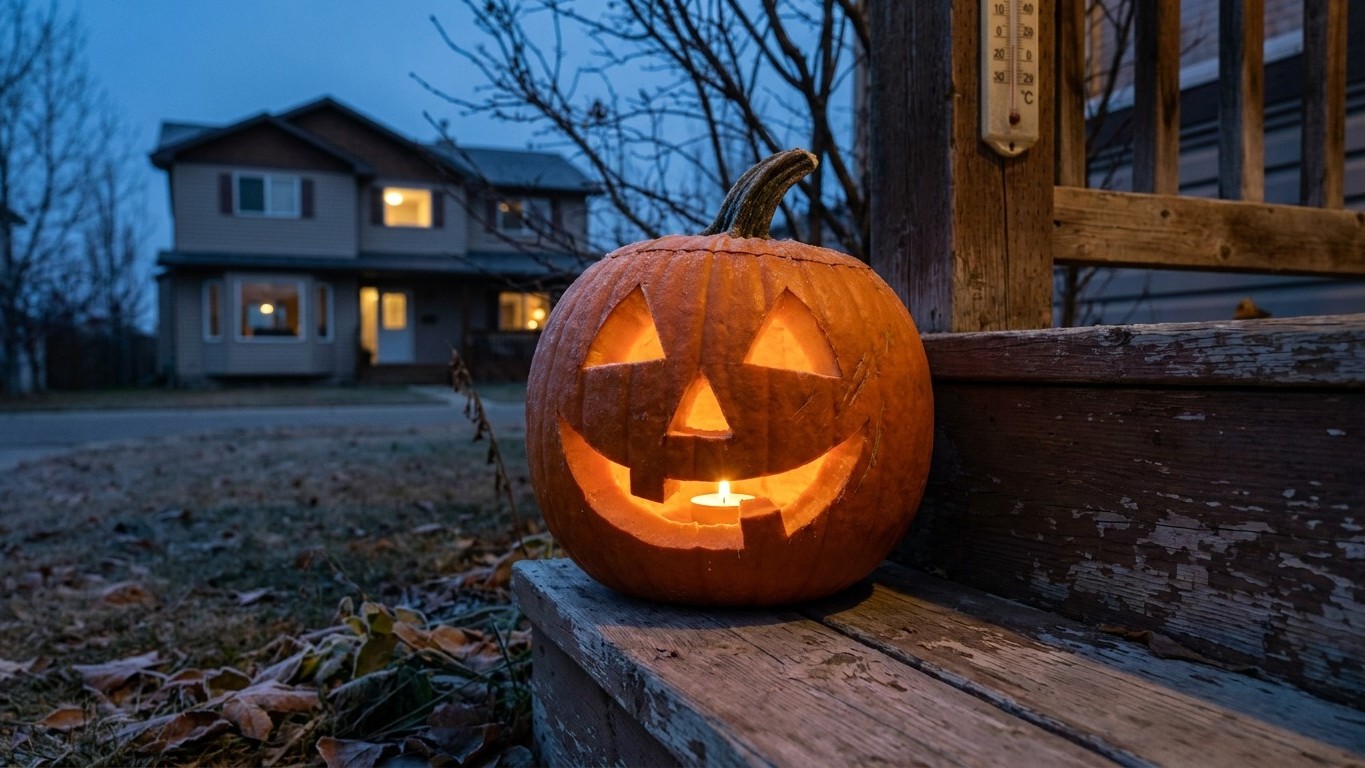

Frost arrives here around September 16 on average, a figure drawn from three decades of Calgary climate data. That’s roughly six weeks ahead of Halloween on October 31, which means a whole, uncarved pumpkin left outside all season has a real shot at freezing long before the holiday shows up. The safe window for carving isn’t early October. It’s the final stretch before Halloween, once the pumpkin has spent most of autumn stored cool and whole rather than sitting exposed on a step or porch rail.
The short answer

Environment and Climate Change Canada’s 1981-2010 Climate Normals for the Calgary Int’l A station put the mean first fall frost at around September 16. Halloween falls on October 31, so that mean date lands about 45 days before the holiday. In plain terms: on an average year, frost has already touched Alberta ground before pumpkin-carving even becomes a topic of conversation at most houses.
What “mean” really means
A mean frost date is the midpoint of a spread, not a guarantee. Environment and Climate Change Canada’s own data show that in roughly half of all years, frost arrives later than September 16, sometimes weeks later. So the date isn’t a wall you can plan around with confidence. It’s a signal that cold weather is already a live risk well before Halloween, and that risk only grows as October wears on. Calgary is also just one reference point. Alberta stretches from the Rockies to the prairies to the northern boreal forest, and a station reading from one city doesn’t speak for every county. Northern districts and higher-elevation areas typically run behind Calgary’s timing, meaning frost can show up even earlier there.
Translating that into a carving window
Given all that, the practical window for carving sits close to Halloween itself, not weeks ahead of it. A pumpkin that’s been chosen carefully, kept whole, and stored properly can hold up for months in the right conditions (more on that below). But once it’s cut open, it’s exposed to air, to whatever temperature swings the week brings, and to any moisture in its storage spot. The realistic answer for most Alberta households is to carve within the final several days before Halloween, treating the mean frost date as a reminder that the season has already turned cold around it, not as a cutoff that applies to the knife itself.
Frost or heat: which one gets it here
A whole pumpkin keeps best in a cool, dark spot between 45 and 50 degrees Fahrenheit, according to University of Illinois Extension. That’s a narrow band, and where a given region falls relative to it tells you whether cold or heat is the thing to plan around. In Alberta, the answer is clearly cold.
The cold end
Alberta’s winters are genuinely severe. The mean daily minimum temperature for the coldest month, per Environment and Climate Change Canada’s Calgary-based normals, sits at 8.2 degrees Fahrenheit. That figure describes deep winter, not late October specifically, but it says something important about the broader climate a pumpkin has to survive here: this is a province where cold arrives hard and stays. Combined with a mean first fall frost around September 16, well ahead of Halloween, the pattern is consistent. By the time most households are thinking about carving, overnight temperatures across much of Alberta have likely already dropped below the 45-50 F storage band, and further below freezing isn’t unusual as October progresses. A pumpkin left in an unheated outdoor spot risks actual freeze damage, not just gradual softening.
Why heat isn’t the concern
In warmer parts of North America, the worry runs the other way: nights stay too mild, temperatures sit above that 50 F ceiling, and a pumpkin ripens and softens faster than the calendar would suggest. That’s not Alberta’s problem. Once autumn sets in here, the risk skews cold, not warm. The practical takeaway is that Alberta households don’t need to hunt for a place to keep a pumpkin cool. They need a place that keeps it from freezing while still staying dark and below room temperature.
Where to keep it until you carve
Finding a spot that holds steady in the 45-50 F range gets harder in Alberta as the season goes on, since outdoor temperatures often drop past that band well before Halloween. A little planning solves it.
A short checklist for storage
- Start with a good pumpkin. University of Illinois Extension recommends choosing one with 1 to 2 inches of stem still attached, free of blemishes and soft spots, and heavy for its size. The stem acts as a seal for that section of the pumpkin, not a handle, so never lift or carry a pumpkin by it.
- Look indoors before you look outdoors. A cool basement, an insulated mudroom, or an unheated but enclosed porch (one that doesn’t dip below freezing overnight) tends to run closer to that 45-50 F band than an open step or an unheated garage once nights turn cold.
- Check an attached garage carefully. Early in the season it may sit in range, but as the mean frost date around September 16 suggests, Alberta nights can drop well below 45 F long before Halloween, so a garage that felt fine in late September may be too cold a month later.
- Keep the pumpkin away from apples, potatoes, tomatoes, or any other ripening produce. Those release a gas that speeds up aging in a stored pumpkin, according to University of Illinois Extension, so the fruit bowl on the same counter is not a neutral neighbor.
- Keep the space dark. Direct sun through a window, even in a cool room, adds heat and moisture cycling that a true cool, dark storage spot avoids.
- Move the pumpkin to its display spot only when you’re ready to carve, ideally within the final days before Halloween, so the cut surface is exposed to open air and outdoor temperature swings for as short a time as possible.
Handled this way, University of Illinois Extension notes a whole pumpkin can hold for three to six months. There’s no published research from any university extension on how long a carved pumpkin lasts once it’s cut open, and no verified preservation method, bleach dips, sealants, or otherwise, that’s backed by that kind of source. The honest answer where readers usually want a number is that none exists. What does hold up is choosing a good pumpkin, keeping it whole and properly stored, and carving it close to the day you plan to display it.
Checking this against your own county
Calgary’s climate normals are a useful reference point, but they’re one station in a province that spans mountains, prairie, and northern forest. If a home sits well north, at higher elevation, or in a district known to run cooler than Calgary, frost is likely to arrive earlier than the mean date used here, not later.
For local guidance specific to a given area, Alberta Agriculture and Irrigation is the province’s official resource for growers and gardeners, and it’s worth checking directly at alberta.ca/agriculture-and-irrigation. Provincial extension staff can speak to regional frost patterns and seasonal conditions in far more local detail than a single Calgary station can offer.
Common questions
Does frost ruin a whole, uncarved pumpkin?
A hard freeze can damage the flesh and skin, especially if the pumpkin sits outside unprotected. That’s part of why storage in a spot that stays above freezing, ideally near 45-50 F, matters so much in a province where frost tends to arrive well before Halloween.
Is a hardiness zone the same as a frost date?
No. A hardiness zone reflects winter cold overall, useful for deciding what a plant can survive year to year, while a frost date is specific to when the first freeze typically hits in fall. They come from different data and answer different questions.
Can I carve early and just keep the pumpkin somewhere cold?
A carved pumpkin is exposed at the cut surface, and no university extension publishes a timeline for how long that holds up or a method to extend it. The more reliable approach is to keep the pumpkin whole in proper storage and carve it close to when you’ll actually display it.
What if my area is north of Calgary or at higher elevation?
Expect frost to arrive earlier than the mean date used here, since Calgary’s normals reflect one station. Alberta Agriculture and Irrigation is the best resource for checking conditions specific to a given district.