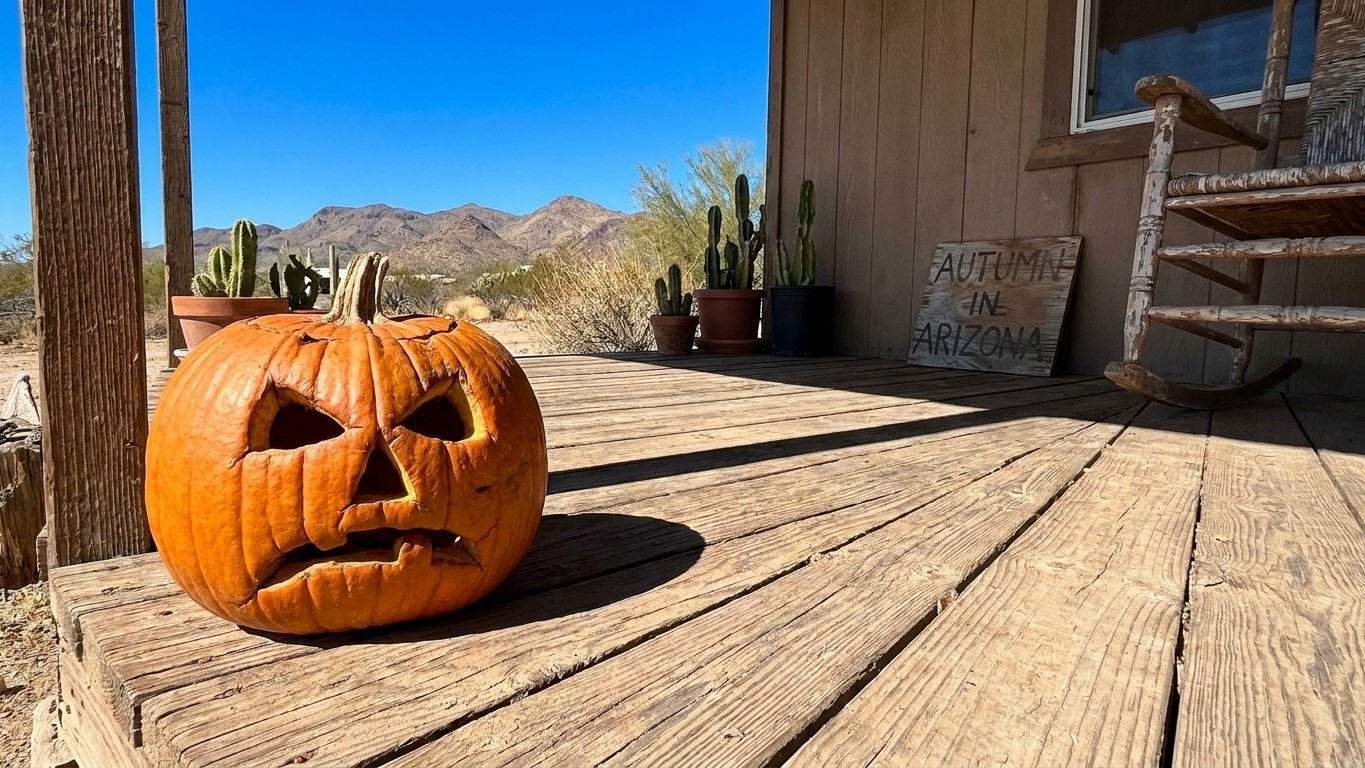

Phoenix’s reference station shows no reliable fall freeze at all, with a frost-free season that NOAA records as running a full 365 days. For a pumpkin sitting on a porch in the low desert, that means the usual frost deadline simply doesn’t apply. The window for carving isn’t set by cold here. It’s set by heat and by how long a carved pumpkin holds up once it’s cut open, which is a much tighter margin than most people expect around October 31.
The short answer

In the low desert, around Phoenix, Tucson, and most of the population centers south of the Mogollon Rim, there’s no mean first fall frost to plan around. NOAA’s 1991-2020 Climate Normals for the Phoenix reference station list the frost-free season as 365 days, and over 30 years of spring records the temperature only dipped to 32 F in 6 of them. A pumpkin left outside through October in this part of the state isn’t fighting frost. It’s fighting warmth, sun, and time.
That changes the whole question of “when.” Instead of counting days back from a frost date, the low-desert answer is about counting forward from the moment you cut into the pumpkin. Once a pumpkin is carved, no extension service publishes how many days it lasts, because there’s no controlled research on it. What is published, from University of Illinois Extension, is how to choose a pumpkin that starts strong and how to store a whole, uncarved pumpkin for months. Put those two facts together and the practical window becomes clear: buy early if you want, but carve late. Carve as close to October 31 as your schedule allows, and keep the pumpkin whole and uncut until then.
If you’re in the high country, around Flagstaff or the Colorado Plateau, this entire calculation flips. That part of Arizona sits at elevation, freezes hard well before Halloween most years, and behaves nothing like the desert stations NOAA uses for Phoenix. A whole pumpkin stored outside there can face real frost risk, not just warmth. The rest of this article works from the low-desert reference station, since that’s where the bulk of Arizona’s population and most porch pumpkins actually sit. If you’re up on the plateau, treat this as a starting point and check locally, which the last section covers.
So the short answer for most of Arizona: there’s no frost pushing you to carve early, and no frost pushing you to carve late either. The pressure runs the other direction. Carve close to Halloween, not weeks ahead of it, because heat and time do the damage that frost would do elsewhere.
Frost or heat: which one gets it here
The cold end
NOAA’s Climate Normals put the mean daily minimum for Phoenix’s coldest month at 45.3 F. That’s not a record low, and it’s not a single cold snap. It’s the average low across the coldest month of the year, and it happens to land almost exactly inside the 45-50 F range that University of Illinois Extension recommends for storing a whole pumpkin. The coldest nights the low desert sees in an average year are already close to ideal pumpkin storage temperature. Nothing here is going to freeze a pumpkin solid or split its shell the way a hard freeze would in a colder climate.
The warm end
The risk in Arizona isn’t the cold end of that range. It’s staying under 50 F at all during the day. Late October in the low desert routinely brings afternoon highs well above the pumpkin storage band, even as nights cool off. A pumpkin sitting in full sun on a porch or in a car is baking through swings of temperature that a research-backed storage guideline never anticipated, because that guideline assumes a cool, stable, dark spot, not a desert afternoon. Warmth speeds up softening and mold, especially once the surface is cut open and exposed. So in Arizona, the applicable threat is heat, not frost, and it’s a daytime problem more than a nighttime one.
Where to keep it until you carve
Finding a spot in an Arizona home that’s genuinely cool, dark, and stable is harder than it sounds, since so much of the state runs warm well into fall. Here’s a rough order of what tends to work, from best to worst:
- An interior closet or hallway away from exterior walls. Interior rooms in a conditioned house stay closer to that 45-50 F range than anywhere outdoors, and they’re dark, which matters as much as temperature.
- A garage, if it’s not baking in direct sun through the day. A detached or shaded garage can run cooler than the house in the evening, though check it isn’t trapping heat from a sun-exposed wall or roof.
- A shaded porch on the north side of the house. Better than full sun, but still exposed to daytime heat swings, so treat this as a short-term spot, not a months-long one.
- Never a car, and never a spot in direct sun. A parked car in Arizona can turn into an oven in minutes, and that heat will soften a pumpkin fast.
- Away from any ripening fruit or vegetables such as apples, potatoes, or tomatoes, since ripening produce gives off a gas that ages a pumpkin faster. Keep it off the kitchen counter near the fruit bowl.
Whichever spot you pick, choose the pumpkin carefully before it ever gets there. University of Illinois Extension recommends looking for one with 1 to 2 inches of stem left, no blemishes or soft spots, and real heft for its size. Shape doesn’t matter. The stem is a seal, not a handle, so never carry or lift a pumpkin by the stem. Once that stem breaks off, that section of the pumpkin is exposed and spoils faster, regardless of where you’re storing it.
Checking this against your own county
Arizona covers desert floor, high plateau, and everything in between, so a Phoenix-based frost picture won’t hold for every county. For a reading specific to where you actually live, the University of Arizona Cooperative Extension (extension.arizona.edu) publishes county-level guidance through its statewide network of offices. That’s the resource to check if you’re outside the low desert, especially anywhere near Flagstaff, the White Mountains, or other high-elevation parts of the state where fall freezes are a real, documented risk rather than a rare exception.
A county extension office can also speak to local growing conditions if you’re raising your own pumpkins rather than buying one, which is a different question from storage and carving timing but one they’re equipped to answer directly.
Common questions
Does Arizona ever get a frost before Halloween?
In the low desert, around Phoenix and similar elevations, no. NOAA’s data shows no reliable fall freeze and a 365-day frost-free season at the reference station. Higher-elevation parts of the state, like Flagstaff, are a different climate and do freeze well before October 31.
How long does a whole pumpkin last before carving?
University of Illinois Extension puts it at three to six months in a cool, dark spot between 45-50 F, kept away from ripening fruits and vegetables. That’s for a whole, uncut pumpkin, not one that’s already carved.
How long does a carved pumpkin last in Arizona?
No extension service publishes a number for this, and no bleach dip or petroleum jelly trick is research-backed either, whatever you may have read elsewhere. The honest answer is that it isn’t published. What is known: choose a pumpkin with an intact 1-2 inch stem, no soft spots, keep it whole as long as possible, and carve it close to the day you plan to display it.
Should I worry more about heat or cold when storing a pumpkin in Arizona?
Heat, in almost every part of the state outside the high country. The coldest month’s mean daily minimum in the low desert sits right around 45.3 F, close to ideal storage temperature, while daytime highs in late October regularly climb well past the upper end of that range.