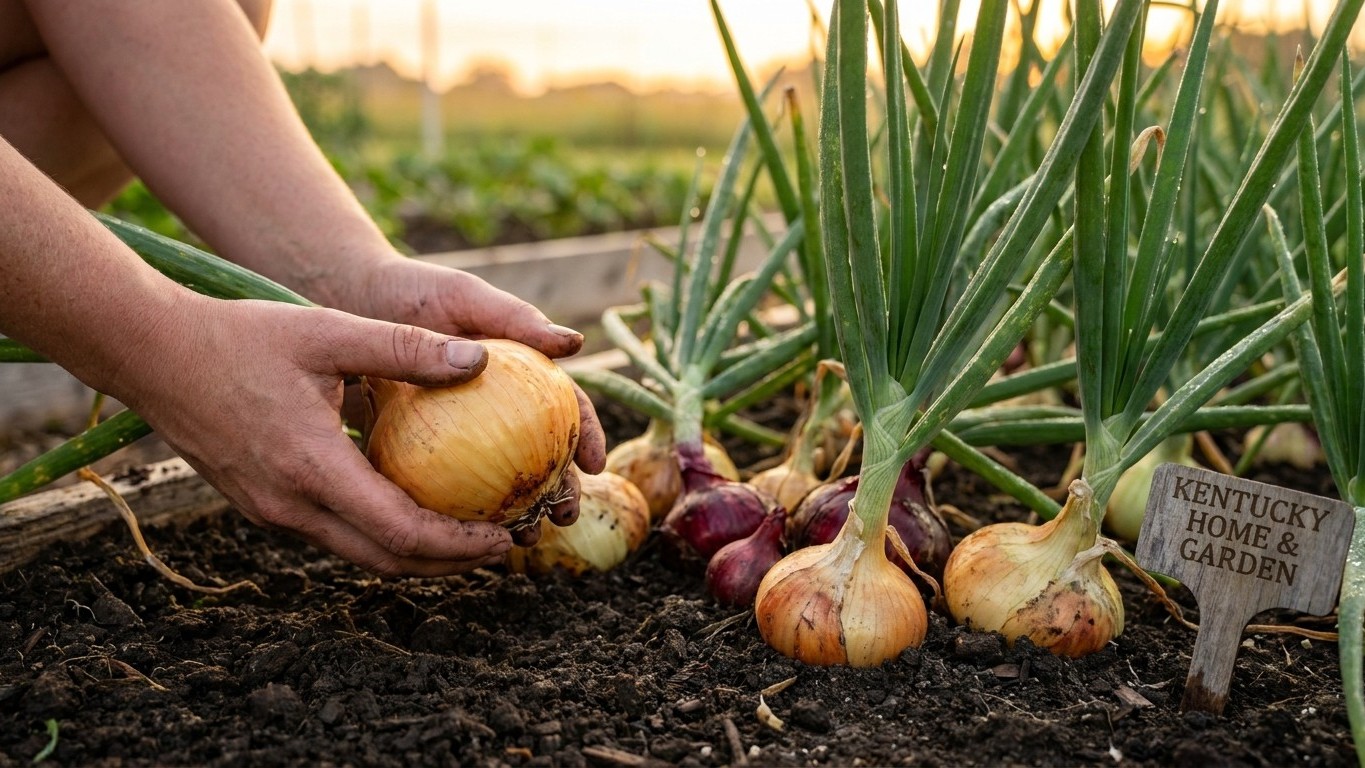

Louisville sits at 38.18 degrees north, and on the longest day of the year the sun gives it 14 hours and 39 minutes of daylight. That single number decides which onion varieties will actually form a bulb in a Kentucky garden and which ones will grow tall, leafy, and useless all summer.
How long your longest day is

Two figures matter here: a latitude of 38.18 degrees north, taken at the Louisville weather station (USW00093821), and 14 hours 39 minutes of daylight on the summer solstice at that same point. Onions don’t bulb because the weather warms up. They bulb because the day gets long enough to trigger it, a response tied to their genetics, not the thermometer. Clemson Cooperative Extension’s Home & Garden Information Center puts the short-day bulbing threshold at around 12 hours, which Kentucky blows past by more than two and a half hours every summer. That rules out short-day onions almost entirely here, and it opens the door to intermediate-day types, and to long-day types that need something closer to 14 or 15 hours before they’ll switch from making leaves to making a bulb. Once you know which types will actually bulb, see When to Plant Onions in Kentucky for the planting windows that match this day length.
At 14:39, Louisville sits right in the middle of that intermediate-to-long-day range. It’s long enough for most intermediate varieties to bulb reliably, and long enough for many long-day varieties too, though not for the ones bred for the far northern edge of the country, where summer days stretch past 15 and even 16 hours.
Kentucky runs from around 36.5 to just past 39 degrees north, roughly 280 miles top to bottom. That’s not a huge spread compared to a state like California or Texas, but it’s enough that a garden near Bowling Green in the south and one near Covington on the Ohio River will see slightly different day lengths at the solstice. If you’re gardening near either edge of the state, it’s worth checking your own latitude rather than assuming Louisville’s number applies exactly to your yard.
Which varieties bulb in Kentucky
Eighteen documented varieties have a published latitude range that covers 38.18 degrees north, meaning the day length here falls inside the window they’re bred to respond to. See The Best Onion Varieties for Kentucky for the full breakdown:
- Ailsa Craig (long-day, 38-60N)
- Barolo (long-day, 38-55N)
- Blush (long-day, 38-55N)
- Bridger (long-day, 35-50N)
- Cabernet (intermediate-day, 35-45N)
- Calibra (intermediate-day, 35-45N)
- Candy (intermediate-day, 33-40N)
- Elsye (intermediate-day, 32-45N)
- Expression (intermediate-day, 32-45N)
- Monastrell (intermediate-day, 35-46N)
- New York Early (long-day, 38-50N)
- Patterson (long-day, 38-55N)
- Red Long of Florence (intermediate-day, 38-50N)
- Red Long of Tropea (intermediate-day, 35-48N)
- Rossa di Milano (long-day, 38-50N)
- Scout (intermediate-day, 32-46N)
- Sierra Blanca (intermediate-day, 32-45N)
- Walla Walla Sweet (long-day, 35-55N)
One more sits right on the edge: White Castle, a short-day type rated for 30 to 38 degrees north. At 38.18N, Kentucky is just above its published ceiling, in what amounts to a blurred zone rather than a hard line. It may bulb here, but it’s not a sure thing, and a gardener planting it should treat it as an experiment, not a guarantee.
Now the part that actually saves you a season. Nine documented varieties will not bulb in Kentucky, for two opposite reasons.
- Gabriella (short-day, 20-35N), bulbs too early, stays tiny
- Madalyn (short-day, 20-35N), bulbs too early, stays tiny
- Red Rock (short-day, 30-36N), bulbs too early, stays tiny
- Frontier (long-day, 40-50N), day never gets long enough
- Powell (long-day, 43-47N), day never gets long enough
- Red Carpet (long-day, 40-45N), day never gets long enough
- Redwing (long-day, 43-65N), day never gets long enough
- Safrane (long-day, 42-50N), day never gets long enough
- Talon (long-day, 42-50N), day never gets long enough
The three short-day varieties fail because they start bulbing while the plant is still small, giving you an onion the size of a golf ball at best. The six long-day varieties fail worse: Kentucky’s 14:39 never reaches the 15-plus hours these were bred for, so the plant never gets the signal to bulb at all. It just keeps making leaves, season after season, until it eventually rots in the ground. If you’ve bought a bag of sets from a big-box store and ended up with a fat green top and nothing underneath, this is almost certainly why. It wasn’t a feeding mistake or a watering mistake. It was the wrong variety for this latitude.
When to plant onions in Kentucky
Kentucky’s day length puts it in intermediate-to-long-day territory, and that shapes the calendar as much as it shapes the variety list. Gardens in the Deep South plant short-day onions in the fall, letting them overwinter through mild temperatures before bulbing in spring. That approach doesn’t work here, because the varieties that bulb at this latitude aren’t the fall-planted short-day types. Kentucky gardeners instead plant in late winter to early spring, using sets or transplants that go in the ground while the soil is still cool but workable, well ahead of the summer solstice that will eventually trigger bulbing.
The frost dates give you the frame. Based on 1991-2020 NOAA climate normals for the Louisville station, the last spring freeze typically falls between March 24 and April 4, and the first fall freeze arrives between November 2 and November 12. Onions tolerate a light frost better than most vegetables, so many gardeners get transplants or sets into the ground several weeks before that spring window closes, giving the plant as much cool-season growing time as possible before longer days push it toward bulbing.
Those dates describe a 30 to 70 percent freeze probability window, an average built from three decades of data, not a promise for any single year. NWS Louisville has noted that this particular station, being urban, tends to run later in spring and earlier in fall than the rural county around it. A garden outside the city should expect a tighter frost-free window than the numbers above suggest, and it’s worth building in a margin rather than planting to the exact edge of the average.
Sweet onions or onions that keep
What ends up in your kitchen depends on the same chemistry every time. University of Missouri Extension puts it plainly: sweet onions don’t store as well as pungent ones, because the sharp bite of an onion comes from volatile sulfur compounds, and those same compounds are what protect the bulb once it’s out of the ground and sitting in a bin. A variety with fewer of them tastes better raw, sliced onto a sandwich in July, but it breaks down faster in storage. A variety with more of them bites harder at the cutting board and lasts longer in a cool, dry pantry.
That trade-off tracks with day length too. Short-day varieties tend to run sweeter and shorter-keeping, which is why the Deep South, where short-day onions dominate, is famous for sweet onion varieties eaten within weeks of harvest. Long-day varieties tend to hold onto more of those sulfur compounds and keep longer into winter, which is why northern growers build their pantries around pungent, storage-type onions that last well into the following year.
Kentucky’s variety list sits in the middle of that spectrum, mixing intermediate-day types that lean toward the sweeter, shorter-keeping side with long-day types that lean toward sharper and longer-keeping. Practically, that means a Kentucky garden can produce both: onions meant to be eaten fresh through late summer, and others set aside for winter use. What it can’t do is promise a variety that’s both sweet and a long-term keeper. Nobody’s chemistry works that way. If your goal is a pantry that still has usable onions in March, plan around the pungent side of your harvest rather than the sweet one, and eat the sweeter bulbs first while they’re at their best.