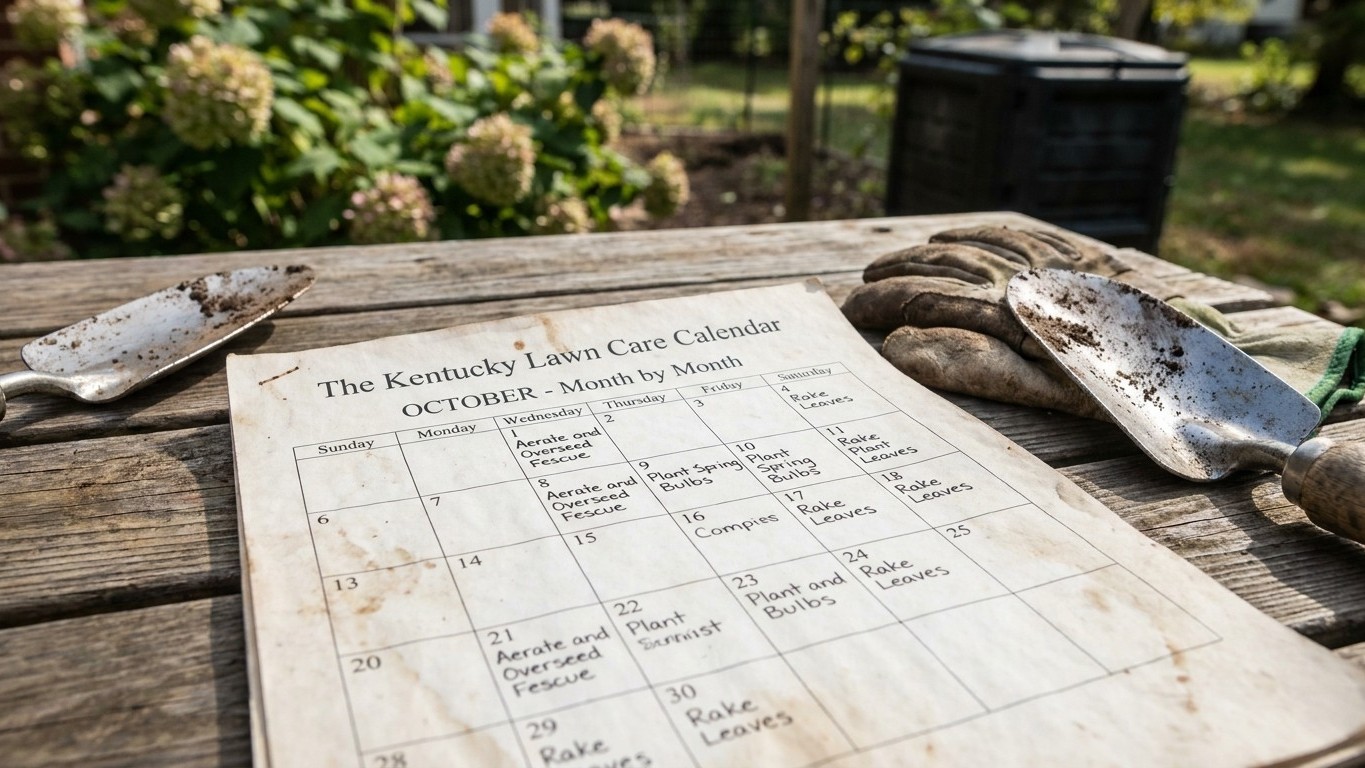

Kentucky’s lawn calendar splits in two, because the state sits in what The Homestead Post classes a transition zone, where neither cool-season nor warm-season grass thrives all year. If you have tall fescue, Kentucky bluegrass or perennial ryegrass, the working season runs fall through spring. If you have zoysiagrass or bermudagrass, it runs late spring through summer. Check which species is actually growing in your yard before you follow a single date, because that fact decides every month that follows.
The short answer for Kentucky
Kentucky, measured at the Louisville reference station, falls into the transition zone, a label The Homestead Post assigns by reading NOAA’s climate normals against the season tolerances published by Clemson Cooperative Extension in HGIC 1214, Selecting a Lawn Grass. Clemson’s guide, along with Penn State Extension’s coverage of the cool-season species, lists tall fescue, Kentucky bluegrass and perennial ryegrass as the cool-season options grown here, and zoysiagrass and bermudagrass as the warm-season options. None of the five is a clean winner.
A cool-season lawn, tall fescue especially, holds its color from October through May and then struggles once summer heat and humidity set in. A warm-season lawn, bermuda or zoysia, thrives in July and August and then goes brown from roughly October to April, not dead, just dormant, waiting on soil warmth to return. Choosing between them is choosing which season you’re willing to look at a tired lawn. If you haven’t settled on a species yet, the trade-offs are laid out in more detail in The Best Grass Seed for Kentucky Lawns.
Everything else on this calendar depends on that one choice. The mowing heights, feeding windows and overseeding dates for a fescue lawn are close to the opposite of a bermuda lawn’s, on the opposite half of the calendar. Confusing the two, applying a fescue schedule to a zoysia lawn or the reverse, is the single most common way a Kentucky lawn ends up thin.
Working through the year

This section assumes you’ve already handled the basics covered in general Kentucky Lawn Care, like a working mower and a recent soil test. From here, the calendar runs by species, not by a single set of Kentucky dates, because Clemson Cooperative Extension publishes a separate maintenance calendar for each grass rather than one for the region.
| Grass | Active growth | Mowing height | Nitrogen (lb N per 1,000 sq ft per year) | Calendar source |
|---|---|---|---|---|
| Tall fescue | Fall through spring, slows in summer heat | 3 to 4 in. | 3 to 4 lb, mostly fall | Clemson HGIC 1219 |
| Bermudagrass | Late spring through summer | 1 to 2 in. | 3 to 5 lb, May through August | Clemson HGIC 1216 |
| Zoysiagrass | Late spring through summer, slower than bermuda | 1 to 2 in. | 2 to 4 lb, growing season only | Clemson HGIC 1217 |
Fescue, bluegrass and ryegrass lawns
Clemson’s HGIC 1219 fescue calendar puts the bulk of the year’s nitrogen down in fall, not spring, because fescue is building root mass while the air cools and the top growth is easy to manage. Aeration and overseeding belong in that same fall window. Count back six to eight weeks from the first fall frost and, using NOAA’s 1991-2020 normals for the Louisville station, which place that freeze between November 2 and November 12, fescue seeding lands somewhere in mid-to-late September for that area. Ground further north or at higher elevation should seed earlier within that same six-to-eight-week rule, not on a fixed date. Spring gets a light feeding at most and a pre-emergent herbicide before soil warms, not a heavy nitrogen push, which just feeds disease pressure once summer humidity arrives.
Bermuda and zoysia lawns
Both warm-season calendars, HGIC 1216 for bermuda and HGIC 1217 for zoysia, start the working year at green-up, not at a calendar date, since a cool spring pushes green-up later regardless of the month. The first mowing and the first nitrogen application both wait until the lawn is actively greening, not just showing a few green blades. Aeration falls in late spring to early summer, while the grass is growing fast enough to recover quickly. Feeding continues on a monthly rhythm through the warm months and stops well before the first fall frost, since a late feeding pushes soft new growth into cold weather with no time to harden off.
What changes across Kentucky
Louisville is only the reference point, not the whole state, and the NWS office covering Louisville has said directly that its urban station runs milder in spring and later into fall than the surrounding rural stretch of Jefferson County. A rural yard in that same county should expect a tighter frost window than the November 2 to November 12 figure NOAA reports for the city station, meaning fescue seeding there should lean toward the earlier end of the calculated range.
Elevation and region shift the whole calendar
Eastern Kentucky’s Appalachian foothills and plateau country sit higher and cooler than Louisville, which pushes green-up later in spring and frost earlier in fall for both grass types. Warm-season lawns in that terrain get a shorter usable season than the same species planted around Bowling Green or the Pennyroyal region further south and west, where the growing season runs longer and bermudagrass holds its color deeper into fall. The Bluegrass region around Lexington tracks closer to Louisville’s timing than either extreme, since elevation and latitude there are similar.
Northern Kentucky, closer to the Ohio River and the Cincinnati metro’s influence, tends to run a step behind Louisville into spring and a step ahead of it into fall cold, the same directional pull as the eastern hill country but with a river valley’s added humidity. None of this changes which grasses are viable, tall fescue and the two warm-season species remain the realistic choices statewide, but it does shift every date earlier or later by a matter of weeks depending on where the yard actually sits.
The mistakes this climate punishes
A transition zone forgives less than either a true cool-season or true warm-season climate, because both grass types are pushed close to their limits here in opposite seasons. A few errors show up every year on the same lawns.
- Feeding a warm-season lawn late in fall. Nitrogen applied close to the first frost forces soft growth that has no time to harden, and the damage shows as winter kill in patches the following spring, not right away.
- Seeding cool-season grass in late spring. Fescue or bluegrass sown in May germinates fine and then dies in the first real heat wave, because the seedlings have no root depth to survive summer stress. The failure shows in July, long after the seeding money is spent.
- Cutting fescue too short in summer heat. Scalping a cool-season lawn below its normal 3 to 4 inch mowing height in July removes the leaf area the plant needs to shade its own roots. The lawn browns within a week or two of the cut, not immediately.
- Watering warm-season lawns through fall dormancy. Bermuda and zoysia going brown in October are shutting down on schedule, not dying of thirst, and extra water at that point mainly invites disease into a lawn that no longer needs it.
- Applying pre-emergent herbicide too late. Once crabgrass has already germinated in spring, a pre-emergent product does nothing, and the gap shows up as a crabgrass-heavy lawn by midsummer.
Every one of these mistakes is a timing error, not a product error. The fix is almost always to slow down and confirm which grass is in the ground and which half of its calendar the current month falls in, rather than reaching for a different bag of fertilizer.
Checking this against your county
Every figure above is anchored to the Louisville station, and Kentucky is long enough, north to south and low to high, that a county three hours away can run on a noticeably different clock. The University of Kentucky Cooperative Extension Service, listed in the USDA’s National Institute of Food and Agriculture land-grant directory at extension.ca.uky.edu, staffs an office in nearly every county and can confirm local frost timing, soil test results and which of the five grasses in this calendar actually performs well on a given piece of ground.
A county office is also the right place to ask about anything with legal weight, like herbicide restrictions or water-use rules during a dry summer, since those details vary by jurisdiction and don’t belong on a general calendar.
Common questions
Can I grow bermuda and fescue in the same yard?
They’ll compete rather than coexist peacefully. Bermuda spreads aggressively by stolons and will invade a fescue lawn over a few seasons, especially in the sunnier parts of the yard, so most Kentucky lawns settle on one species as the dominant grass and treat the other as a weed to manage.
Why is my zoysia still brown in May when the neighbor’s bermuda is green?
Zoysia green-up lags bermuda’s by a few weeks most years, a difference in how each species reads soil temperature, not a sign of trouble. Give it time before assuming disease or winter damage.
Do I need to dethatch every year?
Not on a schedule. Check thickness by hand, a layer thicker than about half an inch between the soil and the green blades is the point to act, and that builds up faster on warm-season lawns mowed low than on fescue.
Is it too late to seed fescue if I missed the fall window?
Fall remains the better window because cooler air and warm soil favor root growth over top growth. A late-winter seeding can work as a backup but expect a thinner stand than a properly timed fall seeding, and be ready to reseed those thin spots the following fall.