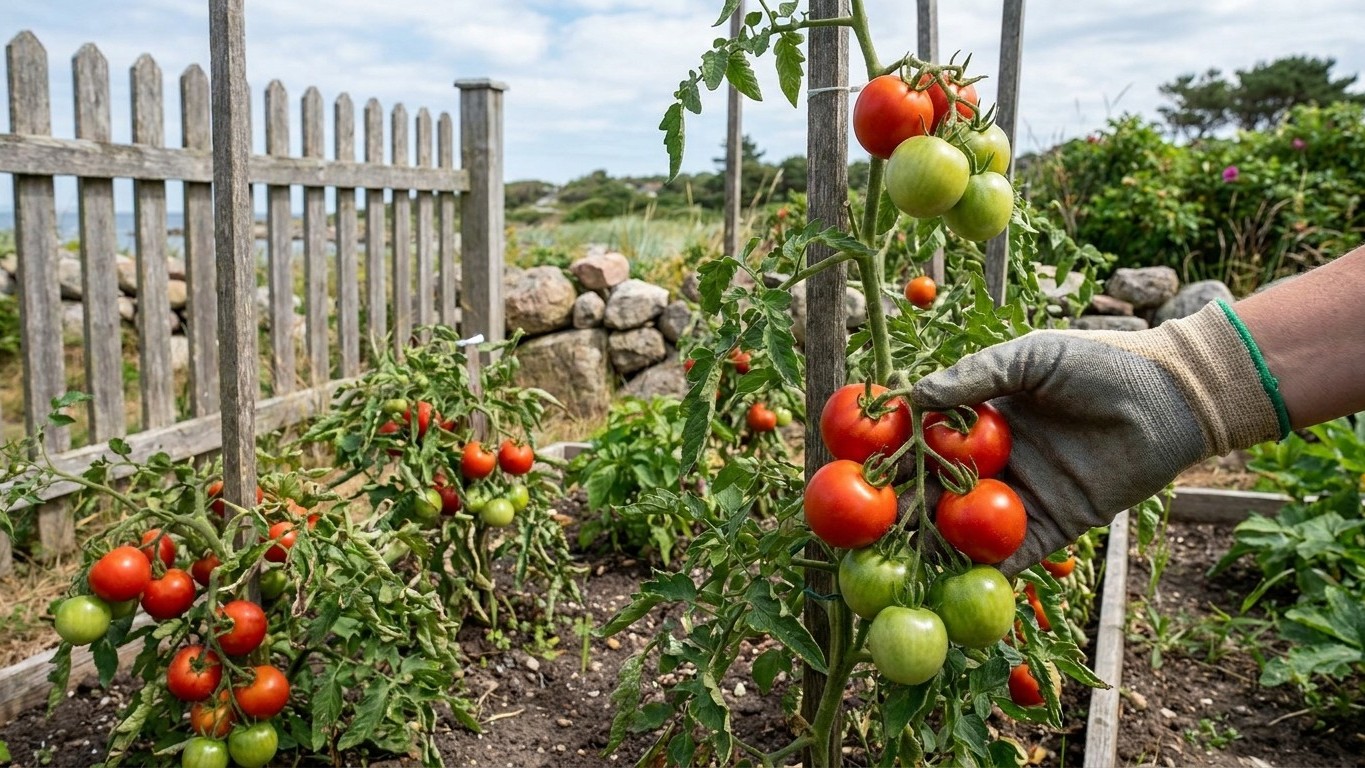

Environment and Climate Change Canada’s 1981-2010 climate normals put the mean last spring frost at St. John’s A at May 30 and the first fall frost at October 17, a growing season of about 140 days on average. Only tomato varieties reaching 55 to 78 days from transplant fit comfortably inside that window, and only if seedlings go into the ground already several weeks old. Check your own last frost date against a station nearer your own garden before setting a transplant date, since inland and northern parts of the province run colder and later than St. John’s.
What this comes down to in Newfoundland and Labrador

The average frost-free window at St. John’s, measured by Environment and Climate Change Canada’s 1981-2010 climate normals, runs from a mean last spring frost of May 30 to a mean first fall frost of October 17, about 140 days end to end. That figure is a midpoint, not a promise: in one year out of two the last frost falls later than May 30, and a cold snap in early October can beat the mean by two weeks or more. A short-season cultivar with real margin to spare is the safer bet in a province where the growing season itself is this compressed.
Work out roughly when to set transplants outside, a step covered on Tomato Planting Dates in Newfoundland and Labrador: Counting Back From Your Frost Window. What it does not assume is which variety to put in the ground once that date arrives, and that choice matters more here than in most places, because a tomato needing 78 days from transplant leaves almost no room for a slow August or an early frost.
Every date below is calculated, not observed. It takes the catalogue days-to-maturity figure for each cultivar, adds it to a mid-June transplant date worked back from the May 30 mean, and checks the result against the October 17 mean fall frost. The margin listed is the gap between that calculated ripening date and the mean frost, in an average year, so lean toward the shorter end of this list if your garden sits colder than St. John’s, which covers most of the province.
Sakura

Sakura needs about 55 days from transplant, the shortest on this list, and produces small round red cherry tomatoes on an indeterminate vine that keeps setting fruit until frost. Set out in mid June, it should give first ripe fruit in early August, leaving roughly 71 days of margin before the October 17 mean frost. It also carries intermediate resistance to nematodes and high resistance to tomato mosaic virus and both common races of fusarium wilt, useful insurance in a short season where a sick plant has no time to recover.
Sun Gold

Sun Gold ripens in about 57 days from transplant, bearing small round orange-gold cherry tomatoes prized for their sweetness, on a vigorous indeterminate vine. A mid-June transplant should be producing by early August, with about 69 days of margin before the mean fall frost. It resists tobacco mosaic virus and fusarium wilt race 1, both rated high, which matters more in a cool, damp climate where foliar disease pressure builds slowly through summer.
Supersweet 100

Supersweet 100 takes about 60 days from transplant and carries small round red cherry tomatoes in long, heavy clusters on an indeterminate vine. Set out mid June, first fruit should appear by mid August, with roughly 66 days of margin left before frost. It has high resistance to verticillium wilt and fusarium wilt race 1, and the long clusters mean a single plant keeps a kitchen supplied well into fall even if some late fruit never fully colours.
Juliet
Juliet reaches about 60 days from transplant and produces small oblong red grape tomatoes in long trusses, on an indeterminate vine bred for crack resistance. A mid-June transplant should ripen by mid August, leaving about 66 days of margin. It carries intermediate resistance to both late blight and early blight, two diseases that thrive in a wet, foggy coastal summer, which makes it steadier than a similarly-timed variety without that resistance.
Amalfi
Amalfi needs about 68 days from transplant, longer than the varieties above but still workable here, and produces medium oblong red paste tomatoes on a compact determinate bush. Set out mid June, first ripe fruit should land in mid August, with about 58 days of margin before the mean frost. It resists nematodes and carries intermediate resistance to both late blight and early blight, a useful combination for a paste tomato grown for sauce, where a late blight outbreak can wipe out a batch at once.
Cherokee Purple
Cherokee Purple takes about 72 days from transplant and produces large beefsteak fruit with dusky pink-purple skin and green shoulders, on a sprawling indeterminate vine. A mid-June transplant should give first ripe fruit in late August, with about 54 days of margin left before the October 17 mean frost. It carries no listed disease resistance, so it is the riskier choice on this list, worth growing for flavor and size but not as the only tomato in a garden that depends on a harvest.
Tiren
Tiren needs about 75 days from transplant and produces oblong red paste tomatoes on an indeterminate vine, used mainly for sauce and canning. Set out mid June, it should ripen in late August, with about 51 days of margin before the mean frost, tighter than any variety above it. It carries high resistance to verticillium wilt, tomato mosaic virus and fusarium wilt race 1, which helps it finish reliably under disease pressure, but the shrinking margin means a late, cold September can leave part of the crop green.
San Marzano II
San Marzano II is the longest-season variety on this list at about 78 days from transplant, producing long oblong red paste tomatoes on an indeterminate vine, the classic shape for canning sauce. A mid-June transplant should ripen in late August, with only about 48 days of margin before the October 17 mean fall frost.
| Variety | Days to maturity (from transplant) | Calculated first ripe | Margin before mean fall frost |
|---|---|---|---|
| Sakura | 55 | Early August | ~71 days |
| Sun Gold | 57 | Early August | ~69 days |
| Supersweet 100 | 60 | Mid August | ~66 days |
| Juliet | 60 | Mid August | ~66 days |
| Amalfi | 68 | Mid August | ~58 days |
| Cherokee Purple | 72 | Late August | ~54 days |
| Tiren | 75 | Late August | ~51 days |
| San Marzano II | 78 | Late August | ~48 days |
Working it out for your own garden
Start from the two mean dates from Environment and Climate Change Canada: May 30 for the last spring frost and October 17 for the first fall frost, both measured at St. John’s A. Push a week or two later for hardening off and cold soil, and mid June becomes the practical window most Newfoundland and Labrador gardeners use for setting transplants outside, later than gardeners further inland in Canada because the coast holds its chill into early summer. That is a range shifted from a range, not a single date, and it should stay that way on your calendar.
Running the numbers on one variety
Take Sakura, at 55 days from transplant. Set out in mid June, it should reach first ripe fruit in early August, which leaves about 71 days before the October 17 mean fall frost, an easy fit with room to spare for a cool patch of weather. Now take San Marzano II, at 78 days from transplant. The same mid-June setout puts first ripe fruit in late August, with only about 48 days of margin left, the tightest margin among the varieties listed. That margin still clears the mean frost date, but it leaves almost nothing for a year where frost arrives early, which happens in roughly half of all years by definition of a mean.
Push the arithmetic further and the line shows itself. A paste tomato needing 90 days from transplant, set out mid June, would not reach maturity until roughly mid September, leaving only about a month before the mean frost and no cushion at all for a cold start to autumn. That is the point past which a variety stops being a workable open-ground choice here and becomes a candidate for a greenhouse or large container instead, brought forward before the numbers run out.
The same subtraction works for any variety: take its catalogue days-to-maturity figure, add it to the mid-June setout window, and compare the result to October 17. If the margin comes out under about seven weeks, treat that variety as a gamble rather than a plan.
The mistakes this state punishes

Planting by the calendar instead of the soil
The most common mistake is treating May 30 as a safe planting date instead of a coin flip. Environment and Climate Change Canada’s own figure is a mean of thirty years of data, which means the last frost falls after May 30 about half the time. Planting tender transplants right on that date, especially after a stretch of unseasonably warm weather, is how a whole flat of seedlings gets cut down overnight.
Choosing a variety the season can’t finish
The second mistake is choosing a variety for its flavour or its size without checking days to maturity against the season at all. San Marzano II and Tiren both finish inside the St. John’s frost window on paper, but only with about seven weeks of margin, and a gardener who plants a week late, or in a spot colder than St. John’s, can end up with a September harvest of green tomatoes. Cherokee Purple carries no disease resistance at all, so a wet, cool summer that favours blight can knock weeks off its effective season by slowing the plant down, not just by killing it outright.
The third mistake is ignoring how much colder inland and northern districts run compared with the coast. St. John’s sits on a milder edge of the province, and a gardener further from the Avalon Peninsula should assume both frost dates arrive earlier in fall and later in spring than the numbers for St. John’s, which shortens every margin by a week or more before a seed ever goes in the ground.
Checking this against your county
Every figure here comes from one station, St. John’s A, and Newfoundland and Labrador is not one climate. A garden on the west coast, in central Newfoundland, or in Labrador will see frost dates shift earlier in fall and later in spring than the numbers used here, sometimes by weeks rather than days, so a province-wide figure is a starting point, not an instruction.
Before committing a season’s transplants to a variety with a tight margin, check your own local frost record against a nearby weather station, and use the Newfoundland and Labrador Department of Fisheries, Forestry and Agriculture’s extension service at gov.nl.ca/ffa to confirm what actually holds true for your area. General growing steps, from soil prep to staking, are covered separately on growing tomatoes in Newfoundland and Labrador, in case any of that groundwork still needs doing before transplant day arrives.
Common questions
Can I grow a 90-day tomato in Newfoundland and Labrador if I start it early?
Starting seed indoors earlier does not change the transplant date, since that is set by soil temperature and the mean May 30 frost, not by how big the seedling is. A longer-season variety can work in a greenhouse, cold frame or large container that lets you set it out earlier than an open bed allows, but in open ground it runs into the same October frost regardless of when the seed was sown.
Do I need disease-resistant varieties or is that overkill for such a short season?
Resistance matters more in a short season, not less, because there is no time left to recover from a slowed-down plant. A variety like Juliet or Amalfi, with resistance to early blight and late blight built in, keeps growing through the damp stretches a coastal Newfoundland summer produces, while an unprotected variety can lose weeks it does not have.
Why do my cherry tomatoes ripen weeks before my paste tomatoes?
Cherry tomatoes like Sakura, Sun Gold and Supersweet 100 carry catalogue days-to-maturity figures in the mid-to-high 50s, while paste types like Tiren and San Marzano II run into the mid-to-high 70s. That gap of roughly three weeks on paper compounds through the season, since a slow start in June pushes every later date back too.
Is it worth growing tomatoes outdoors at all this far north, or should I just use a greenhouse?
Short-season varieties with 55 to 60 days to maturity, like Sakura, Sun Gold or Supersweet 100, do finish outdoors in an average year at St. John’s, with enough margin to survive a slow week or two. A greenhouse or high tunnel removes the guesswork entirely and lets you grow longer-season varieties too, which is worth considering for anyone gardening colder than the coast.