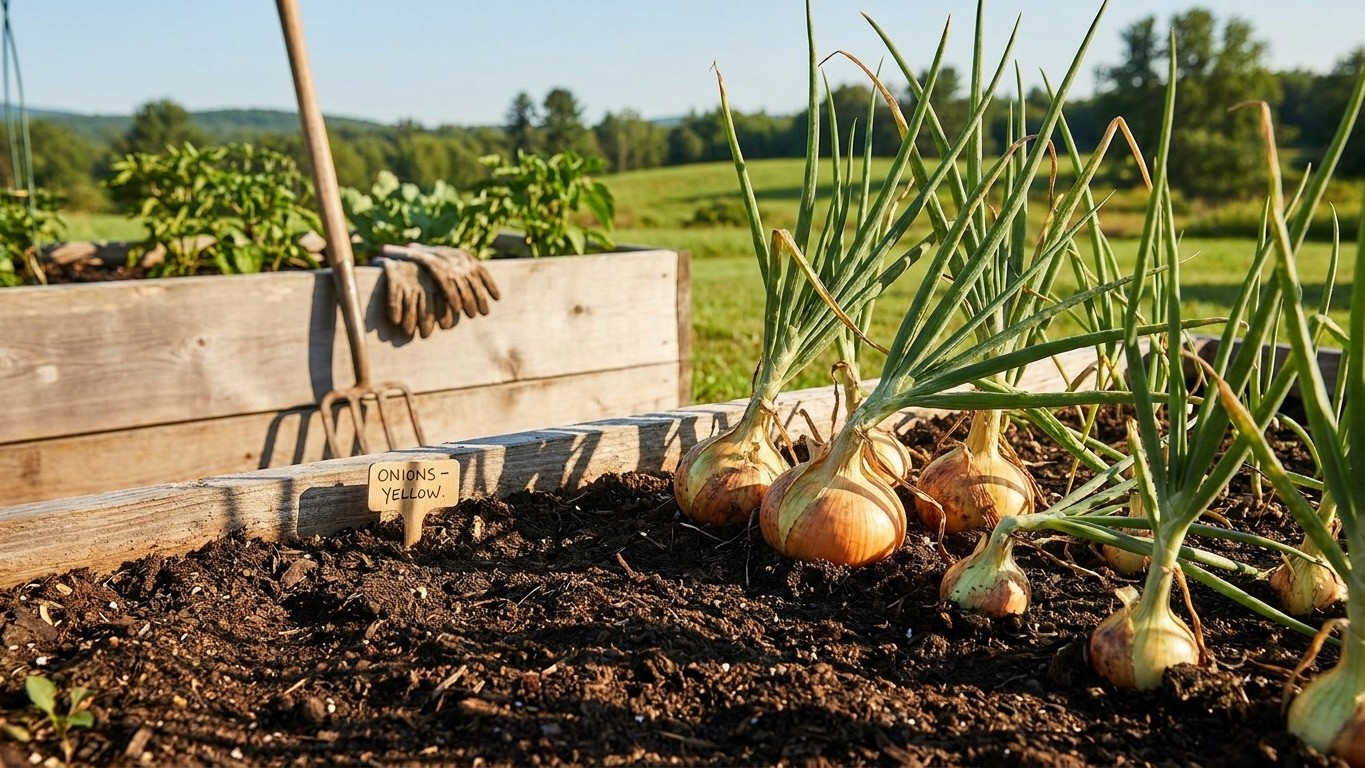

New Hampshire’s growing season is short, but its summer days are long enough to satisfy most long-day onion varieties. That’s the real question here, not soil or fertilizer. Onions bulb according to day length, and Concord’s 15 hours 10 minutes of daylight on the longest day puts the state solidly in long-day territory, with a couple of intermediate-day varieties also worth a look near its southern edge.
How long your longest day is

Concord, New Hampshire sits at 42.93 degrees north latitude, and on the longest day of the year it gets 15 hours and 10 minutes of daylight. That single number decides almost everything about which onion varieties will actually form bulbs in your garden. Onions don’t care how hot it gets. They care how long the sun stays up. A short-day variety starts bulbing once daylight hits roughly 12 hours, according to Clemson Cooperative Extension’s Home & Garden Information Center. A long-day variety waits until daylight stretches to 14 or even 16 hours before it commits to bulbing at all.
At 15 hours 10 minutes, New Hampshire clears that long-day threshold with room to spare. It also clears the 12-to-14-hour range that intermediate-day varieties need, which means a decent number of those will work too. What it rules out, almost completely, is the short-day group, the onions bred for the Deep South and the Gulf Coast, where summer days barely crack 12 to 13 hours. Plant one of those here and the day length arrives so early in the season that the plant hasn’t built enough leaf mass to feed a real bulb.
Everything below is detail built on top of it: which specific varieties fall inside that long-day and intermediate-day window, When to Plant Onions in New Hampshire given the state’s frost dates, and what kind of onion you’ll actually be pulling out of the dirt come fall.
One caveat worth repeating: New Hampshire runs from the Massachusetts border up past the White Mountains to the Canadian line, a span of well over two degrees of latitude. Concord’s numbers are a reference point, not a guarantee for every backyard in the state. A gardener up near Berlin or Colebrook gets more summer daylight than someone down in Nashua or Portsmouth, which only strengthens the case for long-day varieties in the north and gives a little more flexibility to intermediate types in the south. If you’re near either edge of the state, it costs nothing to look up your own latitude before you order seed.
Which varieties bulb in New Hampshire
Of the 28 onion varieties documented across this site, 21 have a published latitude range that covers 42.93N outright, and you can see the full breakdown in The Best Onion Varieties for New Hampshire. Two more sit close enough to the edge of their range that they’re worth trying but not guaranteed. And five are flatly the wrong choice for this state, no matter how good the seed packet photo looks.
Varieties that should bulb here
- Ailsa Craig (long-day, 38-60N)
- Barolo (long-day, 38-55N)
- Blush (long-day, 38-55N)
- Bridger (long-day, 35-50N)
- Cabernet (intermediate-day, 35-45N)
- Calibra (intermediate-day, 35-45N)
- Elsye (intermediate-day, 32-45N)
- Expression (intermediate-day, 32-45N)
- Frontier (long-day, 40-50N)
- Monastrell (intermediate-day, 35-46N)
- New York Early (long-day, 38-50N)
- Patterson (long-day, 38-55N)
- Red Carpet (long-day, 40-45N)
- Red Long of Florence (intermediate-day, 38-50N)
- Red Long of Tropea (intermediate-day, 35-48N)
- Rossa di Milano (long-day, 38-50N)
- Safrane (long-day, 42-50N)
- Scout (intermediate-day, 32-46N)
- Sierra Blanca (intermediate-day, 32-45N)
- Talon (long-day, 42-50N)
- Walla Walla Sweet (long-day, 35-55N)
Two more, Powell (long-day, 43-47N) and Redwing (long-day, 43-65N), sit right at the northern edge of Concord’s latitude. These ranges are a continuum, not a hard line, so treat both as a maybe: they may bulb well in a warm New Hampshire summer, or they may lag slightly behind the varieties listed above. Worth trying in a small trial row before you commit a whole bed to either one.
Varieties that will NOT bulb here
This is the list that actually matters if you’ve ever bought a bag of onion sets from a big-box garden center and ended up with tall green tops and no bulb worth harvesting. That’s almost always a short-day variety planted too far north, and here’s what happens: the plant makes leaves, day length hits its 12-hour trigger while the plant is still small, it forces a bulb anyway, and that bulb stays tiny before the whole thing rots in the ground or in storage.
- Candy (intermediate-day, 33-40N)
- Gabriella (short-day, 20-35N)
- Madalyn (short-day, 20-35N)
- Red Rock (short-day, 30-36N)
- White Castle (short-day, 30-38N)
None of these are documented in depth on this site beyond their published latitude range, but the range alone tells you enough: plant them in New Hampshire and you’re fighting the calendar, not your soil.
When to plant onions in New Hampshire
Because New Hampshire is a long-day state, its planting calendar looks nothing like a Georgia or Texas garden’s. Southern gardeners with short-day varieties plant in fall and let onions overwinter as small plants. That approach doesn’t apply here. Long-day onions in New Hampshire go in during late winter to early spring, timed around the last spring frost so the plant has the longest possible stretch of daylight-building weeks before the June solstice tells it to bulb.
Concord’s climate normals from NOAA put the last spring frost between April 16 and April 27, and the first fall frost between October 13 and October 26. Those numbers come straight from the 1991-2020 U.S. Climate Normals for the airport weather station there, using the 30 to 70 percent freeze-probability band. They’re averages built from thirty years of data, not a promise for any particular spring.
Practically, that means starting onion seed indoors in late winter, roughly ten to twelve weeks before that April frost window, then transplanting hardened-off seedlings outside as soon as the soil can be worked and hard freezes have passed. Onion sets, if you’re using them instead of transplants, can go in a little earlier since the small bulbs tolerate a light frost better than tender seedlings. Either way, the goal is the same: get plants established and growing leaves well before the solstice, because once daylight crosses that bulbing threshold, the plant stops adding leaf mass and starts pulling from what it’s already built. A late-planted onion with only a few leaves at bulbing time gives you a small onion, full stop.
Remember that Concord’s frost dates are a reference point, not a rule for your specific yard. Suburban and rural gardens typically see the last spring frost arrive later and the first fall frost arrive earlier than the airport station records, sometimes by one to two weeks, and more if you’re gardening at elevation in the mountains or in a low-lying frost pocket. Check your own county extension office or a local frost record before locking in a planting date, especially if you’re farther north than Concord or tucked into a valley that holds cold air.
Sweet onions or onions that keep
Here’s the trade-off every New Hampshire onion grower eventually runs into: you can grow onions that taste great fresh, or onions that last through winter, but rarely both in the same bulb. This isn’t a matter of variety marketing. It’s chemistry. The bite in an onion comes from volatile sulfur compounds, and those same compounds are what protect the bulb from rot during long storage. A sweet onion has fewer of them, which is exactly why it tastes milder raw on a sandwich, and exactly why it breaks down in the pantry within weeks instead of months.
University of Missouri Extension puts it plainly in its onion-growing guide: as a rule, sweet onions do not store as well as the more pungent types. That single line explains why the Deep South, with its short-day sweet varieties, ships onions for near-immediate eating, while northern long-day states end up with the pantry staples that survive into spring.
This lines up with day length too. Short-day varieties, built for southern latitudes, tend to run sweeter. Long-day varieties, the kind that actually bulb here in New Hampshire, tend to run sharper and keep longer. Among the varieties that work in this state, that means leaning toward types like Ailsa Craig, Patterson, or Talon if your goal is a braid of onions still solid in March, and toward something like Walla Walla Sweet if you want a milder onion to eat within a month or two of harvest, understanding it won’t make it to winter’s end.
What that means for your kitchen: a New Hampshire onion patch, planted mostly to long-day varieties, is built for storage first. Expect a harvest that’s more useful as a slow-burning pantry supply than as a sweet, crisp eating onion straight off the vine. If you want both, the practical answer is to grow a row of something sharper for the root cellar and a smaller patch of Walla Walla Sweet or a similar long-day sweet type to eat fresh in late summer, accepting that batch won’t last past fall.