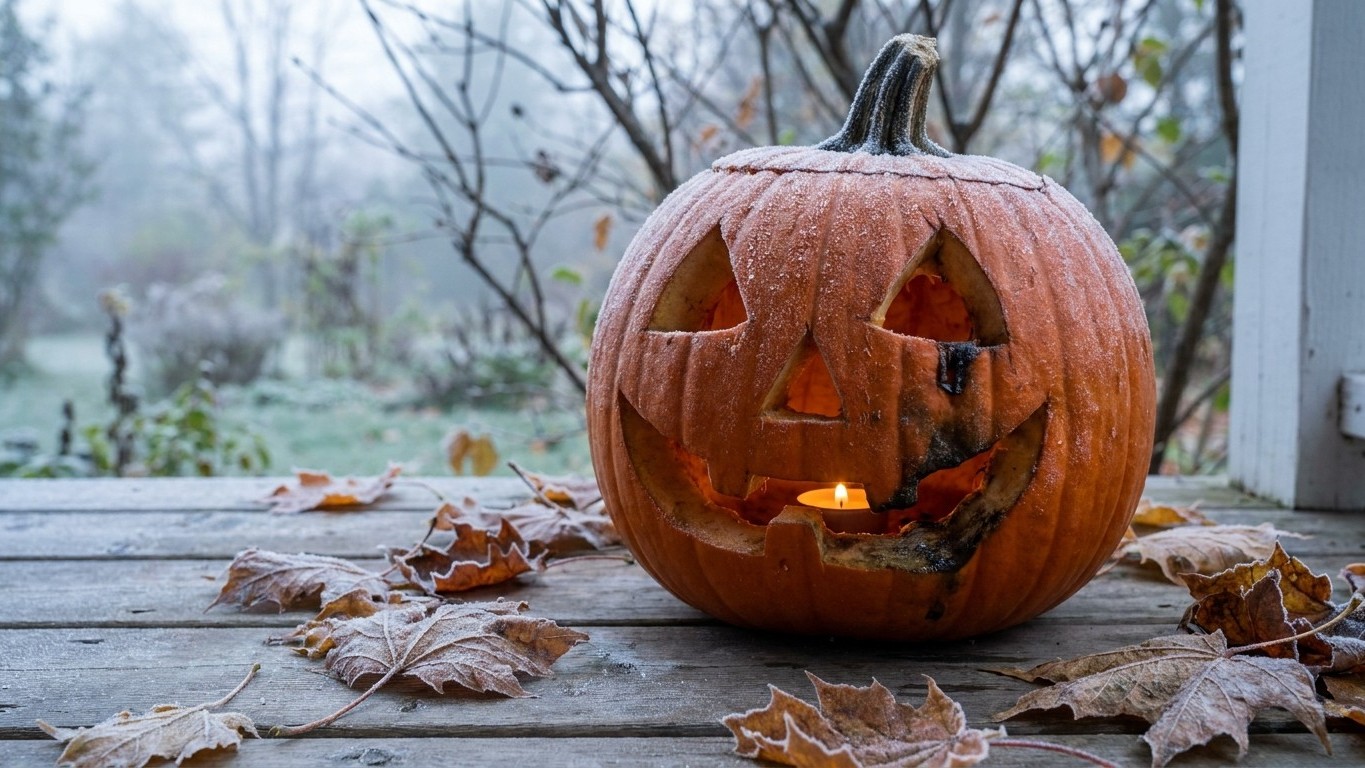

In the Montreal region, the average first fall frost lands around October 5, according to Environment and Climate Change Canada’s Climate Normals for the MONTREAL/ST-HUBERT A station. That’s roughly three and a half weeks before Halloween, not right before it. For anyone planning to Carve a Pumpkin here, that gap matters more than the calendar does.
The short answer

Start with the number: around October 5. That’s the mean date, from a 1981-2010 climate normal, when the Montreal area typically sees its first fall frost. Halloween falls on October 31, which puts that average frost date about 26 days ahead of trick-or-treat night. In plain terms, this region usually gets cold enough to frost a windowsill or a garden bed well before the holiday even arrives.
A mean date is not a guarantee. In roughly half the years on record, frost shows up even earlier than October 5, and in the other half, it arrives later. Some seasons stretch mild well into late October. But treating October 5 as a rough midpoint, rather than a hard deadline, is the safer way to read it. What that midpoint tells a pumpkin owner is simple: by the time Halloween rolls around, this part of Quebec has typically already crossed into frost territory, sometimes weeks earlier.
So what does that mean for a pumpkin sitting out until October 31? Carving too early and leaving the cut pumpkin exposed outside for weeks invites trouble, since a carved pumpkin has no skin protecting its interior from cold air, moisture, and decay organisms. The practical window here runs narrow: carve close to Halloween itself, ideally within the final few days before it, rather than at the start of October when the season’s first frost is statistically already due.
The reasoning isn’t about how long a carved pumpkin “lasts” in some fixed number of days. No extension service publishes that figure, and claims that a carved pumpkin is good for exactly three or five days aren’t backed by research; they’re guesses passed around online. What is backed by research is this: keep the pumpkin whole for as long as possible, store it properly, and carve it as close to the day you’ll display it as your schedule allows. In a region where frost risk is already present a month before Halloween, that advice carries extra weight, since every day a carved pumpkin sits out is a day closer to the cold snap this area is known for.
Frost or heat: which one gets it here
The cold end
Quebec’s fall pumpkin problem is cold, not heat. The mean daily minimum temperature for the coldest month of the year in the Montreal area sits at 6.7°F, according to the same ECCC Climate Normals dataset. That figure describes the coldest month, typically January, not October, so it shouldn’t be read as a frost date. But it does something useful: it confirms that this climate swings hard toward cold once autumn turns, and that the mild shoulder season here is short.
A whole pumpkin keeps best between 45 and 50°F in a cool, dark spot, according to University of Illinois Extension. Compare that band to what late October nights actually look like in this region, especially once the average first frost date around October 5 has already passed. By the back half of October, unprotected outdoor spots regularly dip below that 45-50°F range and toward freezing. Leaving a pumpkin on an open porch or a stoop through the second half of October means exposing it to temperatures well below its ideal storage range, not comfortably within it.
The warm end
Heat simply isn’t the operative risk in Quebec the way it is in warmer parts of the continent. In regions where the first frost arrives late, or barely arrives before Halloween at all, warmth and humidity can soften a pumpkin and speed rot. That’s not the pattern here. Given that frost, on average, precedes Halloween by nearly a month in the Montreal area, the pumpkin’s enemy this far north is the cold snap, not an Indian-summer warm spell. Anyone shopping advice written for a milder climate should adjust accordingly: the guidance that matters here is about shielding pumpkins from freezing air, not from heat.
Where to keep it until you carve
Given a climate where frost typically arrives weeks before Halloween, the goal is finding a spot that holds steady in that 45-50°F band and stays dark, without drifting toward either a heated interior or an exposed freeze.
- An unheated basement or root cellar. These spaces in Quebec homes often sit naturally in or near the 45-50°F range through October, and they’re dark, which slows the pumpkin’s aging.
- An attached, unheated garage. As long as it doesn’t dip to freezing overnight once the season turns colder, an attached garage buffers outdoor cold better than an open porch does.
- A cool interior closet or mudroom, away from heating vents. Keep it well clear of furnace rooms, radiators, or any spot near a woodstove.
- Never near ripening fruit or vegetables. Apples, potatoes, and tomatoes give off ethylene gas that speeds up a pumpkin’s aging, according to University of Illinois Extension, so store it apart from the produce bowl or root vegetable bin.
- Check the stem before storing. Look for a pumpkin with 1 to 2 inches of stem intact. Once that stem breaks off, the exposed spot becomes a weak point where spoilage sets in early. Never carry or lift a pumpkin by its stem; it isn’t a handle, and treating it like one is often what snaps it off in the first place.
Once frost risk is clearly settled in for the season, an unprotected porch or an open shed stops being a safe holding spot. Move the pumpkin somewhere buffered, and hold off on carving until you’re within a few days of Halloween itself.
Checking this against your own county
The Montreal-area frost date is one data point, not a province-wide rule. Quebec spans a huge range of microclimates, from the milder Montérégie lowlands to the Laurentians and points further north, where frost can arrive noticeably earlier. For a reading closer to home, check with Quebec’s ministry of agriculture, MAPAQ, which tracks regional growing conditions and seasonal frost patterns across the province. If your area sits north or at higher elevation than the Montreal reference station, plan on frost showing up sooner, not later, and shift your carving timeline earlier in response.
Common questions
Does frost ruin a whole, uncarved pumpkin?
A light frost on the outer skin doesn’t necessarily doom a whole pumpkin the way it does a carved one, but repeated freezing and thawing outdoors will soften the shell and shorten how long it keeps. Whole pumpkins do best stored in the 45-50°F range recommended by University of Illinois Extension, not left exposed to hard freezes.
Can I carve my pumpkin at the start of October and just bring it inside?
You can, but the interior flesh is exposed the moment you carve, and cut pumpkin has no published shelf-life figure from any extension service. Rather than betting on how many days it might hold up, carve closer to Halloween itself to shorten the window during which the cut surfaces are exposed to air, temperature swings, and moisture.
What if my area gets frost earlier than the Montreal average?
That’s likely if you’re north of the city, at higher elevation, or in a low-lying spot prone to cold pockets. Treat the October 5 mean as a starting point and check regional data through MAPAQ, then shift your storage and carving plans earlier to match your local pattern.
Should I pick a pumpkin with a long stem or a short one?
Look for 1 to 2 inches of stem left on the pumpkin, per University of Illinois Extension guidance. A pumpkin missing its stem, or with a stem that’s already cracked, has an exposed weak point where decay can start early, regardless of how cold or warm the storage spot is.