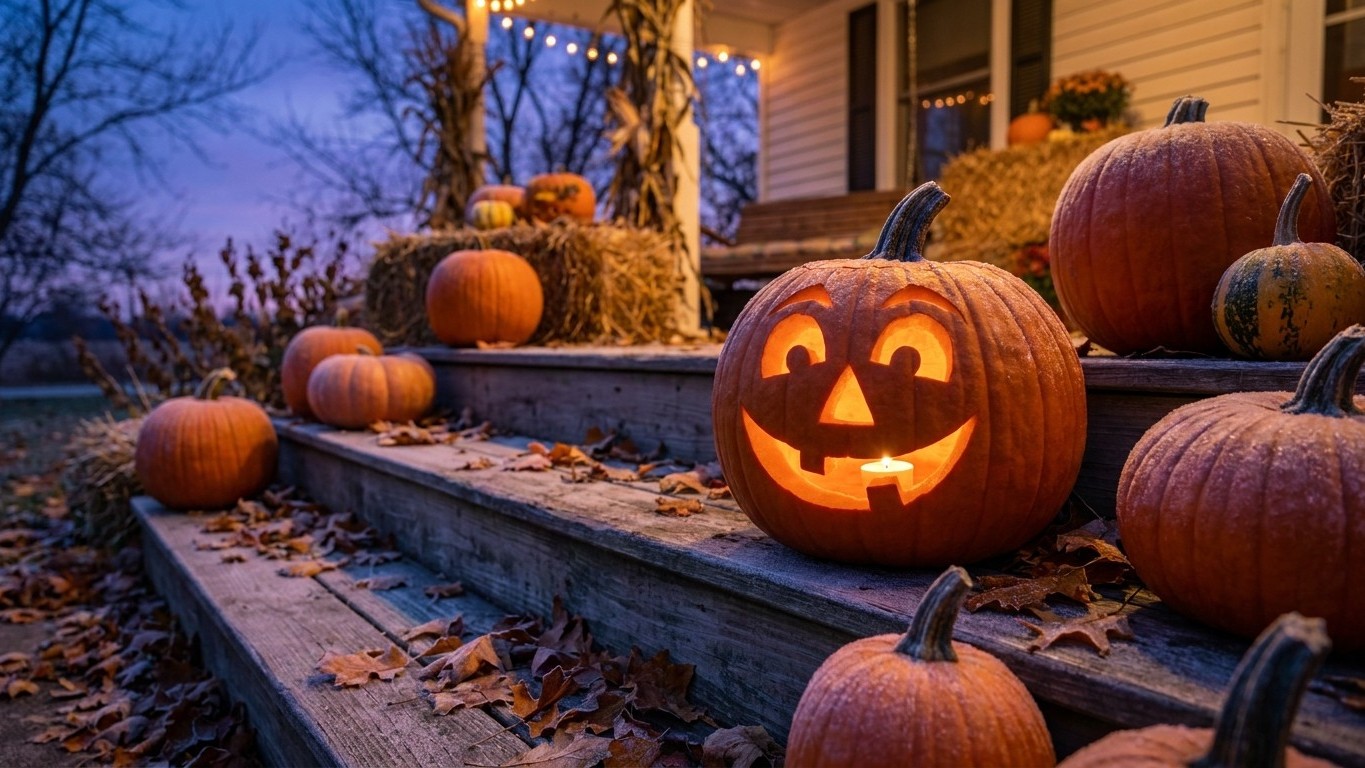

Iowa’s mean first fall frost lands somewhere between October 14 and October 25, based on thirty years of weather station data recorded near Des Moines. That’s before Halloween, not after. For a pumpkin sitting on the front steps, it means the safest carving window sits close to the day itself, with the final week before Halloween being the sweet spot rather than the first weekend of October.
The short answer

The National Weather Service normal for the first fall frost around Des Moines runs from October 14 to October 25. That’s a mean, not a guarantee, and it’s built from thirty years of data at one airport station. Halloween falls after that window, sometimes by a week, sometimes by more than two. Which means in most years, frost has already touched Iowa lawns before trick-or-treaters show up.
There’s a wrinkle worth knowing. Iowa State University Extension county-level frost records, drawn from data going back to 1950, tend to run about 10 days earlier in the fall than the airport station figures above. Treat October 14 to October 25 as the optimistic end of the range. In a lot of Iowa counties, especially away from the warmth a city and its pavement generate, the real first frost can show up in early October rather than mid-month.
What that means for a pumpkin: don’t carve too early. A carved pumpkin is an open wound, exposed flesh, cut skin, and it ages faster once it’s been opened up. A whole, uncut pumpkin tolerates a lot more. So the practical answer is to buy or pick your pumpkin with plenty of lead time, but hold off on the knife until you’re within a week or so of Halloween. Look for one with 1 to 2 inches of stem left when you choose it. Once that stem snaps off, that section of the pumpkin is exposed and starts breaking down faster than the rest.
Given that frost around Iowa tends to arrive somewhere in the one-to-three-week range before Halloween, and sometimes earlier in outlying counties, the working rule is simple: keep the pumpkin whole and protected until close to the day, then carve it in that final stretch. That’s the window that actually matches Iowa’s weather, rather than a generic date that ignores where frost sits relative to the holiday here.
Frost or heat: which one gets it here
The cold end: freeze risk dominates
A whole pumpkin keeps best in a cool, dark spot between 45 and 50 degrees Fahrenheit. That’s the target band. Iowa’s problem in late October is not staying warm enough to hit that band, it’s staying warm enough to avoid dropping well below it. The mean first frost falling around October 14 to October 25 already tells part of that story, but the bigger signal is how cold Iowa gets once winter actually sets in. The average daily low in the coldest month near Des Moines runs 13.8 degrees Fahrenheit. That’s not a record low and not a random cold snap, it’s the typical minimum for that month, and it says a lot about how fast and how far temperatures fall here once the season turns.
That context matters for a pumpkin sitting outside. Frost itself, a light coating of ice at around 32 degrees, is one thing. A hard freeze, where temperatures drop well below that, is another, and it happens on a normal schedule in Iowa as autumn moves toward winter. A pumpkin left unprotected on a step or porch railing after that shift can end up sitting in conditions far colder than the 45-50 degree range it actually needs.
The warm end: rarely the problem in Iowa
In warmer states, the concern runs the other direction, temperatures that stay too high for too long, pushing a stored pumpkin past the top of that 45-50 degree band and speeding up decay. That’s not really the Iowa story in late October. Once the season turns, daytime highs in most of the state settle into a range that sits at or below that upper limit, especially in anything unheated, shaded, or below ground level. The practical risk here runs cold, not warm, which is the opposite problem from what a pumpkin faces sitting on a porch in, say, the Deep South at the same point in the calendar.
Where to keep it until you carve
- Unheated attached garage. This is usually the closest match to that 45-50 degree band in an Iowa home during late October, especially if it’s insulated from the house side and shaded from direct sun through the door.
- Basement or cellar. A cool, dark corner away from the furnace runs stable and rarely swings far from the target range, which makes it one of the better options once the weather starts turning.
- Enclosed but unheated porch, early in the season only. Fine before the first frost hits, but not a safe long-term spot once nighttime temperatures start dropping toward freezing, since it offers no real protection from a hard freeze.
- Never the refrigerator. A standard fridge runs colder than the 45-50 degree band a whole pumpkin needs, which pushes it outside the range that actually preserves it well.
- Away from ripening fruit. Keep it clear of apples, potatoes, and tomatoes. Ripening fruit gives off a gas that ages a pumpkin faster, which is exactly why the kitchen counter next to the fruit bowl is one of the worst spots for it.
- Move it by the base, never the stem. When shifting it from porch to garage as the weather turns, lift with both hands under the pumpkin itself. The stem is a seal, not a handle, and snapping it off opens that section up to spoiling faster than the rest.
Checking this against your own county
The October 14 to October 25 frost window above comes from a single station near Des Moines. Iowa is a big state, and frost timing shifts with elevation, latitude, and how close a spot sits to a city’s heat island. Northern counties tend to see frost earlier than southern ones, and rural areas away from pavement and buildings often see it earlier than towns.
For a number that matches your own address rather than an airport thirty miles away, Iowa State University Extension keeps county-level frost data going back to 1950, and it’s built specifically for growers and gardeners making exactly this kind of timing call. Check it at Iowa State University Extension before deciding how many days of lead time you actually have before Halloween.
Common questions
Does a light frost ruin a whole pumpkin sitting outside?
A brief, light frost is less damaging than a hard freeze, but the concern is what typically follows it. Once nighttime temperatures start regularly dropping well below the 45-50 degree storage range, an uncarved pumpkin left unprotected outdoors is exposed to conditions colder than what preserves it well.
How long does a whole pumpkin actually last before carving?
A whole pumpkin kept cool, dark, and between 45 and 50 degrees can last three to six months. That number applies to an uncarved pumpkin, not a carved one, which ages far faster once it’s been cut open.
How long does a carved pumpkin last once it’s cut open?
No extension service publishes a reliable number for this, because it depends on temperature, humidity, and handling in ways that vary too much to generalize. What’s actually established is simpler: pick a firm pumpkin with an intact stem, keep it whole as long as possible, and carve it close to the day you plan to display it.
Why does the stem matter so much when choosing a pumpkin?
The stem acts as a seal over that part of the pumpkin. Once it breaks off, that section is exposed and spoils faster than the rest of the shell. Look for 1 to 2 inches of stem left on the pumpkin, and skip any with blemishes or soft spots, regardless of shape.