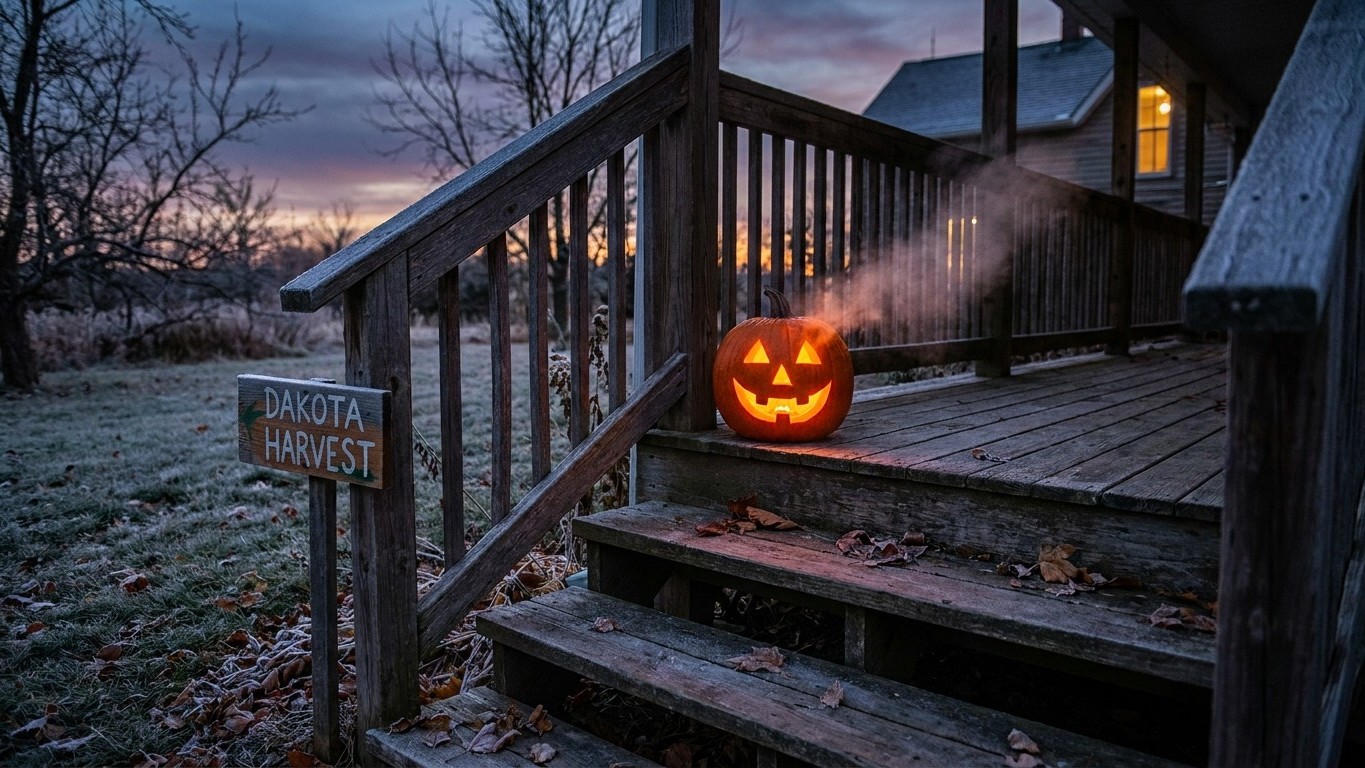

Around Sioux Falls, the mean first fall frost lands somewhere between September 24 and October 4, according to NOAA’s 1991-2020 Climate Normals. That’s three to five weeks ahead of Halloween, which means a pumpkin left sitting outside on a porch or step will likely see at least one freeze before trick-or-treaters show up. The short version: in South Dakota, carve late, not early.
The short answer

That September-to-October frost window matters because it arrives so far ahead of Halloween. In a lot of the country, the question is whether frost sneaks in before the holiday at all. In South Dakota, the more useful question is what happens to a pumpkin during the several weeks between that first frost and the day you actually want it glowing on the front steps. A hard frost doesn’t just nip leaves and tomato vines. It can soften pumpkin flesh and speed up rot if the fruit is left exposed to it, especially once temperatures start dropping into the 20s and 30s overnight, which is common here well before Halloween itself.
So the frost date isn’t really a carving deadline. It’s a storage deadline. Once that first frost has passed, an uncarved pumpkin sitting outside unprotected is living on borrowed time, even if it looks fine on the outside. The fix isn’t to carve immediately, either. A whole, uncarved pumpkin can hold for three to six months if it’s kept cool, dark, and around 45-50 F, according to University of Illinois Extension. That’s a wide window. What you don’t get, from any extension service, is a published number for how long a carved pumpkin holds up once it’s been cut open and exposed to air. That guidance simply doesn’t exist in the research literature, so it’s not something to guess at.
Given that gap, the practical window for South Dakota looks like this: buy or pick your pumpkin any time in October, store it whole and protected from frost, and save the actual carving for roughly the last week before Halloween, ideally the final few days. That keeps the cut, exposed flesh in the air for the shortest stretch possible, right up against the day you want it looking its best, rather than gambling on how it’ll hold up over two or three weeks of South Dakota’s swinging fall temperatures.
Frost or heat: which one gets it here
The cold end
South Dakota’s problem in late October is cold, not heat, and it’s not subtle. NOAA’s Climate Normals put the mean minimum temperature for the coldest month at 8.5 F for the Sioux Falls reference station. That’s not a record low or an average for the whole month, it’s the typical overnight low during the coldest stretch of winter, and it says a lot about how quickly the state tips from mild fall days into genuinely harsh cold once the season turns. By the time that first fall frost has come and gone in late September or early October, nighttime temperatures are already trending well below the 45-50 F range that a whole pumpkin wants for storage. Left outside on a step or porch rail, a pumpkin in South Dakota isn’t just missing the ideal window, it’s often getting exposed to actual freezing temperatures, which can bruise and break down the flesh from the inside.
The warm end
Heat isn’t the concern here the way it is in warmer climates, where an early frost never really arrives and pumpkins have to fight off weeks of 60- and 70-degree days that speed up softening and mold. South Dakota’s frost pattern, arriving three to five weeks before Halloween, means the state skips past that problem almost entirely. Nobody in Sioux Falls or Rapid City is worried about a pumpkin overheating on the porch in late October. The hardiness zone that describes what perennial plants can survive here has nothing to do with this, either. Hardiness zones track winter survival for things planted in the ground, not the temperature a cut fruit needs sitting on a porch for a few weeks. The relevant number is the frost date and the fact that cold, not warmth, is what a South Dakota pumpkin has to survive.
Where to keep it until you carve
Finding a spot in a South Dakota home or yard that sits close to that 45-50 F sweet spot, and stays dark, takes a little thought once outdoor temperatures start swinging toward freezing. Here’s a practical order to work through:
- Check an unheated basement or cellar first. These tend to stay in the 50s even when it’s freezing outside, and they’re already dark, which slows the aging process.
- Try an attached, unheated garage next. It’s usually warmer than the outdoors but cooler than the living space, though it’s worth checking with a thermometer on the coldest nights since an uninsulated garage can dip close to outdoor lows.
- Use an enclosed porch or mudroom if it stays above freezing. Once nighttime temperatures fall into the 20s, an open or poorly insulated porch is no longer a safe bet.
- Avoid the kitchen counter or any heated living space. Indoor heat pushes well past 50 F and speeds up softening long before Halloween arrives.
- Keep it away from apples, potatoes, and tomatoes. Ripening produce gives off ethylene gas, which ages a pumpkin faster, even in an otherwise ideal storage spot.
- Check the stem before you commit to a spot. A pumpkin with 1 to 2 inches of stem left intact holds up better in storage; once that stem breaks off, the exposed area becomes a weak point for spoilage. Never carry or lift a pumpkin by the stem, that’s exactly how it snaps.
Checking this against your own county
The frost dates above come from a single weather station near Sioux Falls, and frost timing in South Dakota varies a lot depending on elevation and how far you are from that reference point. Rural properties and areas at higher elevation often see frost arrive one to two weeks earlier than an airport station reports, sometimes more in the western part of the state. Before locking in a carving date, check current conditions and local frost guidance through South Dakota State University Extension, which tracks regional variation across the state’s counties far than a single statewide average ever could.
Common questions
Does a hard freeze ruin a pumpkin faster than a light frost?
Yes. A light frost may only affect the surface, but a hard freeze can damage the flesh underneath, especially on a pumpkin left outside without any protection. That’s part of why cold, not heat, is the main risk to plan around in South Dakota.
Can I buy my pumpkin in early October and still carve it near Halloween?
Yes, as long as it’s stored whole in a cool, dark spot around 45-50 F. Whole pumpkins can hold for three to six months under those conditions, so early October is fine if storage is handled right.
Is it better to carve early and just accept the pumpkin won’t look perfect on Halloween?
No extension service publishes how long a carved pumpkin lasts once cut, so there’s no reliable way to plan around an early carving date. Carving closer to Halloween avoids that uncertainty altogether.
What matters more, picking a good pumpkin or where I store it?
Both matter, but they solve different problems. A pumpkin with an intact 1- to 2-inch stem, no soft spots, and good weight starts you off strong; proper cool, dark storage is what keeps that head start from being wasted.