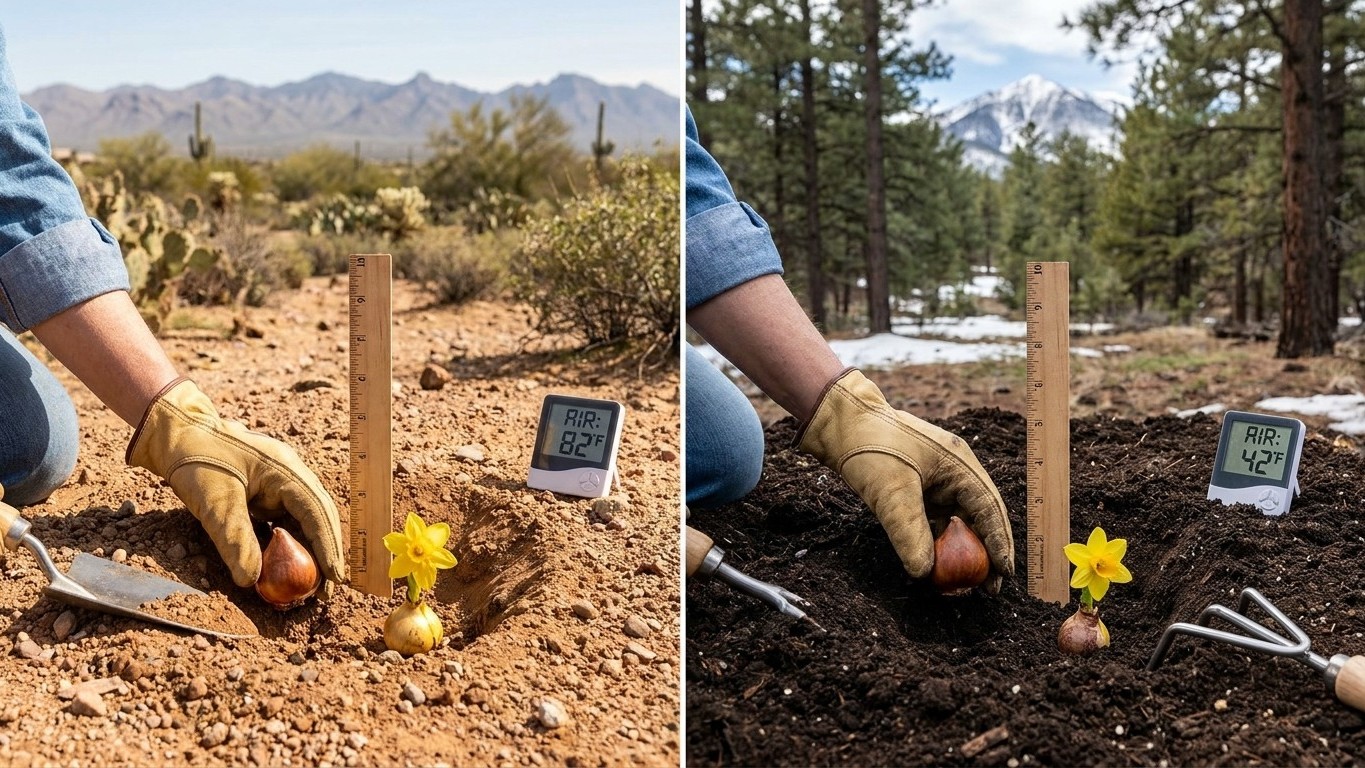

Arizona is really two planting climates wearing one state name. In the low desert around Phoenix, winter barely gets cold at all, and that changes everything about which spring bulbs will ever flower here. In the high country around Flagstaff, hard freezes are routine. The question that decides success isn’t when you plant. It’s whether your bulb gets enough sustained cold to bloom at all.
When to plant bulbs in Arizona

The standard rule you’ll see on seed packets and in most planting guides is to put Spring Bulbs in the ground about six weeks before the average first fall frost. In most of Arizona, that instruction doesn’t apply, because there usually isn’t one. According to NOAA’s 1991-2020 climate data for Phoenix, the station reached 32°F in only 6 of the last 30 springs, and NOAA lists the frost-free season there as a full 365 days a year.
That means the low desert has no reliable freeze date to count backward from. What actually governs bulb planting here is soil temperature and the chilling schedule of the bulb itself, not frost risk. In practice, low-desert gardeners plant in December into January, once nighttime lows have finally cooled off, and only after any bulb that needs pre-chilling has already spent its time in the refrigerator, a method covered in more detail in Forcing Spring Bulbs Indoors in Arizona. Plant into soil that’s still warm and the bulb pushes leaves too early, then sits through a mild winter with no real dormancy trigger and blooms weak or not at all. Many low-desert gardeners sidestep the soil temperature problem entirely by Growing Spring Bulbs in Containers in Arizona, where potting mix can be moved to a cooler spot or refrigerated more easily than an entire garden bed.
High country runs on a different calendar
Flagstaff and the rest of Arizona’s high country are a separate climate entirely. The ground there does freeze hard, on a schedule closer to the Rocky Mountain states than to Phoenix. There, the standard six-weeks-before-frost rule holds: plant too early, into soil still warm from summer, and tender top growth gets caught by the first real cold snap. Plant too late, after the ground has already firmed up, and the bulb goes in without time to grow roots before winter locks it down. It comes up thin and undersized the following spring, if it comes up at all.
Whichever region you’re in, remember that any frost date is only an average built from decades of records. Half of all years land on the early side of that average, half on the late side. In the high country, that means padding your planting window by a week or two rather than betting on the calendar date alone.
Whether your winter is cold enough
This is the question that actually decides whether spring bulbs work in Arizona, and it has nothing to do with planting depth or timing. A tulip, hyacinth, or standard daffodil needs roughly twelve to fourteen weeks of soil temperatures below about 45°F to complete the internal process that builds a flower bud inside the bulb. Skip that cold exposure and the bulb doesn’t die. It just makes leaves, or a flower stem too short to clear the foliage, with no bloom worth looking at.
The number that tells you whether a given location clears that bar is the mean daily minimum temperature of the coldest month, not the record low and not a seasonal average. For Phoenix, the reference station for Arizona’s low desert, NOAA’s 1991-2020 Climate Normals put that figure at 45.3°F. That’s barely above the 45°F threshold, and it describes only the coldest single month, not twelve to fourteen consecutive weeks below it. Low-desert Arizona does not deliver the sustained chill these bulbs need on its own. There’s no margin here, only a near-miss.
Arizona’s high country is a different story, sitting in USDA zones roughly 4b through 6b within the state’s overall 4b-10b range, where hard, sustained winter cold is normal rather than borderline. Bulbs planted there generally get their chilling requirement met by the local climate itself, no intervention needed.
For low-desert gardeners who still want tulips, hyacinths, or big trumpet daffodils, the workaround is pre-chilling: twelve weeks in a refrigerator before planting, stored away from apples, bananas, and other ripening fruit, because the ethylene gas they give off destroys the flower bud forming inside the bulb. It works, but it’s a yearly chore, not a one-time fix, since these bulbs won’t rebuild that chill on their own in a mild desert winter.
| Bulb | Cold needed (weeks below 45°F) | What Phoenix delivers | Verdict |
|---|---|---|---|
| Tulip | 12-14 weeks | One month near the threshold, not sustained | Pre-chill required, or skip it |
| Hyacinth | 12-14 weeks | One month near the threshold, not sustained | Pre-chill required |
| Daffodil, large trumpet types | 12-14 weeks | One month near the threshold, not sustained | Pre-chill required |
| Crocus | Lower end of that range | One month near the threshold, not sustained | Marginal without pre-chilling |
| Grape hyacinth (Muscari) | Lower end of that range | One month near the threshold, not sustained | Best odds of the group without pre-chilling |
A gardener who plants tulips in the low desert and skips the refrigerator step hasn’t made a small mistake. They’ve spent money on a display that won’t happen.
Which bulbs suit Arizona
In the low desert, the bulbs worth planting are the ones with a genuinely low chill requirement or the ones treated as annuals and replaced every year. In Arizona’s high country, the standard hardy spring bulb list applies with far less fuss, since the climate there does the chilling for free.
- Grape hyacinth (Muscari armeniacum), hardiness zones 4-8: one of the better low-chill options for the desert, often treated as needing pre-chilling still but tolerant of a mild winter better than most.
- Freesia, hardiness zones 9-10: suited to the low desert’s mild winters and matches the region’s warmer end of the state’s 4b-10b range.
- Ranunculus, hardiness zones 8-10: performs well in low-desert winter gardens and doesn’t demand the sustained cold that tulips need.
- Anemone (De Caen types), hardiness zones 7-10: another warm-winter performer suited to the low desert’s coldest-month numbers.
- Tulip, hyacinth, and daffodil, hardiness zones roughly 3-8: these belong to Arizona’s high country, where zone 4b-6b conditions supply the chilling naturally. In the low desert, treat them as pre-chilled, one-season plantings.
Bulbs planted outside their comfort zone don’t always fail the same way. Tulips in the low desert without pre-chilling typically leaf out and never flower, or send up a bud that opens on a stem barely off the ground. Bulbs left in wet, poorly draining low-desert soil over winter are just as likely to rot before spring arrives at all. A hardiness range on a tag is a guide, not a guarantee. A tulip pushed right to the edge of its range can survive in a sheltered courtyard bed and fail outright a few yards away in an open, exposed spot.
What digs them up here
Squirrels and voles are selective, and the reason comes down to chemistry rather than taste preference alone. Daffodils and true onion-family bulbs contain compounds that make them bitter or mildly toxic, so most rodents leave them alone. Tulips and crocus have no such defense and are treated as food.
- Bulbs squirrels and voles target: tulip, crocus, ranunculus.
- Bulbs squirrels and voles generally leave alone: daffodil, grape hyacinth (Muscari), freesia, anemone.
For the vulnerable bulbs, the one measure that consistently works is a physical barrier: wire mesh laid flat over the planting bed and staked down until the ground cools enough that digging activity drops off. Repellent sprays marketed for this purpose wash off with the first watering or rain and need constant reapplication to do anything at all, which makes them a weak substitute for a $10 roll of hardware cloth.
Where to check for your own county
Arizona stretches across several degrees of latitude and spans roughly USDA zones 4b through 10b within its borders, from low-desert valleys to mountain plateaus. Every figure in this guide, including the 45.3°F coldest-month minimum, is anchored to Phoenix, the state’s reference station for climate normals. A planting calendar built around that one city can be off by two or three weeks at either edge of the state, whether that’s higher-elevation desert transition zones or the cooler pockets of the high country.
The University of Arizona Cooperative Extension maintains local planting guidance broken down by county, and its agents can tell you which side of the chilling threshold your specific location falls on. Find your county office through the Arizona Cooperative Extension before ordering bulbs, particularly if you garden anywhere between the low desert and the high country rather than squarely in one or the other.