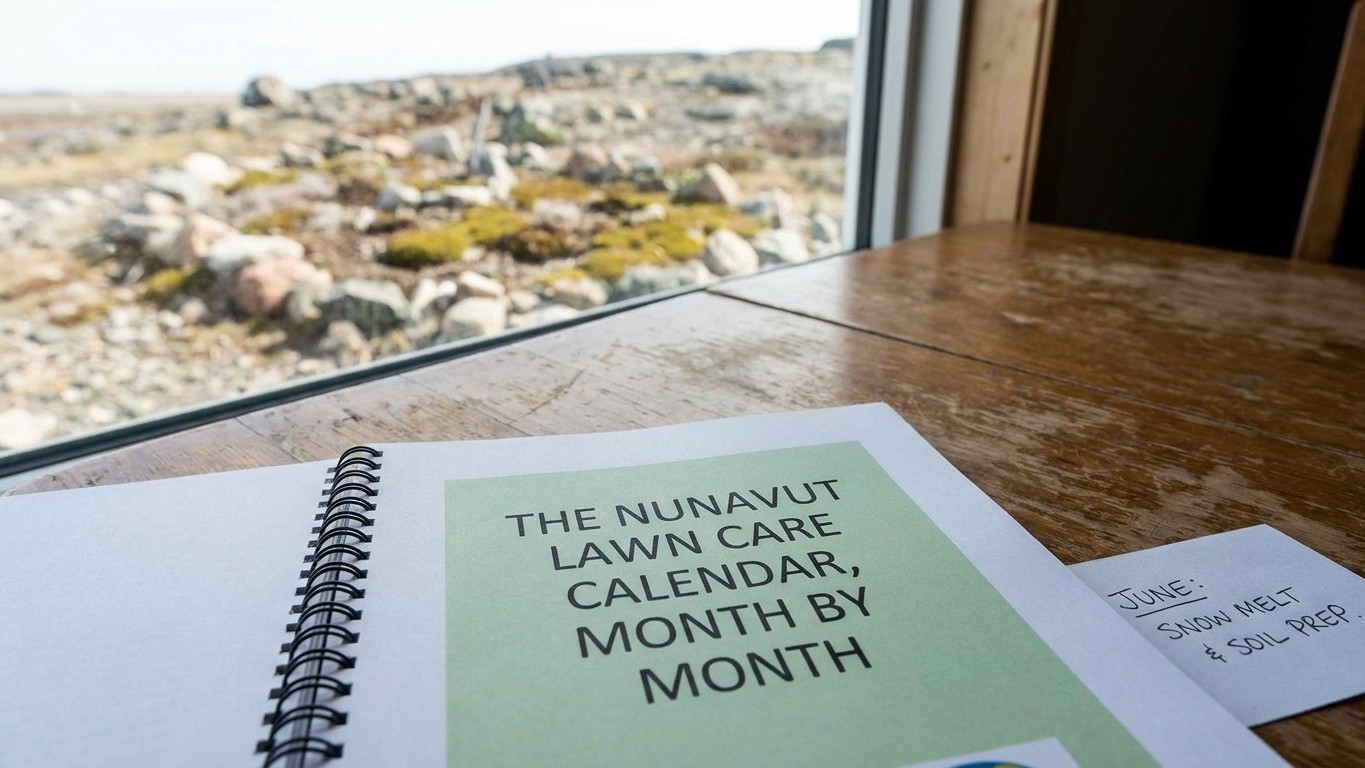

Nunavut’s lawn calendar is built around one number: the mean first fall frost of September 13, recorded at Rankin Inlet by Environment and Climate Change Canada’s 1981-2010 climate normals. That date is an average, not a promise, so in roughly half of all years frost arrives sooner, which is why every task on a Nunavut lawn gets scheduled well ahead of it rather than up against it. The single move that follows from that: pick a cool-season grass in spring, get it seeded and mowed at least twice before late summer, and stop feeding nitrogen well before that date rather than on it.
The short answer for Nunavut
Rankin Inlet’s thaw date is the number every other Nunavut community has to adjust against, not copy outright. A calendar built for tall fescue in South Carolina hits its mowing and nitrogen dates because the ground stays workable for months longer than it ever will here. The five cool-season species grown across the territory follow those same figures — what changes, community by community, is how much of the short thaw-to-freeze window is actually left to use them in.
What that depends on
The exact answer depends on three things: which of those five species you plant, how close your community’s climate runs to Rankin Inlet’s, and how much of the short summer is left once the ground actually thaws. The Best Grass Seed for Nunavut Lawns breaks down how the five differ on shade tolerance, wear, and seed cost, but the timing below applies to whichever one you choose, since all five grow through the same cool-season half of the year.
Working through the year

Clemson Cooperative Extension’s HGIC 1219, the Tall Fescue Maintenance Calendar, is the closest published month-by-month guide for any of Nunavut’s five recommended species, since tall fescue is one of them and its mowing, nitrogen, and irrigation figures don’t change with location. What does change is the calendar Clemson built around those figures: it’s written for South Carolina, where the ground is workable for most of the year. In Nunavut, every one of those same tasks has to be compressed into the weeks between snowmelt and the mean first fall frost of September 13 at Rankin Inlet.
Spring: from snowmelt to first mowing
Wait for standing snow to clear and the soil to firm up before doing anything to the lawn. HGIC 1219 calls for mowing tall fescue at a height of 2.5 to 3.5 inches, and that figure holds regardless of latitude: a taller cut shades the soil, slows evaporation, and leaves more leaf area to feed a root system that only has a few weeks to establish. Seed or overseed as early as the ground allows, because a cool-season lawn needs several weeks of active growth to root in before winter, and in Nunavut those weeks are already in short supply.
Summer: the only real growing window
This short stretch is where nearly all of the year’s growth happens, so most of the water and nitrogen a Nunavut lawn gets should land here rather than earlier or later. HGIC 1219 splits tall fescue’s nitrogen across the year but weights it toward the cooler months, which in Nunavut means modest, split doses through the growing season rather than one heavy feed. Clemson also times spring crabgrass pre-emergent to soil warming in South Carolina, but crabgrass pressure this far north is rare enough that most Nunavut lawns can skip that step, since it targets a weed problem this climate doesn’t really have.
Fall: closing out before the frost
Stop feeding nitrogen and stop overseeding by late summer, several weeks ahead of the September 13 mean frost date, so any new growth has time to harden off instead of getting caught soft. HGIC 1219 times fall aeration for cool-season lawns to relieve summer compaction before dormancy sets in, and that logic transfers directly here: aerate once growth has clearly slowed, not after the first hard frost has already shut the lawn down for the year. Once frost blackens the leaf tips, mowing and feeding are both finished until spring, whatever the calendar says.
What changes across Nunavut
Every figure in this calendar is read from one station, Rankin Inlet, on the Kivalliq coast. Nunavut spans roughly 30 degrees of latitude, from tree-line communities in the south to Grise Fiord and Resolute well inside the Arctic Circle, and no single frost date or grass list can describe all of it.
North of Rankin Inlet
Communities farther north and at higher latitude sit under a shorter and colder summer than Rankin Inlet’s. Their ground thaws later, snow cover often lingers into what would be late spring farther south, and whatever growing window exists closes earlier than the mean date this page is built around. Treat September 13 as the late end of the range for those communities, not the middle of it.
South and inland
Communities closer to the tree line, in the southern Kivalliq and parts of the Kitikmeot, generally see a longer thaw-to-freeze stretch than the Rankin Inlet figure implies, simply by sitting at lower latitude. Inland sites away from Hudson Bay also tend to warm faster in spring than coastal ones, since a large body of open water cools the air above it well into early summer.
Soil and permafrost
Continuous permafrost sits close to the surface across most of the territory. It keeps meltwater from draining away the way it would in temperate soil, so low ground stays cold and waterlogged long after the air has warmed, which can delay a lawn’s green-up even where the calendar above says the season has already started.
The mistakes this climate punishes
Most lawn failures in Nunavut trace back to timing borrowed from a milder climate. The seed packet, the fertilizer bag, and most online calendars are all written for somewhere with a longer, warmer year.
Seeding too late
Waiting until the ground fully dries out before overseeding sounds cautious, but cool-season grass seed needs several weeks of active growing weather to root in before frost. Seed put down close to the September 13 mean first frost at Rankin Inlet can germinate and then get killed by the very first hard freeze, leaving a bare patch that reads as a failed lawn rather than a mistimed one. The damage doesn’t show until the following spring, when that patch stays thin while the rest of the lawn greens up.
Feeding nitrogen too late
A heavy nitrogen application in late summer pushes soft, leafy growth that has no time to harden before frost, and that tissue is the first thing to blacken when the cold hits. It also wastes fertilizer that would have done more good split earlier across the growing season, when the plant could actually use it.
Mowing too short
Cutting cool-season grass down to a short, tidy height removes the leaf area the plant needs to photosynthesize during an already brief growing season. A lawn cut too low here doesn’t just look rough, it goes into winter with less stored energy and comes back thinner the following spring.
Planting a warm-season species at all
Bermudagrass, zoysia, and other warm-season turf will not establish in this climate no matter how carefully the seeding is timed, because they need sustained heat Nunavut’s summer simply doesn’t provide. A lawn attempted with one of them fails outright rather than underperforming, and from a distance that failure can look identical to a seeding-timing mistake.
Checking this against your county
Nunavut has no territorial extension office publishing its own lawn calendar, and the territorial agriculture site currently blocks automated verification, so the working link here is Agriculture and Agri-Food Canada, the federal department covering the territory. It won’t hand you a Nunavut-specific mowing schedule, but it’s the right starting point for anything specific to your community, from soil testing options to frost records beyond the Rankin Inlet normals used on this page.
Before seeding anything, it’s worth working through the basics in Nunavut Lawn Care, because site prep and drainage matter more here, on shallow soil sitting over permafrost, than the exact week you choose to seed.
Common questions
Why is my lawn still brown weeks after the snow melts?
That’s normal dormancy, not death. Cool-season grass typically needs a few weeks of warming soil after snowmelt before it greens up, and standing meltwater over permafrost can slow that further in low spots.
Can I mow as soon as the snow is gone?
Wait until the ground has firmed up. Mowing while the soil is still saturated compacts it, tears wet turf, and does more damage on shallow soil over permafrost than it would on a well-drained lot farther south.
What happens if I skip fertilizing one summer?
An established lawn usually tolerates a skipped season without dying, though growth and color will lag. A newly seeded lawn is more vulnerable, since it has less stored energy and a shorter window to make up for lost feeding.
Should I bother aerating a lawn this small and short-season?
Yes if the soil is compacted or drains poorly, which is common on shallow ground over permafrost. Aerate once growth has slowed in late summer, not right up against the first frost, so the lawn has some recovery time before winter.