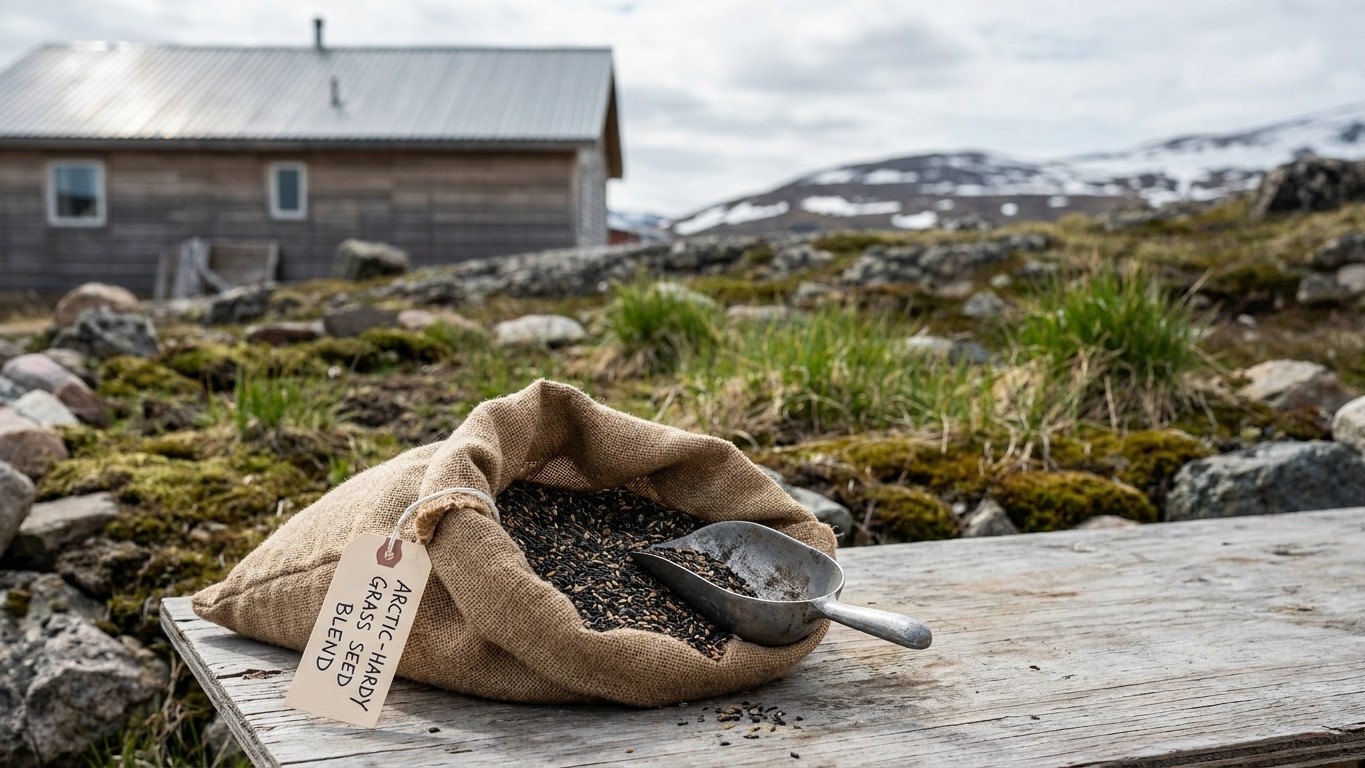

Nunavut sits in a cool-season lawn zone, so the seed that works is Fine Fescues, Kentucky Bluegrass, Perennial Ryegrass, Rough Bluegrass or Tall Fescue, the five species named by Clemson Cooperative Extension (HGIC 1214) and Penn State Extension as the cool-season group. Environment and Climate Change Canada’s 1981-2010 climate normals put the mean first fall frost at Rankin Inlet on September 13, which marks the far edge of how long new seedlings get to root in before the ground turns against them. Choose a blend built mostly on Fine Fescues, get it into the soil as early in the short growing season as you can, and don’t wait for a stretch of warm weather that may not come.
The short answer for Nunavut
Rankin Inlet’s September 13 frost date is the quiet number behind every seed bag recommendation for Nunavut, but your yard probably isn’t Rankin Inlet. A damp, shaded strip against a building foundation needs a different blend than a wind-scoured slope with no cover at all. Five seed types get compared here, and Fine Fescues usually come out ahead for exposed, low-input ground — though drainage, sun, wind, and foot traffic on your own site will do more to decide the winner than any ranking can.
What “best” depends on
There is no single winner among the five, because they solve different problems. A shaded, damp corner near a building foundation calls for something other than an open, wind-scoured slope. Site conditions decide the blend more than any ranking on a seed bag does: drainage, sun exposure, wind, and how much foot traffic the area actually gets. A seed mix leaning on Fine Fescues tends to be the safest default for exposed, low-input sites, because it asks less of the soil and tolerates cold better than the others on this list.
Keep in mind that this whole classification comes from a single reference point. The cool-season label and the September 13 frost figure both trace back to data gathered at Rankin Inlet. A coastal Baffin community, a High Arctic settlement, and a Kivalliq hamlet inland will not share one climate, even though they share this one label. Treat the guidance here as a starting point to test against your own ground, not a fixed rule for the whole territory.
Working through the year

Ranked by how well each holds up here, and what it costs you in exchange, the order runs roughly like this. Fine Fescues establish more slowly than ryegrass but need the least fertility and shrug off cold better than any other grass on the list, which makes them the closest thing to a low-maintenance choice in this climate. Perennial Ryegrass germinates fast and is often mixed in as a nurse crop to hold soil while slower grasses take hold, but it is the least cold-hardy of the five and can thin out hard after a severe winter. Kentucky Bluegrass spreads by rhizomes and repairs itself once established, but it is slow from seed and wants more consistent moisture and fertility than a short Arctic summer easily provides. Tall Fescue roots deeply and tolerates heat and drought better than the others, which matters little here and may work against it, since it is also the least reliably cold-hardy option at the far north end of this zone. Rough Bluegrass (Poa trivialis) only earns its place in wet, shaded ground where nothing else holds; on dry, open soil it thins out fast.
A comparison at a glance
| Species | Establishment speed | Cold tolerance | Best use |
|---|---|---|---|
| Fine Fescues | Slow to moderate | Very good | Exposed, low-input sites |
| Perennial Ryegrass | Fast | Weakest of the five | Nurse crop, quick cover |
| Kentucky Bluegrass | Slow | Good | Self-repairing turf where soil is decent |
| Tall Fescue | Moderate | Fair, marginal in far north | Southern edge of the cool zone |
| Rough Bluegrass | Moderate | Good in shade/moisture | Wet, shaded low spots only |
Clemson’s Tall Fescue Maintenance Calendar (HGIC 1219) lays out a full-season sequence for that species: mowing on the higher side through the warm months, feeding mainly in fall rather than spring, and holding off on aeration or overseeding until the worst heat has passed. That calendar was written for South Carolina’s much longer season, so its actual calendar dates do not transfer here. What does transfer is the sequence and the logic behind it: build root reserves before the cold sets in, rather than pushing soft new growth right before frost. With Rankin Inlet’s mean first fall frost sitting on September 13, that means treating mid-to-late summer, not September, as your main seeding and feeding window, since new grass here gets far fewer weeks to root in than it would in the Carolinas. For the fuller month-by-month breakdown of what that looks like locally, see The Nunavut Lawn Care Calendar, Month by Month.
What changes across Nunavut
The Rankin Inlet figures describe one town in the Kivalliq region, not the territory. Nunavut spans coastal hamlets, inland lake country, and High Arctic settlements on islands like Ellesmere and Cornwallis, and none of them share a single growing season.
Coast, elevation and the High Arctic
Coastal communities on Baffin Island sit closer to sea ice through much of the growing season, which tends to hold spring temperatures down longer than an inland site at the same latitude would see. Settlements farther north than Rankin Inlet, and those at higher elevation or greater distance from the moderating effect of open water, should expect a shorter effective window than the September 13 mean frost date suggests, not a longer one. Inland lake country in the Kivalliq region can also see sharper overnight temperature swings than a coastal site, since large bodies of open water release stored heat slowly while dry ground cools fast after sunset.
None of this changes which five species belong on a seed bag here. It changes how much margin you have to work with. A community running colder or later than Rankin Inlet needs to treat its own seeding window as narrower still, and should lean even further toward Fine Fescues over the less cold-hardy options like Tall Fescue or Perennial Ryegrass.
The mistakes this climate punishes
Most lawn advice written for the rest of the United States assumes a season this territory does not have, and following it here shows up as damage within the same year, sometimes within weeks.
Warm-season habits don’t transfer
- Buying a warm-season blend because it was cheap or on hand: Bermudagrass, zoysia and centipede are built for heat and go into permanent winterkill the first hard frost they meet here.
- Seeding too late in summer, gambling that frost will hold off past the Rankin Inlet mean of September 13: seedlings without enough root growth going into the cold rarely survive to spring.
- Feeding heavily late in the season to green up a thin lawn before winter: it pushes soft top growth instead of root reserves, and that growth is what dies back hardest.
- Mowing too short during the brief warm stretch: closer cutting reduces the leaf area a cool-season grass needs to build the root reserves that get it through winter.
- Skipping site prep and scattering seed straight onto compacted or frozen-adjacent ground: germination fails quietly, and the bare patch is often blamed on the seed rather than the ground.
Each of these shows its damage on a different timeline. A warm-season mistake is visible by the first frost. Late seeding fails silently over winter and only shows as bare ground the following spring. Overfeeding and short mowing both weaken a lawn gradually, so the failure often gets blamed on the next hard winter rather than the practice that set it up.
Checking this against your county
The figures come from a single station, Rankin Inlet A, and a single set of Clemson Cooperative Extension turf publications written for a different climate zone entirely. Before you commit to a seed order, check current guidance through Agriculture and Agri-Food Canada at agriculture.canada.ca, since the provincial and territorial departments update local advisories more often than a single national climate normal does. If you’re working through the broader set of decisions around establishing and maintaining turf this far north, the overview at Nunavut Lawn Care is the place to start before narrowing down to seed choice.
Common questions
Can I just use a regular bag of grass seed from the hardware store?
Check the label before you buy, not after. Many bags sold in general hardware stores are blended for warm-season regions and will winterkill here regardless of how they’re cared for, so confirm the bag lists Fine Fescue, Kentucky Bluegrass, Perennial Ryegrass, Rough Bluegrass or Tall Fescue rather than assuming any lawn seed will do.
Will grass seed actually grow this far north?
Yes, in sheltered, sunny, well-drained spots, but expect a thinner and rougher cover than a lawn farther south, not a dense turf. Exposed, windswept or poorly drained ground will struggle regardless of which species you choose.
Is it too late to seed if it’s already late summer?
It depends on how close you are to your local first frost, and Rankin Inlet’s own mean date of September 13 is only an average, meaning frost arrives later than that in half of all years and earlier in the other half. Treat late summer seeding as a real risk rather than a safe bet, and prioritize getting seed down earlier in the season next year.
Do I need to reseed every single year?
Thin turf from Fine Fescue or Perennial Ryegrass blends often needs some annual overseeding in exposed sites, especially after a harsh winter. A well-established Kentucky Bluegrass area that has had a few seasons to spread by rhizome needs it less often, since it can fill small gaps on its own.