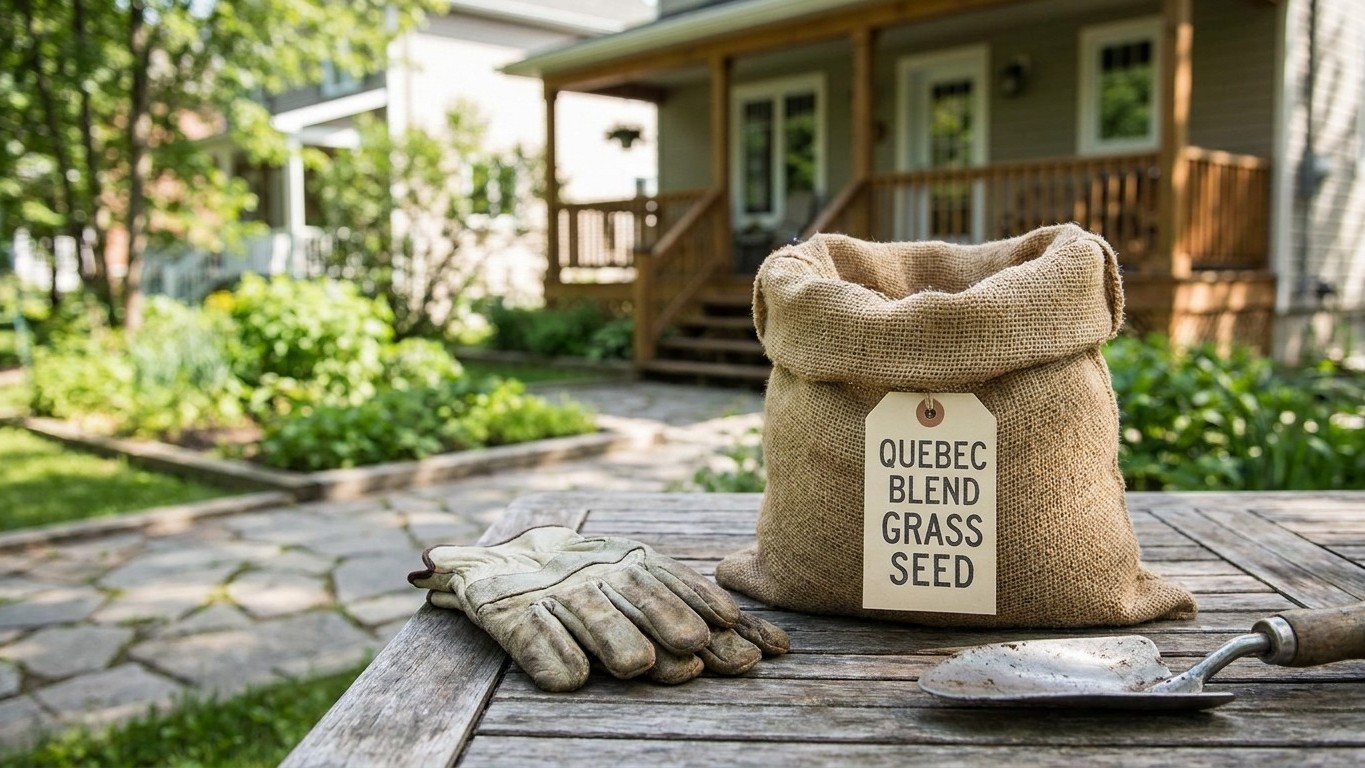

What grass actually works in a Quebec yard? Kentucky Bluegrass and Tall Fescue, mixed with some Perennial Ryegrass for quick cover, is the safe starting point for most lots here — they’re the ones that shrug off both a Quebec winter and a sticky August. If your yard is shaded under big trees or takes a beating from kids and a dog, that changes the mix, but the family is the same. Before you buy a bag of anything, go outside and mark the six to eight weeks before your first fall frost on a calendar — that window is when the seed actually takes.
The short answer for Quebec
For most Quebec lawns, a blend built around Kentucky Bluegrass and Tall Fescue, with Perennial Ryegrass mixed in for quick cover, is the practical starting point. These are drawn from the cool-season list published by Clemson Cooperative Extension in HGIC 1214 and echoed by Penn State Extension, and they are the only species groups that hold through a Quebec winter and a Quebec summer without dying outright. Warm-season grasses such as Bermudagrass or Zoysiagrass belong in a different climate entirely: they go dormant at temperatures cool-season turf shrugs off, and in a Quebec winter they simply do not come back.
Which of the five cool-season species you lean on depends on what the yard actually does. A lawn that takes foot traffic from kids or a dog wants the wear tolerance of Kentucky Bluegrass or Tall Fescue. A shaded side yard under mature maples does better with a Fine Fescue, which tolerates low light better than the others on the list. Rough Bluegrass has a narrower use: it likes damp, shaded, poorly drained ground where little else will establish, and it will not hold up to heavy foot traffic or drought. None of these five species is wrong for Quebec in the way a warm-season grass would be. The differences between them are about the site, not the climate.
Before choosing a species, walk the yard and note where the sun actually falls in July, where water pools after rain, and where the soil has been compacted by traffic. That groundwork belongs to general Quebec Lawn Care, and skipping it is the fastest way to plant the wrong grass in the right zone.
Working through the year

Clemson Cooperative Extension’s HGIC 1219 Tall Fescue Maintenance Calendar is written for South Carolina, but because tall fescue is one of the cool-season species that also grows in Quebec, its mowing heights, nitrogen rates and irrigation figures are usable here once the calendar dates are shifted to match the local frost window instead of Clemson’s.
Spring
As growth resumes, HGIC 1219 calls for mowing tall fescue at 2 to 3 inches and for applying nitrogen at a modest rate compared with fall, since heavy spring feeding pushes leaf growth at the expense of roots. Spring is also when pre-emergent herbicide goes down, timed by the calendar to soil warming rather than a calendar date, so watch soil temperature rather than the page number.
Summer
Mowing height should not drop below the 2 to 3 inch range HGIC 1219 sets for tall fescue, and taller is safer once heat arrives, since a longer blade shades the soil and slows moisture loss. Irrigation, where the calendar calls for it, runs at roughly 1 inch of water per week including rainfall. Summer is not a seeding window for any of the five species: heat kills cool-season seedlings before they root.
Fall
Fall is the seeding and overseeding season for every grass on the cool-season list, and it is built around the frost date, not a fixed month. Working back from the average October 5 first fall frost at the Montreal/St-Hubert A station, aim to get seed down six to eight weeks ahead of that date, which puts the window in later summer rather than early fall. Fall is also when HGIC 1219 calls for the heaviest nitrogen application of the year, because cool-season grass stores that nitrogen in its roots over winter rather than spending it on leaf growth. Aeration, where the lawn is compacted, belongs in this same window, ahead of overseeding rather than after it.
Winter
Once growth stops, mowing and feeding stop with it. The main task is staying off frozen or snow-covered turf, since compressed, dormant grass bruises and is slow to recover once growth resumes.
| Species | Establishment speed | Shade tolerance | Wear tolerance | Trade-off |
|---|---|---|---|---|
| Perennial Ryegrass | Fast, days to weeks | Low | Good | Weak recovery from summer stress |
| Kentucky Bluegrass | Slow, spreads by rhizome | Low to moderate | Very good | Needs full sun and steady moisture |
| Tall Fescue | Moderate | Moderate | Very good | Clump-forming, does not self-repair bare spots |
| Fine Fescues | Moderate | Very good | Low | Thins under heavy foot traffic |
| Rough Bluegrass | Fast in damp shade | Very good | Poor | Fails outright in dry, sunny spots |
For the full month-by-month breakdown of what to do outside the seeding window itself, including spring dethatching and winter prep, see The Quebec Lawn Care Calendar, Month by Month.
What changes across Quebec
The October 5 mean first frost date comes from the Montreal/St-Hubert A station, and Montreal’s position in the St. Lawrence Valley, with the river and Lake Saint-Louis nearby moderating temperature swings, makes it one of the milder places in the province for turf work. Move away from that valley and the growing season compresses from both ends.
The Laurentides north of Montreal and the higher ground of the Eastern Townships (Estrie) sit at greater elevation, and elevation cools a site faster than latitude alone would suggest. A lawn established on a hillside in either region should expect frost to arrive earlier than the Montreal-area mean, which means the fall seeding window needs to open earlier there too, not later.
Further from the moderating effect of the St. Lawrence, in the Gaspé Peninsula and along the North Shore, the combination of higher latitude and closer proximity to the cold water of the Gulf of St. Lawrence shortens the growing season further still. None of the FACTS available here give a station reading for those regions, so treat the October 5 date as a Montreal-area figure only, and check a local frost record before locking in a seeding date on the coast or in the hills.
Soil differs too, and it changes which of the five species performs. Heavier clay soils common in parts of the Montérégie hold moisture longer, which favors Kentucky Bluegrass and disadvantages Fine Fescues, which prefer better drainage. Sandy soils drain fast and dry out fast, and a Fine Fescue’s lower water demand becomes an advantage there that it does not have on clay.
The mistakes this climate punishes
Every one of these errors is common because the timing that works in a milder US climate does not transfer to Quebec’s shorter season, and the damage does not always show up right away.
- Seeding in spring instead of late summer. Spring-sown cool-season grass has to establish, harden off, and then survive a Quebec summer within a few months. It usually thins badly by August.
- Buying warm-season seed because it was cheaper or available. Bermudagrass and Zoysiagrass are not on the cool-season list Clemson HGIC 1214 sets out for this zone, and in a Quebec winter they die rather than go dormant. The mistake is invisible until the following spring, when nothing greens up.
- Cutting below the 2 to 3 inch height HGIC 1219 sets for tall fescue during a hot, dry summer. A short-mown lawn stresses in heat and shows the damage as scattered brown patches within a week or two, not immediately.
- Overseeding after the frost has already arrived. Seed sown after the average October 5 date at the Montreal/St-Hubert A station has too little time to root before dormancy, and a late frost only makes the odds worse.
- Skipping fall nitrogen because the grass has stopped visibly growing. HGIC 1219 sets the heaviest feeding of the year for fall precisely because the plant is still storing nutrients below ground even after top growth slows.
Checking this against your county
Every figure above is a Montreal-area reading, and a lawn two hours away in either direction can be working a genuinely different calendar. Quebec’s agriculture ministry, the Ministère de l’Agriculture, des Pêcheries et de l’Alimentation du Québec (MAPAQ), is the place to check regional guidance before locking in a seeding date, particularly if the property sits well north of Montreal, at elevation, or close to the Gulf of St. Lawrence.
Common questions
Can I just overseed in spring instead of waiting for late summer?
You can, but expect a weaker stand. Spring-sown cool-season seedlings have to get through summer heat with only a few months of root development, and most thin out badly by August. Late summer seeding gives the same seed a full fall and winter to root before it has to face heat stress.
Is it too late to seed if I miss the window before the October frost?
Seed sown right at or after the average October 5 frost date at the Montreal/St-Hubert A station rarely has time to establish before dormancy. In that case, wait for the following late-summer window rather than gambling on a late seeding that will likely fail.
Will Kentucky Bluegrass fill in bare spots on its own?
Yes, that is its main advantage over Tall Fescue. Kentucky Bluegrass spreads by rhizome and can knit over small bare patches on its own, while Tall Fescue grows in clumps and needs to be reseeded into any gap it does not already cover.
Does a brown lawn in a Quebec summer mean the grass is dead?
Usually not. Cool-season turf browns under drought stress and typically greens back up once rain returns and temperatures ease, as long as it was not also mowed too short or scalped while stressed.