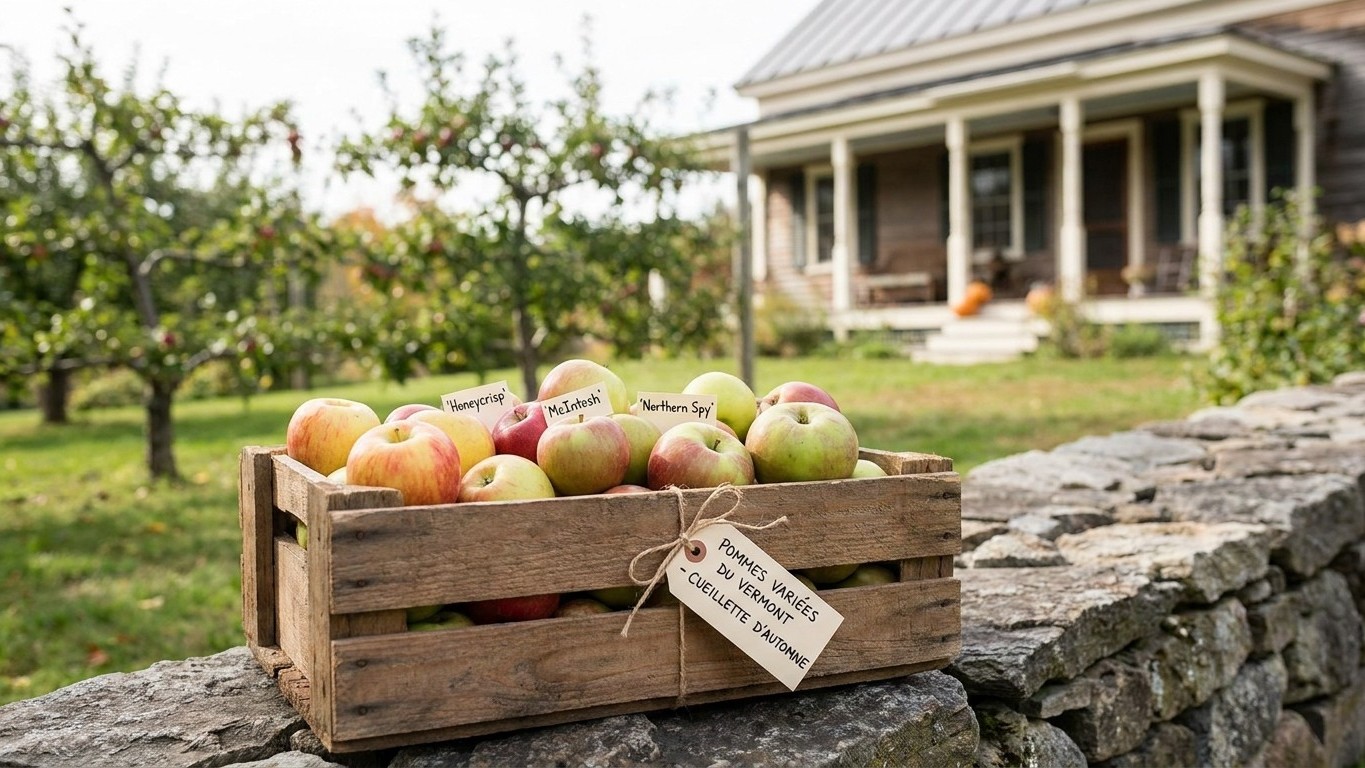

A Honeycrisp tree set into a low valley lot because the nursery photo looked irresistible will blossom straight into a late frost more years than not, and the whole crop goes black on the branch before it ever sizes up. The tree isn’t the problem. The ground is — cold air pools in that low spot on a still April night in a way no catalog label warns you about, and no statewide hardiness map will ever show you your own hillside.
The short answer for Vermont
The apples that succeed anywhere in Vermont are the ones whose winter hardiness rating covers your local minimum and whose bloom lands safely after your local frost window closes, not the ones with the prettiest fruit in a catalog photo. At the reference station in Burlington, NOAA’s 1991-2020 climate normals record a coldest-month mean minimum of 10.2°F, a level that already rules out apple stock bred for milder mid-Atlantic winters. The same station’s 30-70% freeze probability band puts the last spring freeze between April 30 and May 10, which means a tree whose flowers open before early May is gambling every single year.
That answer depends on three things you have to check for your own ground before you check a variety name: the winter minimum your site actually reaches, the length of your frost-free season, and how reliably cold your winter runs. A hillside above a valley floor can run several degrees colder on a still night than the valley itself, and a site with poor cold-air drainage will hold frost longer into spring than a slope that lets cold air flow downhill and away. None of that shows up on a statewide hardiness map. It only shows up if you watch your own thermometer for a season or ask a neighbor who has grown fruit trees on that same slope for years.
The winter minimum decides whether the tree survives at all. The bloom window relative to the last frost decides whether it fruits in a given year. Both filters have to pass before a variety is worth discussing, and a tree that clears the first filter but blooms into a frost pocket will lose its crop on a schedule that has nothing to do with how hardy its wood is.
Working through it

Vermont doesn’t have one best apple. It has a handful of broad scion types that perform differently once you weigh them against a site’s own hardiness and bloom timing, and each one buys you something at a cost. If you haven’t already settled on a planting site and rootstock, work through that step first. Rootstock choice does most of the heavy lifting on cold survival, and the guidance in Growing Apples in Vermont walks through that decision before you get to scion type.
Extreme-hardy, crab-derived types
These trace back to Siberian crab lineage bred specifically for northern winters, and they carry the widest margin below Burlington’s 10.2°F coldest-month normal of anything you can plant. They also bloom later, which helps them dodge the tail end of the spring frost window. The trade-off is fruit quality: smaller, tarter apples suited to cider or preserves rather than fresh eating, but they are the realistic choice for the state’s coldest, highest ground.
Cold-hardy dessert types
These were bred in northern nurseries for eating quality first, hardiness second, and most still clear Burlington’s winter minimum with room to spare. Their bloom generally falls inside the window that closes by early May at the reference station, but they need a full, uninterrupted cold winter to break dormancy evenly. A warm January thaw followed by a hard freeze can catch flower buds mid-break and kill them before bloom even opens.
Disease-resistant modern introductions
Vermont’s humid summers favor apple scab and fire blight, and this group was bred with resistance to both built in rather than relying on a spray schedule. The cost usually shows up as a narrower flavor profile compared to older dessert types, and these are often sold only through specialty nurseries rather than big-box garden centers.
Old New England keeper types
Selected over generations for exactly this region’s winters, these hold in storage for months and were the backbone of old Vermont orchards before refrigeration. Many bear biennially, heavy one year and light the next, and identification and sourcing can be harder since a lot of them survive only through local scion exchanges rather than national catalogs.
| Scion type | Winter hardiness margin | Bloom timing | Main trade-off |
|---|---|---|---|
| Extreme-hardy, crab-derived | Well below Burlington’s 10.2°F normal | Late, low frost risk | Small, tart fruit |
| Cold-hardy dessert | Meets Burlington’s normal with margin | Falls inside typical frost window | Vulnerable to warm winter thaws |
| Disease-resistant modern | Varies by cultivar, check hardiness rating | Mid-season, cultivar-dependent | Narrower flavor, limited sourcing |
| Old New England keeper | Proven in the region historically | Mid to late, cultivar-dependent | Biennial bearing, harder to source |
What changes across Vermont
Every figure above comes from the Burlington reporting station, and Burlington sits in the Champlain Valley, the mildest corner of Vermont because Lake Champlain moderates temperature swings at both ends of the season. Move east into the Green Mountains and elevation starts working against you. The same cold air mass that reaches Burlington first has to climb, so it cools further along the way, which means the last spring freeze there arrives later and the first fall freeze arrives earlier than the reference dates above, and the growing season a tree gets to ripen its wood before winter runs shorter.
The Northeast Kingdom, in the state’s far northeast corner, combines the highest average elevation with the most northern latitude in Vermont. Growers there should treat the Burlington figures as a floor for the hardiness needed, not a match, leaning toward the extreme-hardy end of the scion types and accepting a later bloom and a shorter storage season in exchange.
Elevation isn’t the only local factor. A frost pocket at the bottom of any valley, where cold air drains overnight and settles, can run several degrees colder at dawn than a slope just a few hundred feet uphill. That’s why orchardists traditionally plant fruit trees partway up a slope rather than on the valley floor, and why two sites a mile apart in the same county can carry meaningfully different frost risk.
The mistakes this climate punishes
Most apple failures in Vermont trace back to one of a small set of timing errors, and each one shows up on a predictable schedule once you know what to look for.
- Planting a variety whose bloom opens before the local last-frost window closes: the tree survives, but a May freeze inside NOAA’s 30-70% probability band kills the open flowers, and there’s no crop that year.
- Fertilizing or pruning late in summer, which pushes soft new growth right as the first fall freeze, typically between October 3 and October 13 at Burlington, moves in and kills that growth back.
- Grafting a hardy rootstock but leaving the graft union exposed above the snow line, where the winter minimum bites hardest on the least hardy part of the tree.
- Assuming a single “hardy” variety name is safe everywhere in the state without checking it against local elevation and frost dates first.
The bloom-timing mistake is the one that catches new growers most often, because the tree itself looks fine every year, it just doesn’t fruit some years. The stage that actually decides the outcome is bloom, not the calendar month it usually falls in, and tracking that stage against your own trees each spring matters more than any date printed on a nursery tag. The Vermont Apple Calendar, Stage by Stage walks through how to read that stage on your own trees rather than by the date alone.
Checking this against your county
The frost dates and winter minimum used throughout this page come from the Burlington reporting station, and Vermont’s terrain means the rest of the state runs colder, shorter, or both. UVM Extension publishes county-level guidance that accounts for the elevation and lake-effect differences the statewide averages miss, and it’s worth a call or a look at their tree fruit resources before you commit to a variety. Ask specifically about hardiness zone and bloom-timing figures for your county, and about local scion exchanges if you’re after one of the older regional keeper types that big nurseries rarely stock.
Common questions
Do I need two apple trees to get fruit?
Most apple varieties are not reliably self-fertile, so you generally need a second tree, or a nearby crabapple, blooming in the same window to get consistent fruit set. Check that the bloom timing of your chosen tree and its pollinizer actually overlap, since a mismatch in bloom stage defeats the purpose of having a second tree at all.
Can I grow apples above 1,500 feet in the Green Mountains?
No local source documents a firm elevation cutoff for apples in Vermont, so treat any number you see quoted elsewhere with caution. What’s well established is that higher elevation shortens the growing season and increases frost risk, so growers at that height should lean toward the most cold-hardy scion types and get a site-specific read from UVM Extension before planting.
Why did my tree bloom and then lose the whole crop to frost?
Its bloom opened inside a year when the last freeze fell later than usual within Burlington’s April 30 to May 10 probability band, or later still if you’re outside the Champlain Valley. That band is a probability, not a guarantee, so even a well-matched variety will lose a crop in some years without the tree itself being damaged.
How many years before a new apple tree bears fruit?
It depends mainly on rootstock rather than on the Vermont climate specifically. Trees on dwarfing rootstock generally begin bearing sooner than trees on standard, full-size rootstock, and either way the first few years’ fruit set is usually light while the tree builds out its structure.