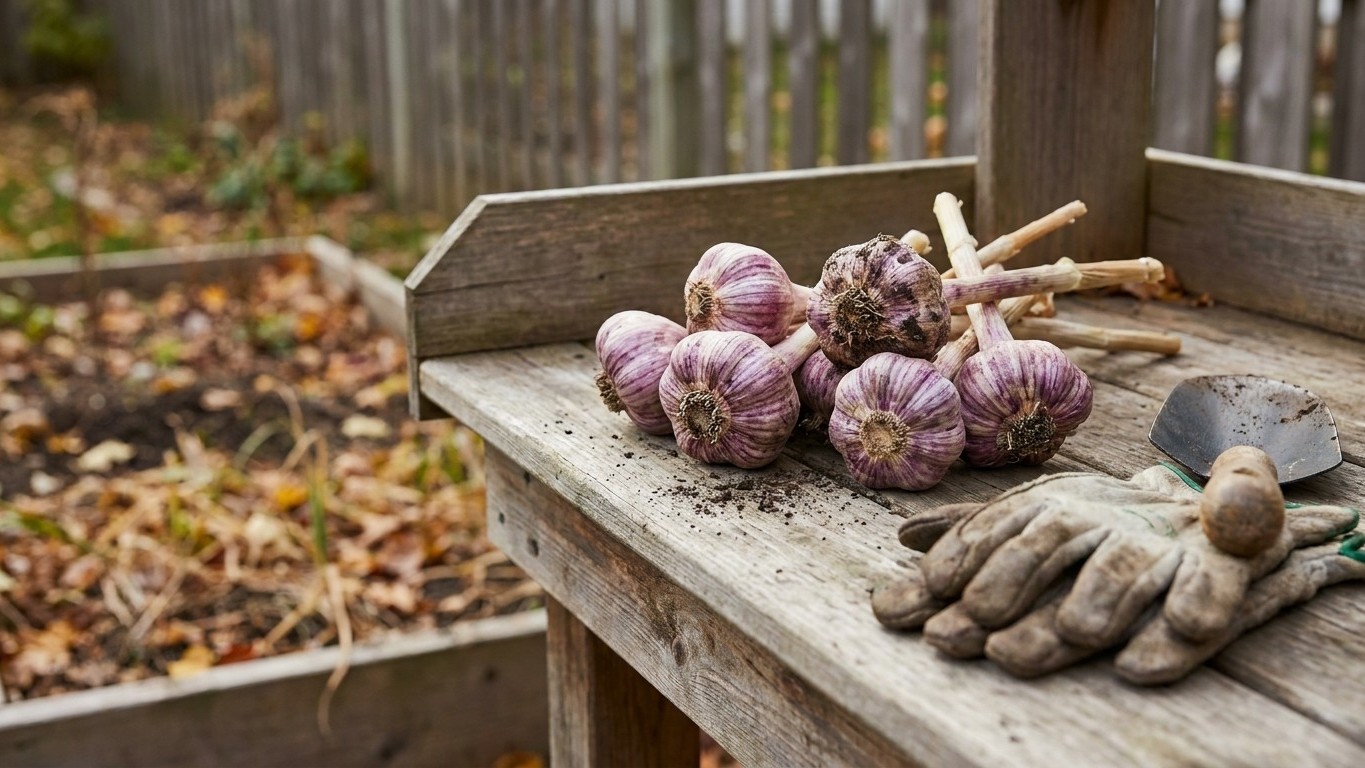

A hard freeze is what actually builds a Duganski bulb. This Purple Stripe is a hardneck through and through, and hardnecks won’t split into fat, easy-peel cloves unless the planted clove sits through several weeks of genuine cold first — that chill is what triggers clove differentiation come spring. Skip the real winter, plant too late or too far south without help, and you get a small, undivided bulb instead of the eight fat cloves this variety is grown for.
What Duganski actually is

Duganski belongs to the Purple Stripe family, one of the recognized botanical groups garlic is sorted into. Purple Stripes carry the wrapper their name promises: a white to buff skin streaked and blotched with deep purple, easy to spot next to a plain tan Porcelain or a papery Silverskin. Seed catalogs that carry Duganski describe its flavor as hot and assertive raw, mellowing into a rich, almost smoky sweetness once roasted, a profile closer to Rocambole than to the milder Porcelain types.
Because it is a hardneck, Duganski sends up a stiff central flower stalk, called a scape, that gets cut off in early summer so the plant’s energy goes into the bulb instead of top growth. That habit gives hardnecks their trademark head: fewer cloves, usually somewhere around four to eight, but each one noticeably larger and easier to peel than a softneck’s dozen-plus small cloves. The tradeoff runs the other way in storage, where catalogs list Duganski’s shelf life at only a few months in a cool, dry space, shorter than a softneck braid that can hang for most of a year. If you’re weighing it against other hardneck options before you order, the wider rundown at Garlic Varieties lays out how Purple Stripe, Porcelain and Rocambole types differ side by side.
What Duganski tastes like, and what to do with it
The heat that makes Duganski assertive raw is at its most useful chopped into something that will never see a stove — a salsa, a chimichurri, a raw vinaigrette — where that sharp bite has room to stand out instead of getting buried under other ingredients. Mince or press it for these; the cell damage from a fine chop releases more of the compounds responsible for that raw punch than a rough slice would.
Cooking changes the calculation. A quick sauté in oil softens the edge within a minute or two, which makes Duganski a solid all-purpose cooking garlic for stir-fries, pan sauces, and anything sautéed with onions as a base. Push it further — a whole head, top sliced off, drizzled with oil and roasted until the cloves are soft and golden — and the sharpness disappears entirely into the smoky sweetness the category is known for. Squeezed straight from the skins, roasted Duganski is worth spreading on bread on its own or stirred into mashed potatoes, softened cheese, or a pan sauce that wants body and a little sweetness rather than bite.
Because the bulbs run large with correspondingly large cloves, Duganski is also a good candidate for dishes that call for whole or halved cloves rather than mince — braises, roasted vegetables, or a pot of beans where big pieces of garlic are meant to be found and eaten rather than dissolved. The bulb’s size and unusually striking purple-streaked wrapper also make it worth setting aside a few heads uncooked, just for the table or for replanting, since a bulb this well-formed is exactly the kind growers use to select seed stock for next season.
Beyond raw, sautéed, and roasted preparations, no specific pairing or regional use is documented for this variety; what’s said above follows from how purple stripe garlic generally behaves under heat, not from any claim particular to Duganski.
Will it get the cold it needs where you are
Duganski is a hardneck, and hardnecks are the pickiest of all garlic types about winter chill. The clove needs a run of weather below 40°F, roughly six weeks total, to trigger the split that turns one clove into a full head of cloves. Skip that vernalization and the plant just bulks up into a single, rounded, undivided bulb, still garlic, but not what you paid for.
Where the cold falls short
At one extreme, California, measured at Los Angeles, spends effectively zero weeks below 40°F in an average winter against the roughly six Duganski wants. Grown straight in the ground there, the cloves have nothing to divide with. The same gap shows up at stations in Louisiana (New Orleans), Texas (Houston) and Florida (Jacksonville), plus Hawaii (Honolulu) and Arizona (Phoenix). All six are rated risky for this variety.
That doesn’t mean skip garlic altogether in those states. It means change the plan:
- Refrigerate seed cloves for several weeks before planting, to mimic the chill the ground itself won’t provide.
- Grow a type that never asked for six weeks of chill in the first place, a softneck of the Artichoke or Silverskin type.
Duganski, being a Purple Stripe hardneck, is the wrong pick for a Houston or Phoenix garden bed without one of those two adjustments.
Where the cold is easy but the season is short
Move to the other end of the map and the problem flips. Prince Edward Island, measured at Charlottetown, is rated comfortable for cold, but its 1,569 growing degree days over the season are still tight for a full-season crop. An earlier cultivar and a black plastic mulch to bank extra soil heat are what make the difference there. Push further north and cold stops being the limiting factor and the season’s total warmth takes over instead. Alaska (Anchorage) logs around 917 degree days a year, Alberta (Calgary) around 1,171, Northwest Territories (Yellowknife) around 905, Yukon (Whitehorse) around 600, and Nunavut (Rankin Inlet) as little as 159. All five clear the vernalization requirement without effort, but none of them reliably accumulate enough season-long warmth to finish a bulb outdoors. A greenhouse or high tunnel, not more cold, is what closes that gap.
When to put the cloves in
Garlic planted in fall roots through the cool months and bulbs up the following summer. The trick is timing: the clove needs enough time in the ground to grow a root system before the soil freezes solid, but not so much time that it pushes green top growth before winter shuts things down. Top growth caught by a hard freeze wastes energy the clove needed for building a head.
Exactly when that window falls depends entirely on how early the ground freezes where you garden, and sources disagree region to region because the frost line moves so much across the map. In a warm-winter state like Louisiana or Texas, growers set cloves out in fall, from early to late November depending on the station, with the crop still not ready to lift until early August. Florida follows almost the same calendar: cloves in during November, bulbs out by early August. None of those states see a hard freeze to plan around, so the window is set more by calendar habit than by soil temperature.
At the cold end, the ground freezes early and stays frozen, so the window opens and closes much earlier in the year. In Prince Edward Island, cloves go in during late September for a harvest in early June. Further north, in Alaska, Northwest Territories and Alberta, planting moves back into late August and early September, with bulbs lifted as early as mid-April to early May the following year. In Yukon the window opens even earlier, early August, and in Nunavut it’s also late August, both regions racing a growing season that’s short on the far end too.
Wherever you garden, the number that actually decides your date is your area’s average first fall frost, not a date copied off a seed catalog. Check that figure with your state or provincial extension service, then count backward using the logic above: enough weeks to root, not enough to leaf out.
Hardneck or softneck: what this one asks of you
Duganski is a hardneck, and that decision brings a set of chores and rewards that come together. You’ll cut a scape in early summer, usually a couple of weeks before harvest, both to keep the plant’s energy going into the bulb and because scapes themselves are edible, good chopped into a stir-fry or blended into a pesto. Skip that step and the bulb ends up smaller.
In exchange, you get a head that’s simple to peel, since a hardneck’s four to eight cloves are large and arranged around a single hard central stem rather than layered the way a softneck’s dozen-plus small cloves are. That’s the trait cooks like Duganski for: fewer cloves to fuss with per meal.
What You Give Up is storage life. A softneck like an Artichoke or Silverskin type, the two families that dominate Supermarket garlic, keeps for most of a year in the right conditions because it lacks the woody central stalk that dries out and lets moisture escape from a hardneck bulb over time. Duganski, like most Purple Stripes, is realistically a fall-to-midwinter eating garlic, not a stash to stretch to next spring’s planting.
The pattern holds across climate too. Hardnecks like Duganski are suited to a long, cold winter, the same conditions covered above. In a genuinely mild winter, a softneck is simply the more reliable choice, and a grower who wants Rocambole-style heat with a bit more resilience might compare Duganski against Purple Glazer, another Purple Stripe that shares the same cold requirement but ripens on a slightly different clock, or against a Porcelain type like the one covered at Georgian Crystal.
Growing and curing it without losing the crop
Plant Duganski cloves pointed end up, about two inches deep and six inches apart, in rows spaced roughly a foot apart, in soil that drains well since a waterlogged bed over winter rots cloves before they root. Break the bulb into cloves right before planting, not weeks ahead, and use only the largest, firmest ones. Small cloves grow into small bulbs, no exception.
Mulch matters more here than for almost any other crop, because this clove sits in the ground through the coldest months of the year with nothing but leaves poking through by spring. A four to six inch layer of straw or shredded leaves insulates the soil against freeze-thaw cycles that can heave a clove right out of the ground, and it suppresses weeds competing with a plant already working with a short root system through winter. Pull the mulch back in spring once new growth is up, and stop watering the bed a couple of weeks before you expect to lift, since wet soil at that stage stains the wrapper and encourages rot in storage rather than a clean cure. Cut the scape when it curls, usually a couple of weeks ahead of the bulb itself being ready.
Knowing when to lift
The clearest signal is the leaves: when the bottom third to half have browned and died back but the top few are still green, the bulb is at its peak. Pull one test bulb, slice it, and check that the cloves fill their skins with no gap.
Cure whole, unwashed bulbs in a shaded, airy spot out of direct sun for a few weeks, until the outer wrapper is fully dry and papery and the neck has tightened. Only then trim roots and tops and move the crop to storage. A head cured too fast or in direct sun goes soft in the neck within weeks, the single most common way a good harvest turns into a spoiled one before winter’s out.
Common questions
Can I plant Duganski in spring instead of fall?
You can, but it rarely divides into a proper head, since spring planting skips most or all of the cold period the clove needs to split. If a fall planting date has passed, refrigerating the cloves for several weeks before a spring planting substitutes for some of that missing chill, though the bulb will usually come out smaller than a properly overwintered one.
Is Duganski the same thing as other purple garlics like Chesnok Red or Persian Star?
No. Purple Stripe is a botanical family, not a single variety, and Duganski, Chesnok Red and Persian Star are separate named cultivars within it. They share the streaked purple wrapper but differ in clove count, bulb size, and days to maturity, so treat each one’s catalog listing as its own set of numbers.
Why did my Duganski bulbs come up small this year?
The usual culprits are planting undersized cloves to begin with, letting the bed dry out during the bulbing weeks, or leaving the scape uncut too long so the plant spent energy on it instead of the bulb. Lifting too early, before the bottom leaves have browned back, also produces a bulb that hasn’t finished sizing.
Can I save my own Duganski cloves to replant next fall?
Yes, since garlic is grown from cloves rather than true seed, saved stock is a clone of what you planted. Save cloves from your biggest, cleanest bulbs only, and if yields start slipping over several years, bring in fresh certified seed stock rather than continuing to replant from the same line, since soil-borne problems can build up in a bed replanted from itself indefinitely.