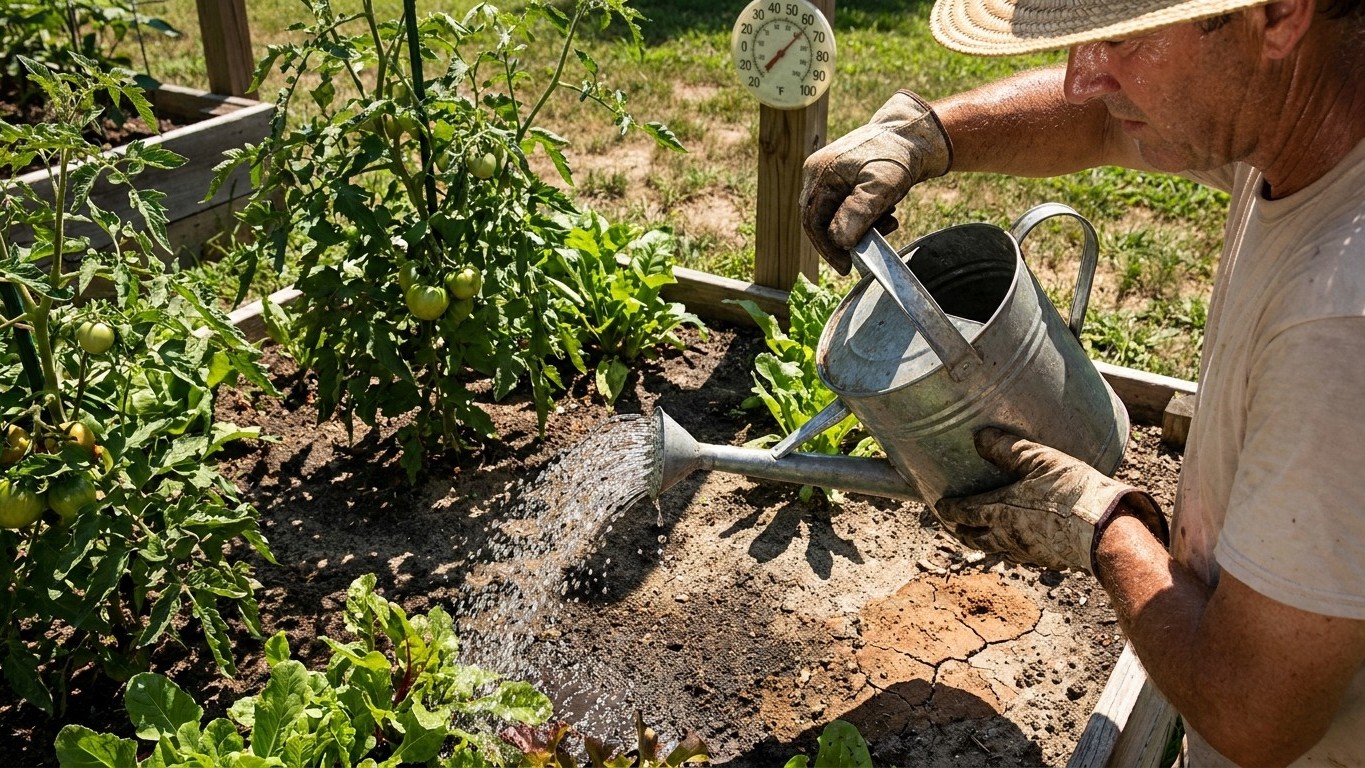

Arkansas gardens face a rare combination: heat that pushes past 90F on 69.2 days a year, paired with a summer that isn’t dry on paper. The driest month, August, still delivers 3.16 inches of rain. The gap between what falls and what plants actually need is where most watering mistakes happen.
What changes here

Two numbers set the terms for every Arkansas garden. The driest summer month, August, brings 3.16 inches of rain on average. And the state’s reference station logs 69.2 days a year at or above 90F. Together they describe a place where rain shows up, but heat burns through it fast enough that the calendar can lie to a gardener who isn’t checking the ground.
A vegetable bed or a young shrub wants roughly an inch of water a week to keep growing without stress. Spread August’s 3.16 inches evenly across the month’s four weeks, and that’s about 0.79 inches falling from the sky in a typical week. That leaves a shortfall of roughly 0.21 inches the gardener has to carry by hand, hose, or drip line, every single week of the driest stretch of summer. It doesn’t sound like much until you’re standing in a garden at 95F wondering why the tomatoes are wilting by 3 p.m.
Soil texture decides how far that inch actually goes. On sandy ground, water drains through within hours, leaving little reserve by the next afternoon. On heavy clay, common across parts of Arkansas, the same inch can sit near the surface for a week, which sounds like an advantage until roots start to suffocate in a soil that never got the chance to breathe. Arkansas gardeners rarely deal with one extreme or the other in a pure form. Most work a blend, which means the safest move is testing your own bed rather than assuming the county norm applies to the six-foot patch behind your house.
How to water when it matters
The method that works here isn’t complicated, but it has to be deliberate. Deep, infrequent watering at the base of the plant, done in the morning, beats a daily splash almost every time. Deep watering pushes moisture down where roots actually live, six to eight inches under the surface, training the plant to grow downward instead of hugging the top inch of soil where the sun will find it first. Morning watering matters because it gives foliage time to dry before nightfall, when Arkansas humidity combined with wet leaves becomes a breeding ground for fungal disease.
Checking soil moisture at root depth, not just on the surface, is the step most people skip. A dry crust on top doesn’t mean the roots below are thirsty, and a damp top layer after a light shower can hide bone-dry soil two inches down.
- Push a finger or a trowel two inches into the soil near the base of the plant before deciding to water at all.
- On sandy soil, water in shorter, more frequent sessions, roughly every two to three days during August’s heat, since the ground holds little reserve.
- On heavy clay, water less often but more thoroughly, allowing the top few inches to dry between soakings so roots aren’t sitting in saturated ground.
- Apply water slowly at the base until it reaches roughly six inches deep, checking with a trowel if you’re unsure.
- Water in the early morning, before 9 a.m. if possible, so leaves and soil surface dry out well before evening.
- Start from about one inch of total water per week, sky and hose combined, and adjust up during stretches of 90F-plus days.
That last number is a starting point, not a rule. A raised bed, a container, and a patch of native clay will each ask for something slightly different, and the only way to know for certain is to keep checking that two-inch depth through the season.
What goes wrong
Watering a little bit every day
A quick daily sprinkle feels responsible, but it does the opposite of what a plant needs. Shallow, frequent watering keeps moisture in the top inch of soil, so roots never bother growing deeper. When a hot stretch hits, those shallow roots are the first to bake, because they never developed the reach to reach the cooler, damper soil below.
Watering leaves in the evening
Wetting foliage after sunset leaves it damp all night, and Arkansas’s summer humidity does the rest. Fungal spores thrive in that combination, and by the time spots show up on tomato leaves or squash foliage, the damage is already spreading.
Trusting a rain shower
A fast summer thunderstorm can look like it solved the watering problem, but a lot of that rain runs off a dry, hard surface before it soaks in. With 69.2 days a year hitting 90F or above, the ground bakes hard between storms, and a heavy downpour often wets only the top half-inch. The only way to know is the same finger test used before watering: two inches down, dry or damp.
Skipping mulch
Bare soil under Arkansas summer sun gives back moisture almost as fast as it’s applied. A two- to three-inch layer of mulch slows evaporation and keeps that hard-won inch of water where roots can use it, instead of letting the heat pull it straight back into the air.
Watering ground that hasn’t dried
On the clay-heavy end of the spectrum, the opposite mistake shows up: adding water to soil that’s still saturated from days ago. Roots need oxygen as much as moisture, and a bed watered on a schedule rather than by what the soil is actually doing can drown before anyone notices a problem above ground.
Local help
For soil testing, planting calendars, and guidance specific to Arkansas conditions, the University of Arkansas System Division of Agriculture Cooperative Extension Service is the state’s primary resource. Watering restrictions vary by city and water district and change with drought conditions, so check current rules directly with your local water provider before setting an irrigation schedule.
Common questions
How often should I water my garden in Arkansas during summer?
Start with about one inch of water a week, combining rainfall and manual watering, and adjust based on soil type and how many days that week hit 90F or above.
Is August really the driest month in Arkansas?
Among the summer months, yes. NOAA normals put August at 3.16 inches, compared to 3.55 in June and 3.33 in July, making it the lowest of the three.
Does clay soil mean I need to water less in Arkansas?
Not necessarily less water, but less often. Clay holds moisture longer than sandy soil, so watering on the same frequent schedule can waterlog roots instead of helping them.
What’s the biggest watering mistake in Arkansas gardens?
Trusting that summer rain is enough. With 69.2 days a year at or above 90F, evaporation outpaces a light shower fast, and only checking soil at root depth tells the real story.