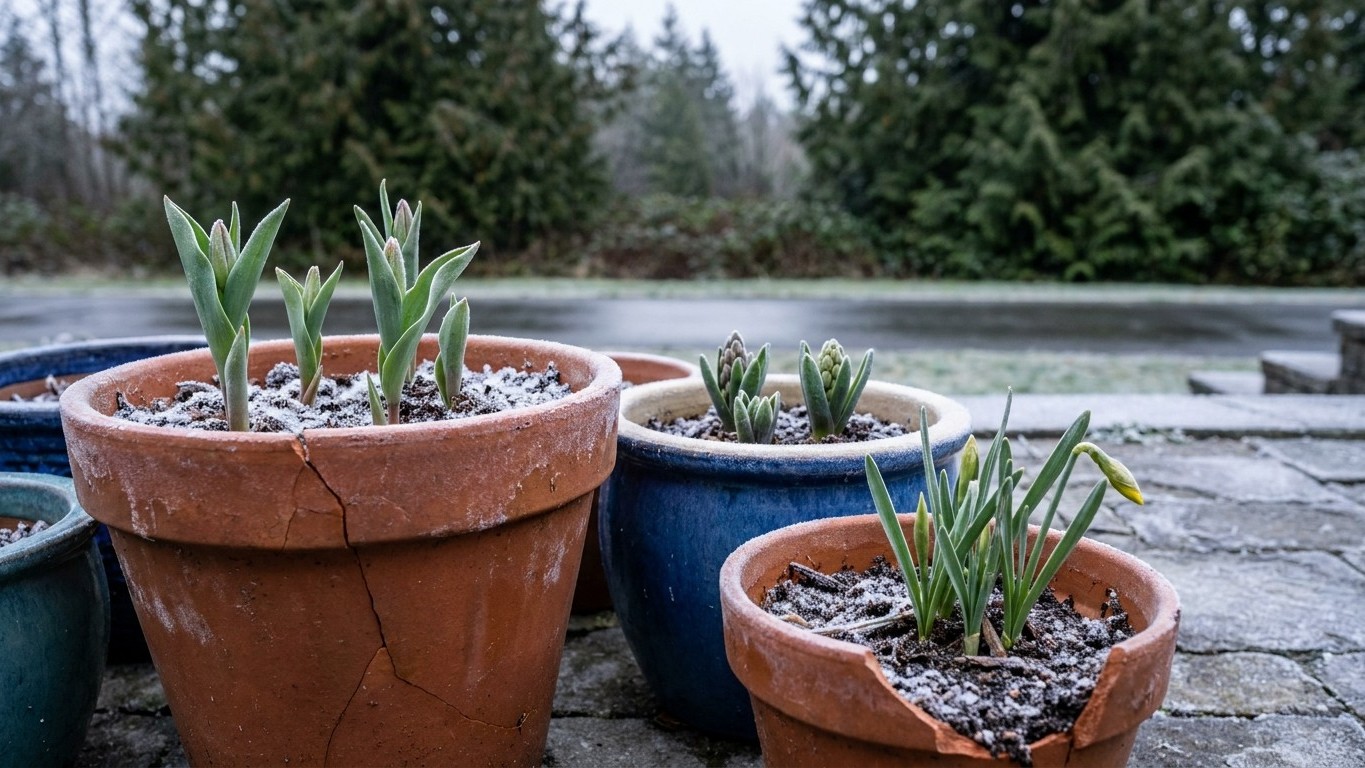

Spring Bulbs in pots face two separate problems in British Columbia, and only one applies here. The coldest month’s average low sits at 33.5°F, well under the 45°F threshold a bulb needs to break dormancy, so the ground already delivers enough winter chill without artificial forcing. The real risk is the container itself: a pot exposed to Vancouver’s Canadian hardiness zone 9a winter can freeze solid, root ball and all, in a way garden soil never does.
Why this matters in British Columbia

The number that settles this argument is 33.5°F, the mean daily minimum for the coldest month at the Vancouver reference station, per Environment and Climate Change Canada’s 1981-2010 Climate Normals. That figure sits comfortably below the 45°F ceiling a spring bulb needs to satisfy before it will flower, and it stays there for the better part of the coldest month, not just a night or two. Forcing exists for gardeners whose ground never gets that cold for long enough, twelve to fourteen weeks, so the bulb has to be chilled artificially in a refrigerator or an unheated space. That is not the problem here. Coastal British Columbia’s winter, mild as it feels compared with the interior, still delivers sustained cold in the 30s, and that is exactly what a tulip or a hyacinth is built to read as winter.
The problem that does apply is the container itself. Garden soil is a poor conductor of cold: even when the air drops well below freezing, the top few inches crust over while a bulb sitting four or six inches down stays insulated by the mass of earth around it. A pot has no such buffer. Exposed on every side, a container’s soil tracks the air temperature far more closely, and in a hard freeze it can go solid clear through, root system included, while an in-ground bulb thirty feet away never sees ice below the surface. That difference is why a hardiness rating written for a garden bed does not describe a pot on a patio.
British Columbia’s reference city sits in Canadian hardiness zone 9a, drawn from Natural Resources Canada’s 1991-2020 normals. That is the Canadian zone system, built from seven climate variables, not the single-variable USDA system printed on plant tags imported from American nurseries; the two do not convert on a common scale. What zone 9a tells a gardener here is that the ground rarely freezes hard or long. It does not promise the same for a terracotta or plastic pot sitting above that ground, exposed to wind and cold air on every face. That gap between bed and container, not a shortage of winter chill, is the actual planning problem for spring bulbs grown in pots in this territory.
How to do it here
Because the ground already supplies the chill a spring bulb needs, the container method in British Columbia is less about creating cold and more about managing exposure to it. The steps below apply whether the pot stays outside all winter or comes indoors partway through for an earlier bloom.
- Choose bulbs rated at least two Canadian hardiness zones below 9a if the pot will sit outside, unprotected, through the coldest month. A bulb rated for zone 7 or colder in the ground has enough margin to survive the faster freeze-thaw of a container; one rated tight to zone 9 does not.
- Pot into a container with drainage holes and a fast-draining mix. Waterlogged soil freezes into a denser, colder mass than soil that drains, and it thaws unevenly around the bulb, which does more damage than the cold alone.
- Site the pot against a south or west-facing wall, or group several pots together, before the coldest month arrives. Either move concentrates heat radiating off the house and cuts direct wind exposure, both of which raise the effective temperature the bulb experiences compared with an open patio.
- Mulch the pot’s surface with four to six inches of straw, bark, or leaves once temperatures start dropping toward the 30s. This is a rough substitute for the insulating mass a garden bed provides naturally, and it matters more for a container than for the same bulb planted in the ground.
- If forcing a potted bulb for an earlier or indoor bloom, count twelve to fourteen weeks below 45°F before bringing it into warmth. An unheated garage that stays above freezing works; a refrigerator drawer works too, provided it is kept away from ripening fruit, since the ethylene gas apples and pears give off can kill the flower bud forming inside the bulb.
- Bring the pot into a cool, dim spot first, not straight into a warm, bright room. A week of transition lets the shoot lengthen before the leaves and flower are asked to open, which is what keeps the stem from staying short and stunted.
None of this requires guesswork. The 45°F threshold and the twelve-to-fourteen-week window can be checked against a garage thermometer or a refrigerator’s own dial; the two-zone buffer can be checked against the bulb’s tag next to a Canadian hardiness zone map. The one thing working in British Columbia’s favor: for a bulb planted straight into the ground rather than a pot, most of this checklist is unnecessary. The soil does the work on its own.
Which bulbs are worth it
Not every spring bulb is worth the extra handling a container demands, and the deciding factors are mechanical as much as botanical: how long the bulb needs in the cold, and how tall and top-heavy the flower gets once it opens. A short chill requirement means the bulb can be forced or moved sooner, and a short, sturdy stem means it stays upright in a pot instead of leaning over the rim.
Paperwhite narcissus need no chilling period at all, which is exactly why they turn up everywhere as a one-time indoor gift plant: they are not hardy enough to survive a British Columbia winter outdoors regardless of the pot, so nothing is lost by treating them as disposable after they bloom. Hyacinths and crocus need a shorter chill than tulips, roughly twelve to fifteen weeks against sixteen or more, and their stems stay low enough that a container wind gust rarely does damage.
- Hyacinth
- Crocus
- Muscari (grape hyacinth)
- Species and botanical tulips (short-stemmed types, not the tall Darwin hybrids)
- Paperwhite narcissus (indoor, one-season use)
Bulbs that sulk in containers tend to combine a long chill requirement with height that a pot’s limited root run can’t anchor well. Fritillaria imperialis carries a heavy flower head on a stem that can top three feet, and it topples in wind that a garden bed would never let it feel. Large Darwin and Triumph tulips, bred for cut-flower height, run into the same problem at a smaller scale. Alliums take their time both to chill and to bulk up, and a container rarely gives the bulb the years it needs to build to a full-size bloom.
- Fritillaria imperialis
- Darwin and Triumph tulips (tall hybrid types)
- Allium (most ornamental species)
A reader unsure which category a specific variety falls into can use the same two questions asked here: how many weeks of cold does the tag call for, and how tall does the label say the stem gets. Anything under fifteen weeks and under twelve inches is a safe bet for a pot.
What goes wrong, and when you can still fix it
Most container bulb failures in British Columbia trace back to one of three mistakes, and each leaves a distinct symptom.
Leaves but no flower
Green growth appears on schedule, but no bud ever forms, or the bud shrivels before opening. This means the cold period fell short of what the bulb needed, whether it wintered outdoors in too sheltered a spot or was pulled from artificial chilling too soon. It cannot be fixed this season; the bulb has already spent its stored energy on leaves instead of a flower. The fix is next year’s cold period, counted in full weeks rather than estimated.
A flower on a stem too short to see
The bud opens, but it sits low in the leaves instead of rising above them on a visible stem. This happens when the pot was moved into warmth too early, before the shoot had time to elongate in cool, dim conditions first. Like the previous failure, this one is set before the symptom shows up; there is no way to stretch a stem after the flower has already opened. The remedy is the transition step: a week in a cool, dim spot before the bright, warm room, applied to next season’s bulbs.
Rot at the base of the bulb
Soft, discolored tissue at the bulb’s base, sometimes with a smell, points to standing water rather than cold at all. A pot without drainage holes, or one sitting in a saucer that never empties, keeps the bulb wet through the exact weeks it should be resting dry and cold. Caught early, moving the bulb into fresh, fast-draining soil and cutting back watering can still save it. Once the tissue has gone fully soft, the bulb is finished for this season and cannot be replanted.