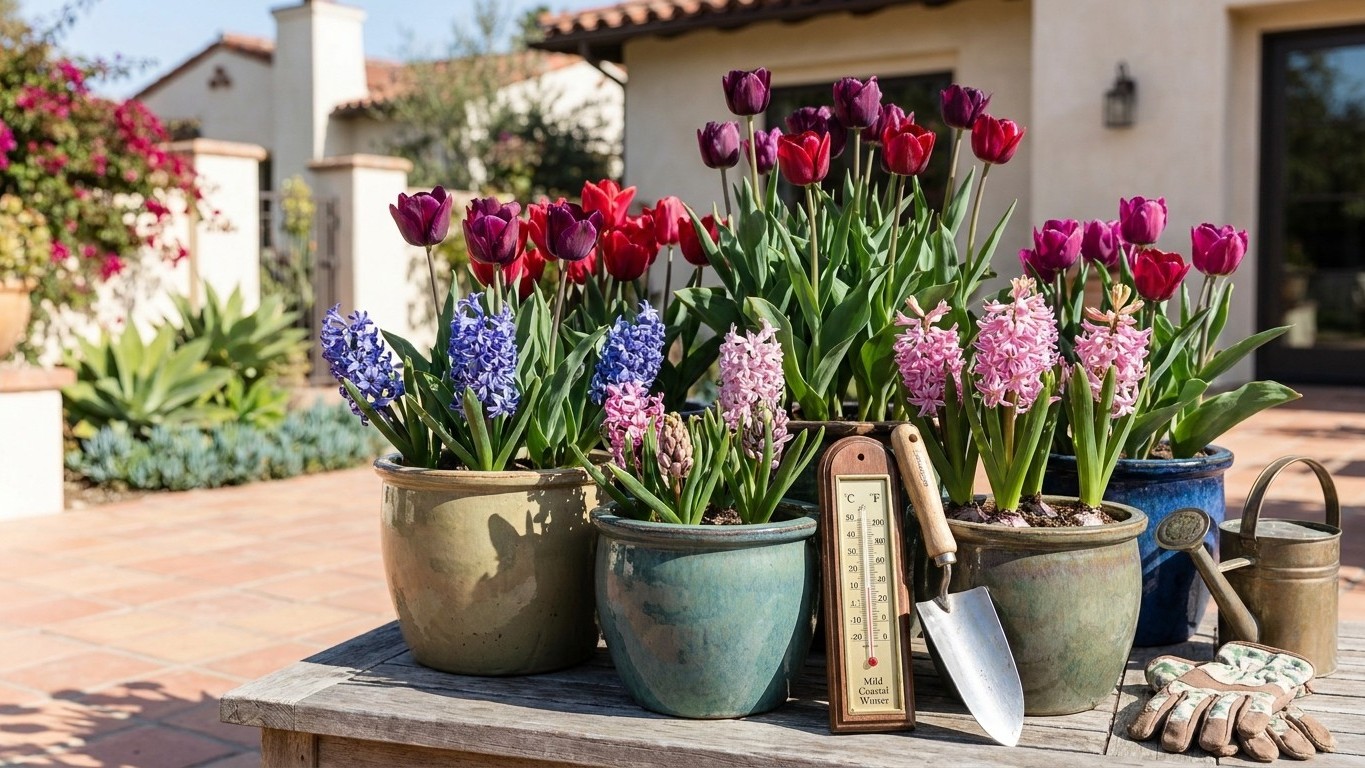

California’s coldest month averages a 49.1°F low in Los Angeles, according to NOAA Climate Normals. Spring bulbs like tulips and hyacinths need 12 to 14 weeks below 45°F to bloom. That gap means forcing, not winter freeze risk, is the real challenge for container bulbs across most of the state.
Why this matters in California

Start with the number: 49.1°F. That’s the mean daily minimum for the coldest month at the Los Angeles reference station, per NOAA’s 1991-2020 Climate Normals. Spring-flowering bulbs like tulips, hyacinths, and most daffodils need a sustained stretch, 12 to 14 weeks, of temperatures below 45°F to complete the internal chemistry that turns a bud into a flower. At 49.1°F, the coldest month here never even dips into that range on average. The ground simply doesn’t get cold enough, long enough, for these bulbs to do what they’d do on their own in Minnesota or Michigan.
This is the opposite problem from what gardeners face in a hard-freeze climate. There, the question is whether a container freezes solid, killing roots that would have survived in the insulated ground. Here, the question is whether the bulb ever gets cold at all. USDA’s Plant Hardiness Zone Map puts California in a startling range, 5a to 11a, built on average annual extreme minimum temperatures. That range spans everything from alpine passes in the Sierra to frost-free coastal valleys. Los Angeles itself sits at the warm end of that spread, and it’s the coastal and valley gardener, not the mountain one, who runs into the chill-deficit problem this page addresses.
If your address is up in the Sierra foothills or the high desert, closer to zone 5a or 6a, your winters may already deliver enough natural chill, and your container risk shifts back toward freeze-through, since a pot has none of the insulating mass that soil in the ground provides. But for the coastal strip, the Central Valley, and most of Southern California, where the bulk of the state’s population and gardens sit, the coldest-month figure of 49.1°F tells the real story: the cold has to come from somewhere else. That somewhere is a refrigerator or an unheated garage, and it’s the subject of the next section.
How to do it here
Forcing a bulb is a controlled substitute for the winter California doesn’t provide. The sequence matters, and skipping a step usually shows up later as a plant with leaves and no flower.
- Buy pre-chilled bulbs when possible. Some mail-order suppliers sell bulbs that have already logged their cold hours. Check the packaging or listing; if it says “pre-cooled” or “ready to force,” you can skip straight to potting.
- Pot the bulbs in a well-draining container. Use a standard potting mix, set bulbs pointed-end up, and water once to settle the soil. Don’t fertilize yet.
- Chill for 12 to 14 weeks below 45°F. An unheated garage that stays above freezing but below 45°F works if you have one. A refrigerator’s vegetable drawer is the more reliable option for most California homes, since garages here often run warmer than 45°F even in January.
- Keep chilling bulbs away from ripening fruit. Apples, bananas, and other fruit release ethylene gas, which will kill the flower bud inside the bulb before it ever gets a chance to open. Store bulbs in their own drawer or a separate fridge if you keep produce nearby.
- Check for root growth before moving bulbs to warmth. Tip the pot gently after about 10 weeks. White roots showing at the drainage holes mean the chilling period is doing its job; no roots yet means the bulb needs more time before you move it.
- Bring the pot into a bright, cool room, not full heat. A sudden jump from 45°F to a warm living room shocks the bulb. A cool, bright spot in the 50s to low 60s for the first week lets the stem elongate before the flower opens.
On the container question specifically: if you’re forcing bulbs and keeping the pot outdoors during the chill period rather than in a fridge, the pot needs to be rated at least two USDA zones hardier than the bulb’s stated hardiness, or you need to move it into an unheated garage and mulch the sides. In the Los Angeles reference zone, this rarely bites, since winter lows don’t threaten a pot’s root ball the way they would in the Sierra foothills. But if you garden at altitude, treat container freeze-through as the primary risk instead, and skip the refrigerator step entirely since the ground cold may already be sufficient.
Which bulbs are worth it
Not every bulb is worth the fridge space. Some finish their cold requirement quickly and tolerate a container’s cramped root run; others need so many weeks of chill, or grow so tall, that forcing in a pot becomes more trouble than it’s worth.
- Paperwhite narcissus: needs no chilling at all, forces in water and gravel, blooms in 3 to 4 weeks.
- Crocus: short chill requirement, stays low, rarely topples in a pot.
- Hyacinth: forces reliably with a full 12 to 14 weeks of chill, sturdy stem holds up well in a container.
- Muscari (grape hyacinth): compact growth, forgiving of a slightly shortened chill period.
- Dwarf tulip varieties: shorter stems than standard tulips, less prone to flopping once forced.
- Standard tall tulips: the classic Darwin hybrids grow tall stems that often bend or snap once forced indoors, without the wind resistance they’d get outdoors.
- Large trumpet daffodils: need a long chill period and produce top-heavy blooms that a small pot struggles to anchor.
- Fritillaria: finicky about both chill duration and post-chill temperature, sulks or fails to open with any inconsistency.
Since most spring bulbs bought for Containers are one-season purchases in California anyway, they were never going to naturalize and return next year the way they might in a colder climate. That changes the math: forcing a bulb that costs a few dollars and was already destined for the compost pile after one bloom cycle isn’t a loss if it fails. It’s worth trying the trickier ones once, just to see.
What goes wrong, and when you can still fix it
Leaves grow but no flower appears
The chill period was too short. The bulb has enough stored energy to push up foliage, but the flower bud never fully developed during the cold treatment. This bulb won’t bloom this season. Let the leaves die back naturally, feed the bulb with a bit of bulb fertilizer, and try a full 12 to 14 week chill next year, this time tracking the weeks on a calendar.
A flower opens on a stem too short to see over the pot rim
This means the bulb was moved into warmth too early, before the stem had elongated during the cool transition phase. The flower itself is fine this season, just low. Nothing to fix now; next time, keep the pot in a bright but cool spot (50s to low 60s) for a full week after removing it from the fridge before moving it into a warmer room.
The bulb turns soft and rots in the pot
Standing water is almost always the cause. A container without enough drainage holes, or a saucer that holds water against the pot’s base, keeps the bulb wet enough to rot before it ever gets a chance to root or chill properly. A rotted bulb can’t be saved this season. For the next attempt, check that the container has multiple drainage holes and empty any saucer within an hour of watering.