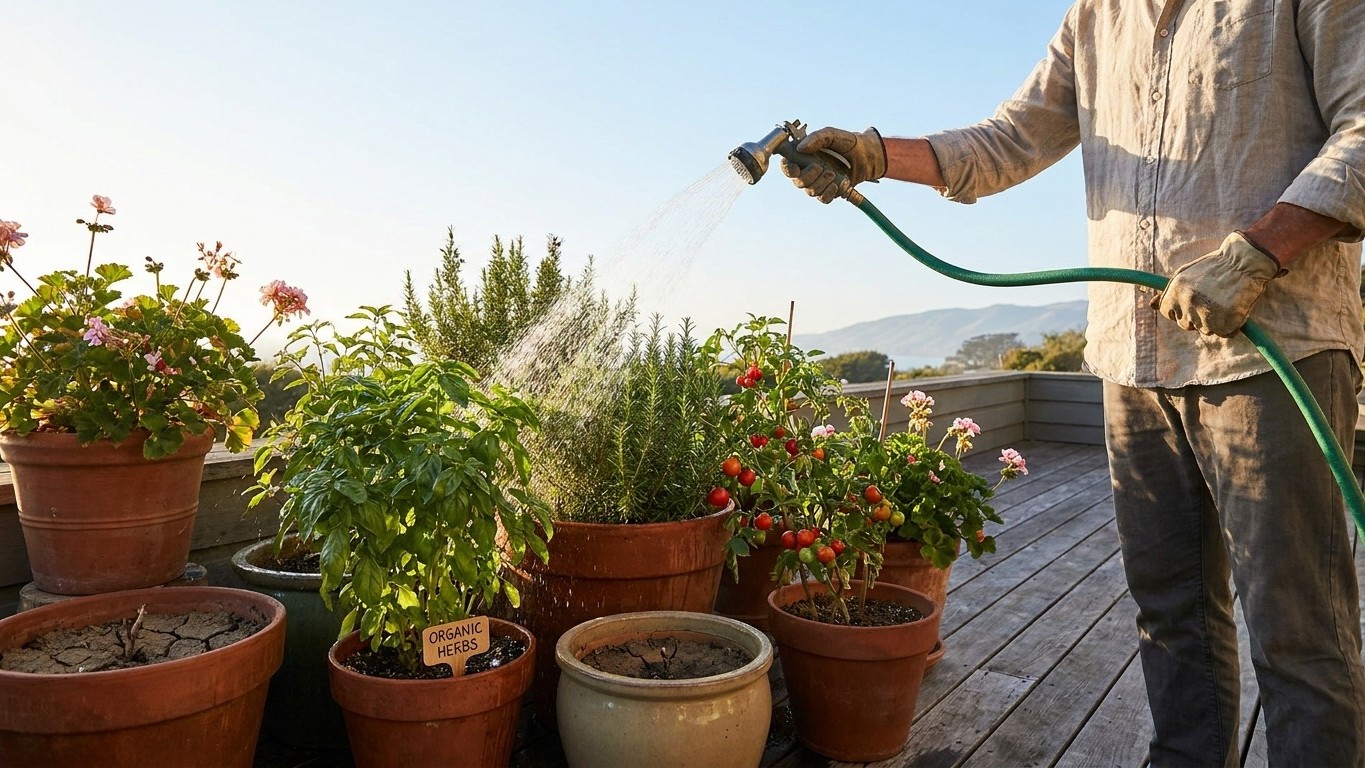

August delivers 0.0 inches of rain here, on average, while the whole year sees just 2.4 days at or above 90F. That combination means a California garden along this coastal stretch gets almost no help from the sky in summer, but it also isn’t fighting off relentless heat the way inland deserts do. Here’s what that means for the hose.
What changes here

Two numbers set the terms for summer watering in this part of California. The driest summer month, August, averages 0.0 inches of rain at the reference station. Across the full year, the same station logs only 2.4 days that reach 90F or higher. Read together, they describe a garden that has to be watered entirely by hand or by irrigation system through the peak growing season, but one that isn’t also battling the kind of scorching heat load that pushes water needs into overdrive.
Run the arithmetic and the gap becomes obvious. A typical vegetable or ornamental bed wants somewhere around an inch of water a week to keep growing steadily. In August, with 0.0 inches falling for the entire month, the sky contributes nothing to that weekly inch. Spread across a week, that’s zero. June and July aren’t much better: June averages 0.08 inches for the whole month, July just 0.04 inches. Divide either of those across four or five weeks and you get a few hundredths of an inch a week, an amount that wets dust without reaching a root.
What that means in practice: during June, July and August, the gardener is carrying essentially all of that weekly inch, not a portion of it. There’s no month in this stretch where rainfall does meaningful work for you. Soil texture then decides how that inch, once applied, actually behaves. Sandy soil lets water pass through quickly and holds little in reserve, which means the same inch needs to be split into more frequent, lighter waterings. Heavy clay holds water far longer, sometimes close to a week, but it also drowns roots if it’s watered again before it’s had the chance to dry. Knowing which kind of ground you’re working with matters more here than almost anywhere, because there’s no rain arriving to correct a bad guess.
How to water when it matters
With next to no summer rain to rely on, the method matters more than the impulse to water often. Deep, infrequent watering at the base of the plant, done in the morning, outperforms a quick daily spray for a specific reason: it trains roots to grow downward chasing moisture, rather than staying shallow near a surface that dries out within hours under California sun. Morning watering also gives foliage time to dry before evening, when cooler temperatures and lingering moisture create ideal conditions for fungal disease.
Checking the soil before watering matters just as much as the schedule. The surface can look bone-dry while the root zone underneath is still damp, or look fine on top while roots are parched two inches down. Push a finger or a trowel two inches into the soil near the base of the plant. If it’s dry at that depth, it’s time to water. If it’s still cool and moist, wait.
A starting point, not a rule
A reasonable starting point for most beds here is two deep waterings a week during June, July and August, given that essentially none of the weekly inch arrives naturally. That number needs to be checked against your own soil, though, not treated as fixed. Sandy ground drains fast and holds little, so it often needs shorter, more frequent sessions rather than two heavy soakings. Heavy clay can go a full week on one deep watering, but adding more before it’s dried invites root rot.
- Check soil moisture two inches down with a finger or trowel before watering, rather than judging by the dry surface.
- Water at the base of the plant, not overhead, to keep foliage dry and reduce disease risk.
- Water in the morning, so any moisture on leaves evaporates before evening humidity sets in.
- Apply water slowly and deeply, aiming for roughly one inch total per week, split across two sessions on sandy soil or one on heavy clay.
- Adjust frequency based on what the finger test shows, since 0.0 inches of August rain means nothing corrects a missed watering.
What goes wrong
“A little water every day keeps things green”
Daily light sprinkling is the costliest habit in a place where August rainfall averages 0.0 inches. It wets only the top inch or so of soil, which trains roots to stay near the surface where daytime heat bakes them dry within hours. The plant ends up more dependent on water, not less, and more vulnerable the moment a watering gets missed.
“I’ll water in the evening to cool things down”
Evening watering feels good in the heat, but it leaves leaves damp overnight, right when cooler air and stagnant moisture create the conditions fungal disease needs to take hold. Morning watering gives the sun hours to dry foliage before nightfall.
“That light rain probably did the job”
With summer rainfall this thin, a passing shower or a damp morning marine layer can trick a gardener into skipping the hose. A brief drizzle often wets only the top half-inch of soil, nowhere near root depth. The finger test settles it every time; the sky rarely does, not here.
“I’ll mulch later”
Skipping mulch means the sun takes back most of what was just watered in. A two-to-three-inch layer around the base slows evaporation and keeps the soil from swinging between soaked and bone-dry, a swing that stresses roots more than a slightly dry week ever would.
Local help
The University of California’s Division of Agriculture and Natural Resources runs the state’s Cooperative Extension network, offering region-specific guidance for home gardeners at ucanr.edu. Watering restrictions vary by water district and change with drought conditions, so check current rules with your local water provider rather than relying on statewide averages alone.
Common questions
Does California really get zero rain in August?
At the reference station used for these normals, the 1991-2020 average for August is 0.0 inches, meaning gardens should plan on receiving no meaningful rainfall that month.
If it’s not that hot here, why does watering matter so much?
With only 2.4 days a year reaching 90F, heat stress is limited, but the near-total absence of summer rain still means every drop a plant uses has to come from irrigation, not weather.
How do I know if my soil is sandy or clay-heavy?
Squeeze a moist handful: sandy soil falls apart immediately, while clay holds its shape and feels sticky. This affects how often you should water, even when the weekly total stays the same.
Can I skip watering after a foggy or drizzly morning?
Check two inches down with a finger or trowel first. A light coastal drizzle or marine layer moisture rarely penetrates past the surface, so it shouldn’t replace a scheduled deep watering.