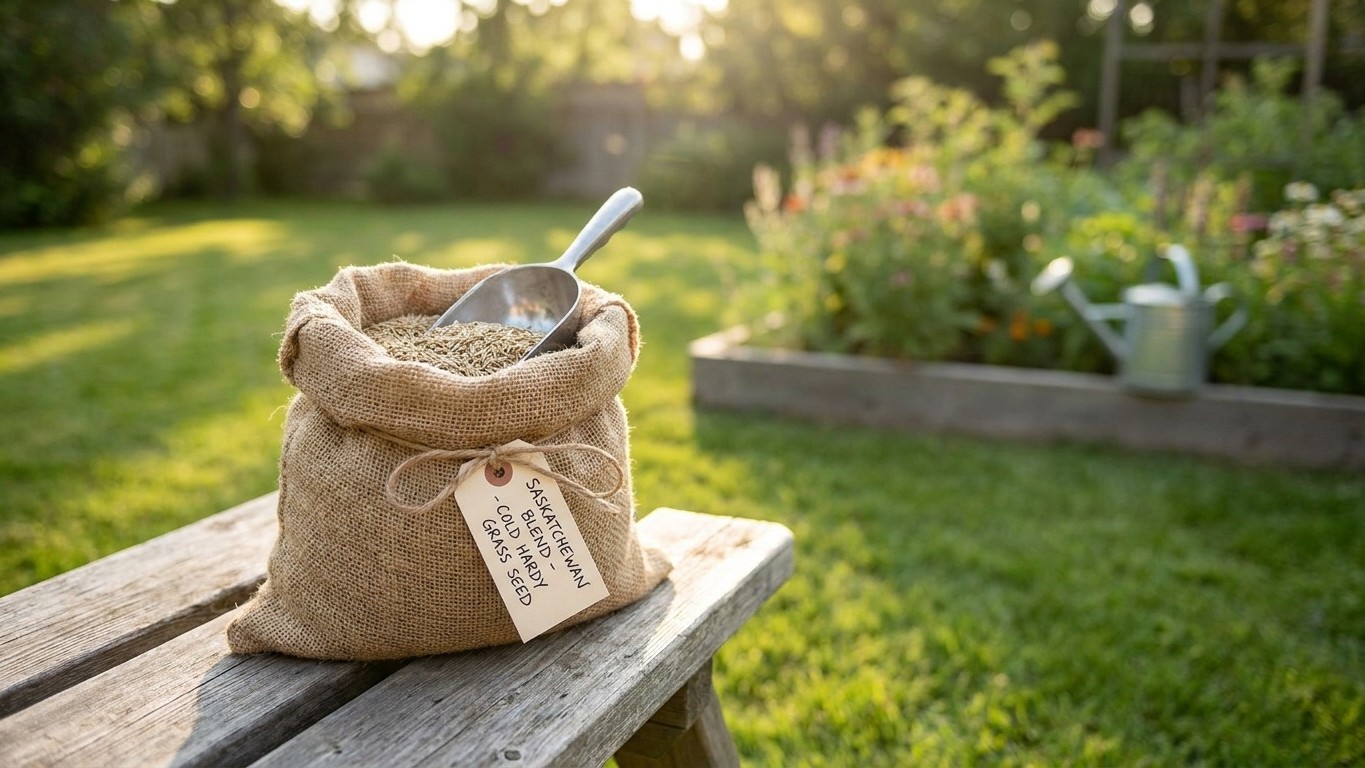

Saskatoon’s climate normals are the reference point that puts every Saskatchewan lawn in cool-season turf territory, the same reading that quietly rules out Bermudagrass, Zoysia, and every other warm-season seed stacked on garden center shelves each spring. What’s left is a short list: Kentucky Bluegrass, Fine Fescues, Perennial Ryegrass, Tall Fescue, Rough Bluegrass. A full-sun front yard wants a bluegrass-led blend that spreads and self-repairs; a yard shaded by spruce or elm wants fescue instead.
The short answer for Saskatchewan
Saskatchewan falls in the cool-season turf zone, the classification The Homestead Post assigns by reading local climate normals near Saskatoon against the season tolerances published by Clemson Cooperative Extension (HGIC 1214). That zone rules out Bermudagrass, Zoysia, and every other warm-season species sold for southern lawns. They need a long run of real heat to establish, and none of them survive a Prairie winter.
The species that do work here, named by Clemson HGIC 1214 and confirmed for this climate by Penn State Extension, are Kentucky Bluegrass, Fine Fescues, Perennial Ryegrass, Tall Fescue, and Rough Bluegrass. Of these, a blend led by Kentucky Bluegrass is the safest default for a full-sun front lawn, because it spreads by underground rhizomes and fills bare patches on its own. A shaded yard under mature spruce or elm does better on a Fine Fescue mix, since fescue tolerates the low light that thins bluegrass out.
Which one earns the biggest share of the bag depends on how much sun the yard gets, how much foot and dog traffic it takes, and whether you want a lawn that heals itself or one you’re willing to overseed every couple of years. None of that changes the zone itself. Saskatoon is the reference point for that zone, and the province is not one climate: the same cool-season label holds further north and at higher elevation, but the safe window for working inside it gets narrower the further you get from Saskatoon.
Working through the year

Ranking the five species
Kentucky Bluegrass is the strongest all-round pick for a Saskatchewan yard that gets a full day of sun. It spreads by rhizome, so a thin patch from dog traffic or a rough winter fills back in without reseeding, and its dense sod resists compaction. The cost is patience: it is the slowest of the five to germinate, so a newly seeded bluegrass lawn looks thin and weedy for longer than the others before it fills in.
Tall Fescue trades some of that self-repair for a root system that runs deeper than any other cool-season grass, which makes it the most forgiving of the five during a dry stretch once established. It grows in bunches rather than spreading by rhizome, so a bare patch stays bare until you overseed it. Clemson Cooperative Extension’s Tall Fescue Maintenance Calendar (HGIC 1219) is built around this species, and while its exact dates are set for South Carolina’s longer season, the rhythm it describes, fall feeding, high mowing through heat, aeration and overseeding once the worst of summer breaks, carries over to a Saskatchewan lawn even though every date on it needs to shift earlier to fit the Prairie growing season.
Perennial Ryegrass earns its place as a nurse grass rather than the whole lawn. It germinates faster than anything else on the list, which is why it shows up in nearly every blend bag to hold soil and choke weeds while the slower bluegrass gets established. On its own it does not spread and does not repair itself, and an exposed ryegrass lawn is the one most likely to show winterkill after an unusually hard freeze.
Fine Fescue is the shade specialist. It holds color under trees where bluegrass thins, needs less nitrogen than the others, and tolerates poorer soil. Its weakness is traffic: fine fescue wears out under a well-used path or a dog run faster than bluegrass or tall fescue does.
Rough Bluegrass fills one narrow niche, a wet, shaded low spot where nothing else holds, and performs poorly everywhere else on the property because it carries the weakest heat and drought tolerance of the five. Most Saskatchewan lawns use it, if at all, only in that one corner.
| Species | Spread habit | Germination speed | Drought tolerance | Best use |
|---|---|---|---|---|
| Kentucky Bluegrass | Rhizome, self-repairing | Slow | Moderate | Full-sun main lawn |
| Tall Fescue | Bunch-type | Moderate | High | Drought-prone, heavy-traffic areas |
| Perennial Ryegrass | Bunch-type | Fast | Low to moderate | Quick cover, nurse grass in blends |
| Fine Fescue | Bunch to short-rhizome | Moderate | Moderate | Shade under trees |
| Rough Bluegrass | Stoloniferous | Moderate | Low | Wet, shaded low spots |
Fitting seeding into the calendar
Environment and Climate Change Canada’s 1981-2010 climate normals put the mean first fall frost at September 18 at the Saskatoon SRC station, though frost arrives later than that in half of all years, so treat the date as the middle of a window rather than a deadline. Seed needs roughly six weeks of growing weather to root deeply enough to survive winter, which means the safe stretch for a fall seeding closes well ahead of the frost itself, not on it. A spring seeding, once the soil has thawed and dried enough to work, is the lower-risk option for anyone who missed the fall window, though it means competing with weed germination that a fall-seeded lawn mostly skips. For the full month-by-month order of these jobs, including when to overseed and when to hold off, the Saskatchewan Lawn Care Calendar, Month by Month lays out the sequence.
What changes across Saskatchewan
Every figure on this page is measured at or near Saskatoon, and Saskatchewan is not one climate. The Cypress Hills in the southwest sit at a noticeably higher elevation than the surrounding plains, and that elevation alone pushes the growing season shorter and the safe seeding window earlier than it is at Saskatoon, even though the Cypress Hills sit further south on the map than the reference station.
The northern half of the settled province, toward Prince Albert and the edge of the boreal forest, runs a shorter frost-free season than Saskatoon simply because it sits closer to the colder air masses that settle over the north each fall. A seeding job there needs to go in earlier relative to the calendar than the same job at Saskatoon, even though the species choice, a cool-season blend, does not change at all.
The southern grain belt around Estevan and Swift Current typically runs a bit warmer and carries a longer stretch of frost-free days than Saskatoon, which gives a fall-seeded lawn there more room before the safe window closes. None of this changes which of the five species belong on a Saskatchewan lawn. It changes only how much slack there is around the timing, and the safest habit anywhere in the province is to treat the Saskatoon figures as the middle of the province’s range, not its edges.
The mistakes this climate punishes
Seeding in the wrong window
Sowing cool-season grass seed in the middle of summer is the most common mistake on a Saskatchewan lawn, and it fails for a simple reason: bluegrass, fescue, and ryegrass germinate best in cool soil, and hot, dry midsummer soil kills a large share of the seedlings before they ever grow a true leaf. The failure doesn’t show up as bare dirt right away. It shows up three or four weeks later as a thin, patchy stand that never fills in the way the seed bag photo promised.
Cutting too short in the heat
Scalping a cool-season lawn during a hot, dry stretch removes the leaf area the grass needs to shade its own roots, and the damage doesn’t show the day you mow. It shows a week or two later as a lawn that goes from green to straw-brown across the whole yard at once, not in scattered patches. That brown is not dead grass. Cool-season turf goes dormant under drought stress and greens back up once rain or irrigation returns, but a lawn scalped short during that dormancy takes longer to recover and stays open to weed seed while it’s thin.
Feeding at the wrong end of the season
A heavy dose of nitrogen right before the ground freezes pushes soft, leafy growth that has no time to harden off, and that growth is what gets damaged over winter, not the grass fed earlier and given time to slow down naturally. The safer pattern for a cool-season lawn is to put most of the season’s nitrogen down in late summer and early fall, while growing weather remains, rather than after growth has already begun shutting down for winter.
- Seeding in July heat instead of the cooler weeks that bookend the growing season
- Mowing short during a dry spell instead of raising the deck
- Feeding heavily right before freeze-up instead of earlier in fall
- Assuming a summer-brown lawn is dead and tearing it out instead of watering and waiting
Checking this against your county
Every date and figure on this page is anchored to Saskatoon, and a lawn in Yorkton, Melfort, or the Cypress Hills works on a slightly different clock. For local frost data, soil information, and variety trials specific to your county, the Saskatchewan Ministry of Agriculture is worth checking before you buy seed in bulk. If you’re setting up the rest of the season’s routine around this seeding decision, the broader Saskatchewan Lawn Care guide covers the soil prep and mowing basics this page assumes you already have in place.
Common questions
Can I plant Bermuda grass or Zoysia in Saskatchewan?
No. Both are warm-season species that need a long stretch of real summer heat to grow and will not survive a Prairie winter. Stick to the cool-season species named by Clemson Cooperative Extension (HGIC 1214): Kentucky Bluegrass, Fine Fescue, Perennial Ryegrass, Tall Fescue, or Rough Bluegrass.
What’s the best grass seed for shade in Saskatchewan?
A Fine Fescue blend is the strongest performer under trees, since it tolerates lower light and needs less nitrogen than Kentucky Bluegrass. It won’t hold up as well to heavy foot traffic in that same shady spot, so keep paths and play areas out of it where you can.
Is it too late to seed if I missed the fall window?
A fall seeding needs weeks of growing weather before the ground cools down for good, and once that window has closed for the year, seed sown into cold soil mostly sits dormant instead of germinating. Wait for spring rather than forcing a late fall seeding, since a poor stand this fall is harder to fix than starting fresh once the soil thaws.
Why is my new grass patchy even though I used a good blend?
The species in a typical blend germinate at different speeds. Perennial Ryegrass often shows green within a week or two while Kentucky Bluegrass can take several weeks longer, so a blended lawn looks uneven and thin at first even when every seed in the bag is doing exactly what it’s supposed to do. Give it the full season before judging the stand.