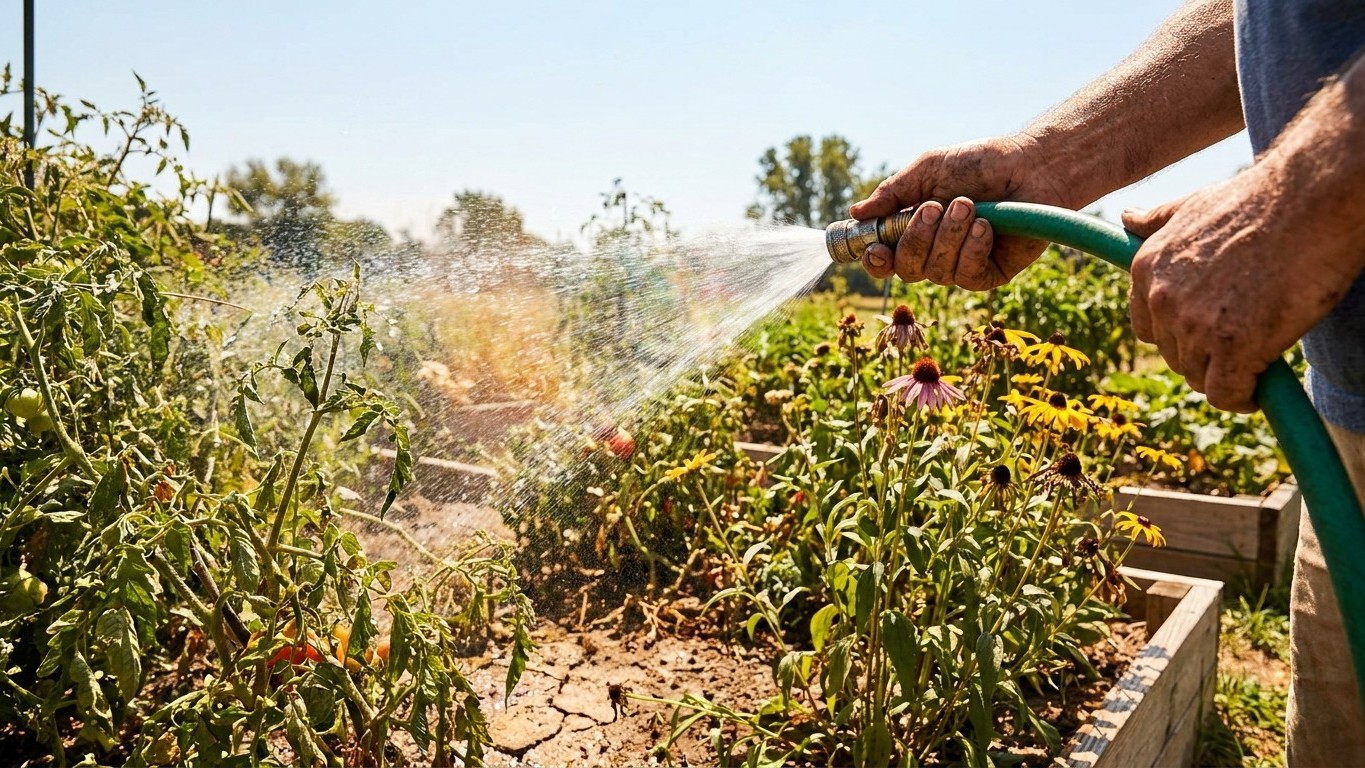

Tennessee gardens need roughly an inch of water a week during the growing season, but August, the driest summer month, delivers only 3.79 inches for the entire month while 40 days a year climb past 90F. That gap between what falls and what evaporates is why a hose or drip line matters most in late summer, not June.
What changes here

Two numbers set the terms for a Tennessee garden in summer: 3.79 inches of rain in August, the driest month of the season, and 40.0 days a year that hit 90F or higher. Taken together, they mean the sky provides less water exactly when the air is pulling the most moisture out of the soil and off the leaves.
Do the arithmetic and the gap gets concrete. A vegetable bed or a border of perennials wants close to an inch of water every week. August spreads its 3.79 inches across roughly four and a half weeks, which works out to under an inch a week on average, and that average hides the real problem: Southern summer rain tends to arrive as a single afternoon thunderstorm rather than a steady soak, so a week can go by with zero rain and then get dumped on all at once. A gardener who waits for the sky to average out will watch plants wilt on the dry days in between.
Soil texture decides how far that rain, or that hose water, actually reaches the roots. A sandy bed drains fast: water that falls today is gone by tomorrow, pulled down past the root zone before a plant can use much of it. A heavy clay bed holds onto water for a week or more, which sounds generous until it rains again before the clay has dried, and roots sit in soggy ground with no oxygen. Neither failure is about how much water fell from the sky. Both are about how long that water actually stayed where roots could use it.
June and July run wetter than August, at 4.36 and 4.16 inches respectively, so the squeeze tightens as summer goes on. That’s the pattern worth remembering: the driest stretch of a Tennessee summer lands right when the heat load, measured by those 40 days above 90F, is at its peak. Plan the watering schedule for August, and June mostly takes care of itself.
How to water when it matters
The method that works in Tennessee isn’t complicated, but it runs against instinct. Deep and infrequent watering, applied at the base of the plant and early in the morning, beats a daily light sprinkle every time, because of what happens underground and on the leaf surface.
A deep soak pushes water down six inches or more, which is where a mature plant’s roots actually live. A light daily sprinkle wets only the top inch, and roots follow the water, staying shallow and exposed right where an August afternoon bakes the soil hardest. Watering at the base instead of overhead keeps leaves dry, and dry leaves matter in a state where humidity is already high enough to invite fungal disease without help. Morning watering gives the sun time to dry any incidental splash on foliage before evening, when cool, damp leaves sit overnight and become a breeding ground for mildew and blight.
Before turning on the hose, check the soil rather than the calendar. A finger pushed two inches down, or a trowel lifted at the edge of a bed, tells the real story. If it’s dry at that depth, water. If it’s still damp, wait, even if it’s been a few days since the last rain.
Texture changes the rhythm from there. Sandy soil holds little, so it needs shorter, more frequent soakings, maybe every three or four days in the hottest stretch of August. Heavy clay holds a week’s worth of water, so watering it again before it has dried invites root rot rather than helping the plant.
- Start with about 1 inch of water per week as a baseline, split into one or two deep sessions rather than daily light ones.
- Check soil moisture two inches down with a finger or trowel before every watering, and skip the session if it’s still damp.
- Water at the base of the plant, not overhead, using a soaker hose, drip line, or the base setting on a watering can.
- Water in the early morning, before 9 a.m. if possible, so any residual moisture on leaves dries out by midday.
- Adjust frequency for your own soil: shorten the interval on sandy ground, lengthen it on clay, and confirm with the finger test each time rather than sticking to a fixed calendar.
That baseline is a place to start, not a rule to follow blindly. A rain gauge on the actual property, checked weekly against the finger test, will tell a gardener more about their own bed than any regional average.
What goes wrong
“I water a little every day, just to be safe”
This is the single most common mistake in a Tennessee summer, and it backfires exactly when the heat is worst. Daily light watering trains roots to stay near the surface, chasing the shallow moisture instead of growing deep. When a 90F day hits, and there are 40 of them most years, those shallow roots sit in soil that heats and dries fastest, and the plant wilts even though it was “watered” that morning.
“I’ll water in the evening after work”
Evening watering feels convenient, but it leaves leaves wet overnight in warm, humid air, which is close to ideal conditions for fungal disease. Powdery mildew and leaf blight spread fastest when foliage stays damp for hours in the dark. Morning watering gives the sun a full day to dry any splash before nightfall.
“It rained yesterday, so I skipped watering”
A summer thunderstorm can look like a soaking and deliver almost nothing to the root zone. Many August storms wet only the top half-inch of soil before running off, especially on compacted or sloped ground. The only way to know is to check: push a finger two inches down after the storm has passed, and water anyway if it’s dry at that depth.
“I didn’t bother with mulch this year”
Bare soil around a plant loses moisture to evaporation almost as fast as it’s applied, particularly on the days that hit 90F. A two- to three-inch layer of mulch slows that loss, keeps soil temperature more even, and stretches the time between waterings, which matters most in a month like August when rain is already scarce.
Local help
The University of Tennessee Institute of Agriculture Extension offers county-level guidance on soil testing, plant selection and watering practices suited to local conditions. Watering restrictions vary by water provider and can change during dry stretches, so check with the local utility or municipal water department for current rules before setting up an automatic irrigation schedule.
Common questions
How much should I water my garden in a Tennessee summer?
Start with about 1 inch of water per week, delivered in one or two deep sessions rather than daily light ones, and adjust based on how dry the soil is two inches down.
What’s the driest month for gardens in Tennessee?
August is the driest summer month, averaging 3.79 inches of rain, compared to 4.36 inches in June and 4.16 inches in July.
Is it better to water in the morning or evening?
Morning. It lets any moisture on leaves dry before nightfall, cutting the risk of fungal disease that thrives on wet foliage left damp overnight.
Do sandy and clay soils need different watering schedules?
Yes. Sandy soil drains fast and needs shorter, more frequent watering, while clay holds moisture for up to a week and can drown roots if watered again before it has dried out.