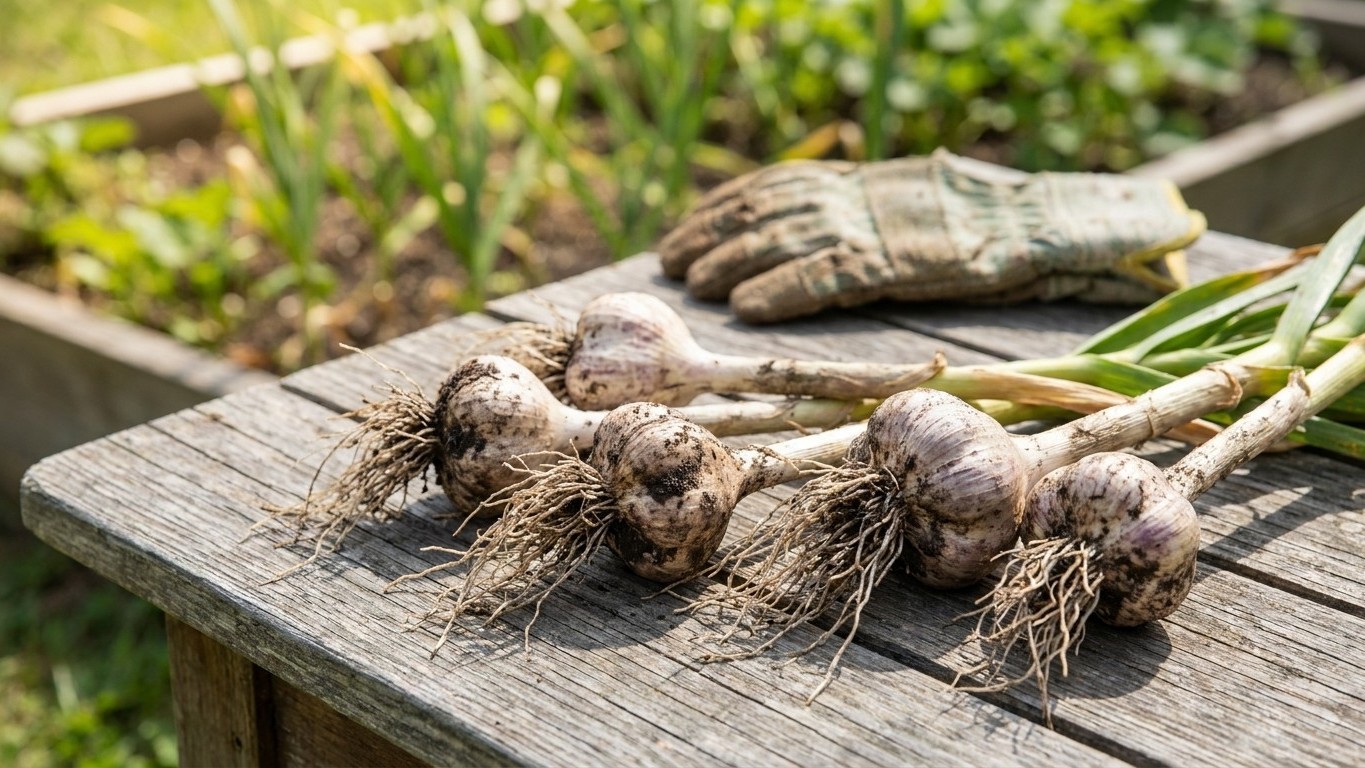

Six to eight weeks of cold soil is what a garlic clove needs before it will bother splitting into a head instead of staying a single round bulb, and Illinois hands that over without effort. First fall frost lands between October 24 and November 3 across most of the state, and the freeze that follows runs clean through December, January and February — months of cold, not a scraped-together few weeks. That margin is why the planting date and variety choice below matter less than you’d think.
Will garlic get the cold it needs in Illinois

Why the chill matters
Garlic clove division depends on cold, not on the calendar. A clove planted in fall needs a sustained stretch of cold soil before it will split into the multiple cloves that make a head of garlic rather than a single round bulb. University of Georgia Extension publication C854 sets that requirement at six to eight weeks of cold, because a bulb that misses it simply does not divide.
Illinois clears that bar without much argument. NOAA’s 1991-2020 climate normals put the state’s reference first fall frost, measured near Chicago, between October 24 and November 3, and the cold that follows through December, January and February runs for months, not weeks. Once the ground freezes in earnest after that window, cloves sit through a winter that delivers well beyond the six to eight weeks University of Georgia Extension calls for, and a rural county well outside Chicago that turns colder earlier only adds to that margin. Growers just across the border in Indiana work from a similar clock, for the same reason.
If a clove missed its cold
That gives most Illinois gardeners a rare bit of certainty: you are not limited to softneck types the way a grower in a mild coastal climate would be, and it opens the door to a wider range of Garlic Varieties That Suit Illinois Winters that growers can choose from. The one case worth planning for is seed garlic that came from a warm-climate source, a mail-order bulb of uncertain origin, or a grocery-store head that never saw a real winter. For that situation, you have two working options:
- Refrigerate the cloves at a cold, non-freezing temperature for several weeks before planting, to manufacture the chill a warm-climate bulb may not have banked.
- Plant a softneck variety instead, since softnecks form cloves reliably even on a shorter or milder cold season than a hardneck expects.
Neither option is a downgrade. In most of Illinois, neither is even necessary, but it is worth knowing before you plant a bulb of unknown history and wonder in July why it never split.
When to put the cloves in
The frost window
Garlic wants roots established before the ground locks up for winter, and answering When to Plant Garlic in Illinois takes the guesswork out of timing that window right, but it should not push much top growth before the cold arrives, since that growth wastes stored energy and often dies back untidily. That balance points to planting roughly four to six weeks before the ground freezes hard, which in most of Illinois follows not long after the first fall frost.
NOAA’s 1991-2020 climate normals put that reference frost, measured near Chicago, between October 24 and November 3. Counting back four to six weeks from the early end of that window lands in the second half of September. Counting Back From the later end lands in early October. Most Illinois growers plant somewhere inside that band, watching how the season is running rather than fixing on a single day, which is also why the named varieties later in this guide carry a planting recommendation of early October to mid October: that range sits inside the four-to-six-week band ahead of the Chicago reference frost, with room on either side for growers farther north or south to shift a week or two.
What shifts it
The Chicago figure is a single reference station, and it moves in both directions across the state. Areas near Lake Michigan often see their first freeze arrive later than inland spots at the same latitude, because the lake holds summer heat into fall. Southern Illinois, down toward the Ohio River, typically stays frost-free longer than the Chicago station, so growers there can plant later in that same rough window without cloves putting up excess top growth before winter. Check your own county’s frost history against the Chicago figure rather than assuming it applies uniformly, since a swing of even a week or two changes how much root growth a clove manages before the ground freezes.
The most common mistake is planting too early out of eagerness. A clove that puts up several inches of leaf before a hard freeze usually survives, but it enters winter with less energy stored in the bulb, and that shows up as a smaller head the following summer. Aim for roots, not leaves, before the ground freezes for good.
Which types suit Illinois
Hardneck options
Illinois’ winters set the direction here more than personal taste does: hardneck garlic is the safer default across most of the state, because hardnecks need a real cold season to perform well, and Illinois delivers one every year. Softneck types tolerate mild winters that never fully commit to cold, the kind found in coastal Oregon or much of California, which is not the constraint an Illinois grower is working around.
Catalog hardneck options for this territory include German White, German Red, Duganski, Chesnok Red, Bavarian Purple, Blue Music, Georgian Crystal, Georgian Fire, Fall Festival and Ivan, all set out in the same early-October-to-mid-October window this climate calls for. They differ mainly in clove count, wrapper color and heat, details printed on the seed catalog page for each. Hardnecks also throw a scape, the curled flower stalk cut off in early summer, which softnecks do not produce.
Softneck options
Softneck types are not out of place in Illinois. They trade the cold-season advantage for a different one: softnecks generally store longer in the pantry than hardnecks, often well past the point a hardneck bulb starts sprouting or softening, because their tighter, papery wrapper holds up better off the plant. Inchelium Red, Lorz Italian, Early Red Italian and Italian Late are softneck options in the same planting window, worth choosing if long storage matters more to you than the flavor range hardnecks offer.
| Trait | Hardneck | Softneck |
|---|---|---|
| Cold requirement | Needs a real winter to divide well | Tolerates milder winters |
| Storage life | Shorter, typically a few months | Longer, often into the following spring |
| Scape | Produces a scape, cut in early summer | No scape produced |
| Fit for Illinois | Strong fit, given the state’s cold winters | Workable, chosen mainly for storage life |
Soil and bed preparation
Drainage first
Garlic spends most of a year in this soil, through the wettest and coldest stretch of the Illinois calendar. A bed that puddles after rain will rot cloves long before any fungus gets the credit. If your planting spot holds standing water an hour after a heavy rain, raise the bed above grade with amended soil, or move the row to higher ground before you plant a single clove.
Work the bed while it is still workable, in the weeks before planting, rather than fighting wet, heavy soil at the last minute. Loosen the top eight to ten inches and mix in finished compost or well-rotted manure, since garlic is a heavy feeder that draws on that fertility for the many months it spends in the ground. Clear out the previous crop’s roots and any volunteer bulbs left from last year’s onion or garlic planting, since alliums left in the row carry soil-borne problems straight into the new crop.
What to skip
Skip fresh, un-composted manure at planting, since it can burn the root zone right as cloves are trying to establish before the freeze. Skip planting garlic where onions, leeks or garlic grew recently if you have any room to rotate the bed, since disease pressure builds fastest where the soil stays damp longest, and Illinois’ wet shoulder seasons give it plenty of chances to do that. A raised bed also earns its keep in early spring, when meltwater and spring rain saturate flat ground long before anything else can be planted. Garlic set the previous fall does not care about that mud, since it is already established, but the drainage decision made in fall is what determines whether that spring thaw drowns the cloves or simply drains past them.
What the climate here favours, and what it does not
Reading the numbers
Illinois’ growing-season temperatures put some garlic diseases in range for a real stretch of the year, and rule others out for most of it, based on threshold data compiled by UC IPM in UC ANR Publication 3453. Those published thresholds are soil temperatures, and the figures below are air temperatures, so what follows describes a tendency written into the calendar, not a confirmed infection. A monthly average also is not a month spent entirely inside a range: a month averaging in the middle of a disease’s window still holds days well above and below it. And this comes from one reference station, not a description of the whole state.
| Disease | Published range | Months in range here | What it means |
|---|---|---|---|
| White rot | 50-75°F | 5, including 1 at optimum | Widest overlap with the Illinois season |
| Fusarium basal rot | 59-90°F | 4 | Overlaps spring and early summer |
| Southern blight | 86-95°F optimum | 0 | Below optimum all season, not impossible |
| Pink root | 75-85°F optimum | 0 | Below optimum all season, not impossible |
White rot, caused by Sclerotium cepivorum, has the widest overlap with the Illinois calendar: its 50-75°F published range falls inside the growing-season mean air temperature here in five months, September, October, May, June and July, with one of those landing right at the pathogen’s optimum. Fusarium basal rot, caused by Fusarium oxysporum f. sp. cepae, overlaps in four months on a wider 59-90°F range. Both pathogens persist in soil for years once established, so the real defense is not the weather, it is the seed stock. Plant only clean, disease-free cloves, since an infected bulb introduces either pathogen regardless of what the thermometer reads that month.
Southern blight and pink root fare differently. Neither disease’s published optimum, 86-95°F for southern blight and 75-85°F for pink root, lines up with Illinois’ growing-season mean air temperature in any month. That does not mean either disease is impossible in an Illinois garden. It means both run below their most active range for the whole season here, so an infection introduced on infected stock spreads more slowly than it would in a hotter climate, not that it cannot take hold at all.
Getting it through the winter
Mulch: how much and when
Illinois’ freeze-thaw cycles heave soil more than a single steady deep freeze would, and heaving is what pushes a shallow-planted clove partway out of the ground over winter, exposing it to cold air and drying wind it was never meant to face. A mulch layer of clean straw laid four to six inches deep, put down right after planting, insulates the soil enough to smooth out those freeze-thaw swings.
Lay mulch after planting, not weeks ahead of it, since mulching too early while the ground is still warm can encourage the same excess top growth that early planting causes. Straw is the standard choice because it stays loose and lets air through even when wet, unlike matted leaves, which can seal the surface and trap water against the cloves through a thaw.
- Plant cloves at the depth the variety calls for, then mulch right after.
- Check the bed after a hard freeze-thaw cycle for cloves that have heaved partway out, and press them back down and re-cover.
- Leave the mulch in place through the coldest months rather than pulling it at the first mild week.
- Pull the mulch back gradually in early spring, once green shoots are pushing through, so the shoots are not smothered.
Do not remove mulch too early in spring. A late cold snap after growth has started can damage leaf tips without harming the bulb below, and stripping insulation right before an earlier hard freeze is the more common mistake Illinois growers make with garlic beds.
Harvest and curing here
Curing in Illinois humidity
Garlic tells you it is ready by dying back, not by a date on the calendar. Lift bulbs when roughly the bottom half of the leaves have browned and the top few are still green, since pulling too early leaves bulbs undersized, and waiting until every leaf has collapsed lets the wrapper split and cloves separate in the ground, which costs storage life later either way.
Dig, do not pull. Loosen the soil a few inches out from the row with a fork before lifting, since tugging a bulb by its neck out of heavy, wet Illinois clay snaps the stem and leaves the bulb behind.
Curing is where Illinois’ humid summer air works against the grower more than the cold ever did. A bulb needs two to three weeks of warm, dry, well-ventilated air to cure properly, and a muggy stretch right at harvest slows that drying and invites mold on the outer wrapper before the inside has finished curing. Hang bulbs in loose bunches, or lay them in a single layer on screens out of direct sun, with a fan running if the air is at all sticky. Do not rush this step by cutting the tops off green or by stacking bulbs deep in a bin, since trapped humidity in the middle of a pile is exactly where soft rot starts after a harvest that otherwise went fine. Once wrappers are papery and necks are tight and dry, trim roots and tops, brush off loose soil without washing, and move bulbs to a cool, dry, dark space.
Local help
County-level frost dates, soil test results and current disease reports all vary across a state as long as Illinois, and the Chicago-area figures in this guide are a reference point, not a local forecast. Illinois Extension maintains county offices that can confirm your local frost window and test your soil before you plant. That local check costs little and catches problems one weather station cannot see.
Common questions
Can I plant garlic in spring instead of fall in Illinois?
You can, but expect much smaller bulbs. Fall planting gives cloves months to grow roots before the cold sets in and lets them bank the chilling that triggers clove division. Spring-planted garlic misses most of that root-establishment window and usually produces small, sometimes undivided bulbs.
What if I miss the fall planting window entirely?
Get cloves in the ground as soon as you can, even into late fall close to freeze-up, and mulch heavily right away to protect roots that have had little time to establish. Yields will likely be smaller than a properly timed planting, but a late-planted clove usually still produces a head, just not the size you would get from planting on schedule.
Can I plant garlic from the grocery store?
You can try it, but two problems come with it. Grocery bulbs are sometimes treated with a sprout inhibitor that also slows root growth, and you have no idea whether that bulb was grown through a real winter or carries a soil-borne disease from wherever it was grown. Seed garlic sold specifically for planting avoids both issues.
Do I have to cut the garlic scape?
On hardnecks, yes, if you want the biggest possible bulb. The scape is the curling flower stalk that appears in early summer, and cutting it while it is still curled redirects the plant’s energy into the bulb instead of the stalk. Softneck varieties do not produce a scape, so there is nothing to cut on those.
Do I need to water garlic over the winter?
Generally no, once the cloves are in and mulched. The main watering job happens right after planting, to settle soil around the cloves and start root growth before the ground freezes. Through the dormant winter months, snow and rain typically supply what little the bed needs, and the mulch layer helps hold that moisture at the soil surface.