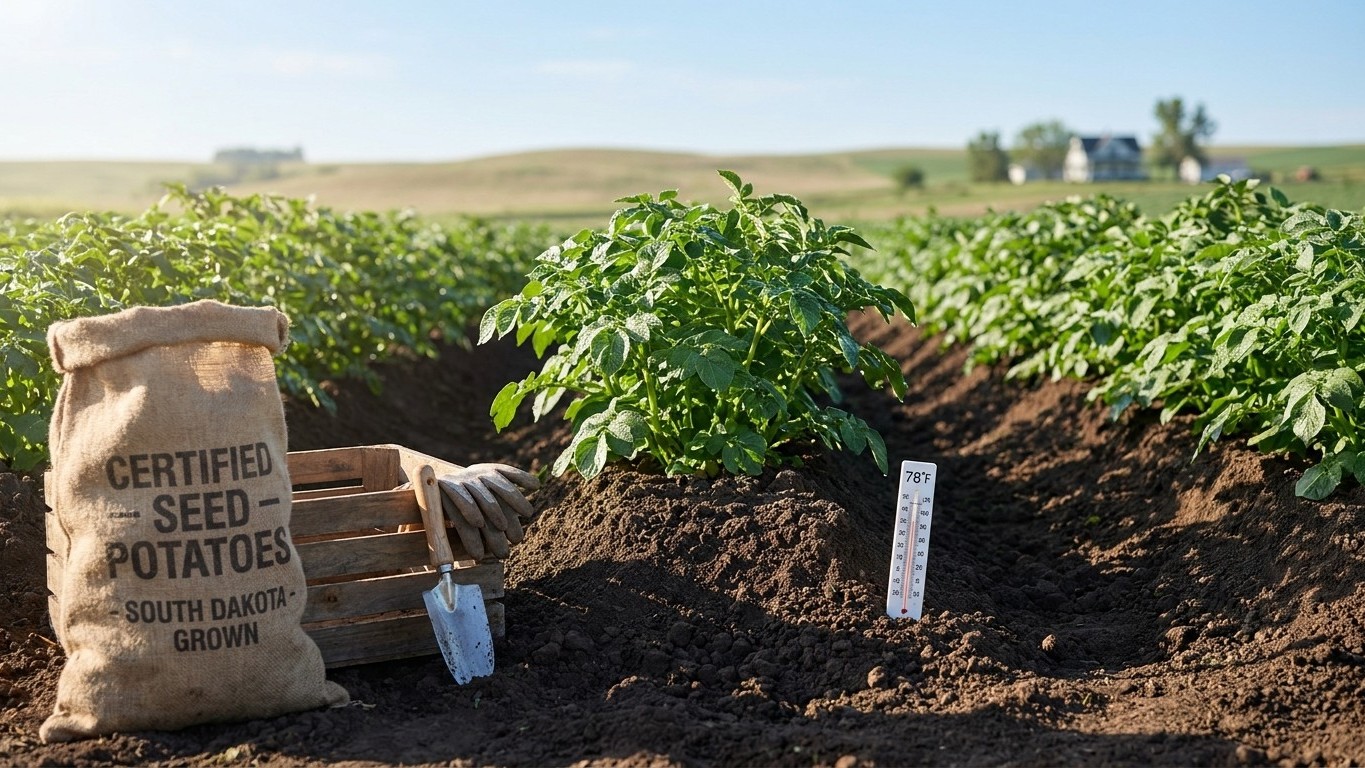

South Dakota gardeners get a real break most potato-growing regions don’t: a summer that stays under the heat ceiling that stops tubers from sizing up. That means the real question here isn’t whether potatoes will grow, it’s whether you get seed into the ground early enough to use the cool weeks before summer settles in—see When to Plant Potatoes in South Dakota for exact dates. Time it right, start with certified disease-free seed, and hill on schedule, and a full season here performs about as well as anywhere in the northern Plains.
The short answer

Two numbers decide how this crop behaves in South Dakota. The first is 13.8, the average number of days per year that Sioux Falls reaches 90 F or higher, according to NOAA NCEI Climate Normals covering 1991 to 2020. The second is the last spring frost window at that same reference station: April 29 to May 9. Those two figures together tell you almost everything you need to know before you buy seed potatoes.
Here’s why the 90 F number matters so much. Utah State University Extension identifies soil temperatures above 90 F as the point where tuber set and tuber fill are inhibited, meaning the plant stops building new potatoes and stops enlarging the ones it has. In a state where that threshold gets crossed roughly two weeks’ worth of days a year, on average, the crop has plenty of room to size up before heat becomes a limiting factor. Compare that to states where 90 F days number in the forties or fifties, and you can see why South Dakota potato growers aren’t fighting the same battle as gardeners in the Southern Plains or the Mid-South.
In practical terms, that means South Dakota supports a full-season potato crop for most gardeners, not just an early spring crop dug before summer arrives. You still want to get the timing right, because a plant that’s slow to establish loses those cool early weeks that matter for root and tuber development. But you’re not racing a heat clock the way a gardener in Texas or Oklahoma is.
Variety choice adds another layer, and the useful distinction is season class, not a maturity date in days (neither Utah State nor the University of Maine Cooperative Extension, the two authorities behind this guidance, publish a specific day count, and any number you see elsewhere is someone’s estimate, not measured fact). See Potato Varieties That Suit South Dakota for specific recommendations. Season class tells you roughly how a variety is developed and used:
| Season class | General use |
|---|---|
| Early | Boiling, salads; ready for harvest sooner in the season |
| Mid-season | Boiling, general kitchen use |
| Late | Baking, storage |
With South Dakota’s moderate heat load, all three season classes have room to finish properly in most years, and that same forgiving climate is what makes Harvesting and Storing Potatoes in South Dakota straightforward once the crop matures, which gives gardeners more flexibility on variety selection than growers in hotter climates.
When to plant here
Planting date isn’t a calendar guess, it’s arithmetic worked backward from your last frost date. Here’s how that math runs using the Sioux Falls reference window of April 29 to May 9.
- Start from the last frost window. At the reference station, that’s April 29 to May 9. Your own yard may run later, especially in low spots or at elevation, so treat this as a starting point, not a guarantee.
- Watch soil temperature, not air temperature. Potatoes go in the ground once soil reaches 50 F, per Utah State University Extension guidance. A soil thermometer pushed a few inches down gives you a real reading; air temperature on the news doesn’t.
- Count back 14 to 21 days from your last frost date. That’s the window when soil typically hits 50 F ahead of the frost-free date. Using the early end of the Sioux Falls window (April 29), that puts planting in roughly the second week of April for many South Dakota gardens; using the later end (May 9), it pushes closer to late April.
- Adjust for what you actually measure. If your soil thermometer says 50 F earlier than the calculated window, you can plant. If a cold snap keeps soil below that mark, wait. The thermometer overrides the calendar every time.
This backward-counting method works the same way no matter where you live in the state. Swap in your county’s own frost date (more on finding that below) and run the same three-week window. The point isn’t to hit an exact date, it’s to get seed into soil that’s actually warm enough to sprout without rotting, while still capturing as many cool weeks as possible before any heat stress arrives.
What the heat does to the crop
The mechanism is simple and it’s the single fact that should shape every planting decision in this state. Once soil temperature climbs above 90 F, tuber set and tuber fill stop, according to Utah State University Extension. The plant doesn’t die, and the foliage may look fine, but the underground work of building and enlarging potatoes shuts down for as long as that heat holds.
This is where South Dakota’s climate profile changes the answer compared to hotter states. With an average of 13.8 days a year at 90 F or above at the Sioux Falls reference station, the state simply doesn’t accumulate the kind of sustained soil-baking heat that forces gardeners elsewhere into a spring-only strategy. In states where 90 F days stack up for weeks on end, the standard advice is to plant as early as possible and dig the whole crop before that heat arrives, because there’s no realistic way to carry plants through a summer that stays above the threshold. South Dakota’s heat load is light enough that a full-season crop, planted at the right soil temperature and left to mature through summer, generally works without that spring-only workaround.
The part gardeners get wrong is assuming irrigation solves a heat problem. It doesn’t. Watering keeps the plant alive and keeps foliage from wilting, but it does nothing to lower soil temperature enough to restart tuber set once that 90 F threshold is crossed. If a stretch of unusually hot days does hit your garden, mulching to shade the soil and keep root-zone temperatures down matters more than running the hose more often. That’s a management tool for the occasional hot spell here, not a season-long strategy, because South Dakota’s climate mostly keeps you under the ceiling to begin with.
What goes wrong here
- Starting with uncertified seed. Seed potatoes saved from a grocery store bag or an uncertified source often carry viruses that stunt growth and reduce yield, sometimes without any obvious symptom on the plant. Buying certified seed potatoes is the single change that prevents the most disappointment.
- Planting into cold, wet soil before it reaches 50 F. Seed pieces sitting in cold ground are far more likely to rot before they sprout than to simply wait it out. Check soil temperature directly rather than planting off a calendar date alone.
- Skipping the hilling and ending up with green tubers. Potatoes that develop near the soil surface and get exposed to sunlight turn green and produce solanine, a compound that makes them unsafe to eat. Hilling soil up around the stems as plants grow keeps developing tubers covered and prevents this.
- Digging too early. Pulling potatoes before the plant has finished its work means smaller tubers and thinner skins that don’t store well. Let the foliage yellow and die back before digging for storage potatoes, and dig only what you’ll eat soon if you’re harvesting new potatoes early on purpose.
Checking this against your own county
The Sioux Falls figures used throughout this guide come from one weather station, and South Dakota’s range of elevation and its north-south spread mean your own last frost date can run one to two weeks later than that reference window, sometimes more at higher elevation or in low-lying areas prone to cold air pooling. A statewide planting month is a starting point for the arithmetic in the section above, not an instruction to follow blindly.
Before you commit to a planting date, check the frost data and planting guidance published for your specific county through South Dakota State University Extension, available at extension.sdstate.edu. Local extension offices track conditions specific to their area and can tell you whether your county tends to run ahead of or behind the Sioux Falls reference dates used here.
Common questions
Do I need to worry about summer heat killing my potato plants in South Dakota?
Not in most years. With an average of only 13.8 days a year reaching 90 F or above at the Sioux Falls reference station, South Dakota’s heat load stays well under the level that shuts down tuber development in most other potato-growing states. Occasional hot spells can still slow things temporarily, but a full-season crop is realistic here.
Can I use my own saved potatoes as seed instead of buying certified seed?
You can, but it carries real risk. Uncertified seed potatoes frequently carry viruses that reduce vigor and yield without always showing visible symptoms. Certified seed potatoes are tested and are the more reliable starting point.
What happens if I plant potatoes before the soil reaches 50 F?
Seed pieces sitting in cold, wet soil are prone to rotting before they ever sprout. Waiting for soil to reach 50 F, generally 14 to 21 days before your last frost date, gives seed a much better chance of establishing properly.
Is it better to grow early, mid-season, or late varieties in South Dakota?
All three season classes have room to perform well given the state’s moderate heat load. The choice comes down more to intended use, boiling versus baking versus storage, than to any heat limitation forcing you toward one class over another.